For decades, the theory of gravity, which follows from general relativity,
At this time, researchers first discovered thatThe behavior of distant galaxies does not correspond to the predictions of gravity theory. Distortions of space-time from distant clusters and star systems turned out to be much stronger than the mass of such objects calculated based on observations.
Later, in the late 1990s, researchersdiscovered another unusual fact. It turns out that the rate of expansion of the universe increases with time. This effect posed another challenge to Albert Einstein's theory: the gravitational effects of matter were supposed to slow the expansion of the universe, not speed it up. The modern cosmological model - the ΛCDM model - has found answers to these questions, but scientists do not give up hope to challenge the genius of the first half of the 20th century.
Why do scientists think the universe is expanding at an accelerated rate?
The accelerated expansion of the universe was discovered in1998 as a result of the work of two independent teams at once: the Supernova Cosmology Project and the High-Z Supernova Search Group. Both research groups studied the acceleration of the expansion of the Universe by analyzing distant stellar explosions.
La-type supernovae have almost the samestandard luminosity. By observing the brightness of such objects, one can determine how far away they are. In addition, as the universe expands, light from distant objects shifts to the red side of the spectrum. By measuring redshift, one can determine how much the universe has expanded since the supernova occurred.
Astrophysicists during theseexperiments were confident that the Universe should expand at a slower rate, after which the process should either stop or begin to contract. But the unexpected result, which both groups of scientists independently came to, was that the Universe is expanding at an accelerating rate.
The expansion of the universe was later confirmedother methods. Measurement of the cosmological microwave background (traces of the Big Bang), effects of gravitational lensing and analysis of baryon acoustic oscillations confirm the hypothesis of the expansion of the Universe.
In 2007, both teams that discovered the effect of the expansion of the Universe were awarded the Gruber Prize in the field of cosmology, and in 2011, three of the participants were awarded the Nobel Prize in Physics.
 Accelerated expansion of the universe. Image: NASA, STSci, Ann Feild
How to explain the accelerated expansion?
To explain the observations (the expansion of the Universe and the stronger distortion of space-time from distant galaxies), scientists introduced two new models - dark matter and dark energy.
Dark matter is a hypothetical formmatter, which scientists believe makes up about 85% of the matter in the universe. It is called dark because it does not interact with the electromagnetic field in any way. In other words, such matter does not reflect, absorb or emit light and other electromagnetic waves. However, it has its own mass, and hence the gravitational influence. Adding dark matter to cosmological models helps explain the stronger gravity of distant galaxies.
Dark energy is a hypothetical formenergy, unlike dark matter, little is known about it. Dark energy is believed to be very homogeneous, not very dense, and cannot interact with any of the fundamental forces other than gravity. This energy is associated with the vacuum energy. If we assume that as the Universe expands and free space increases, this energy increases, then the transition from uniform to accelerated expansion can be explained.
Although the dark energy hypothesis describes wellthe processes observed in the Universe, its very existence and interaction only with the gravitational field are difficult to associate with the general theory of relativity and Einstein's theory of gravitation.
How to test the theory?
Some scholars believe that if the theorygravity cannot explain dark energy, perhaps it is incomplete, and we need to add an additional parameter or variable to the equation that will tie all the observations together. To test this hypothesis, scientists look in the past for signs of a violation of the theory of gravity.
One such work is international researchdark energy using the 4-meter Victor Blanco Telescope in Chile. The results of this observation were presented in August at the International Conference on Particle Physics and Cosmology (COSMO’22) in Rio de Janeiro.
Study participants looked for evidencethe fact that the force of gravity has changed throughout the history of the universe, or in the distant past. For their work, they used, in addition to the main Blanco telescope, data from the Planck satellite of the European Space Agency.
Astrophysicists have studied images of galaxies onthe presence of more subtle distortions due to the curvature of space by dark matter - an effect called weak gravitational lensing. The strength of gravity determines the size and distribution of dark matter structures, and the size and distribution in turn determine how curved these galaxies appear to us.
By measuring all these parameters, it is possible to determine the forcegravity in distant galaxies. And since the light from them takes millions and billions of years to reach us, in essence, scientists are investigating how gravity behaved in the past.
The researchers reported that they have already studiedgravitational forces and shapes in more than 100 million galaxies, but in all experiments, observations are fully consistent with Einstein's theory. So, the nature of dark energy remains a mystery.
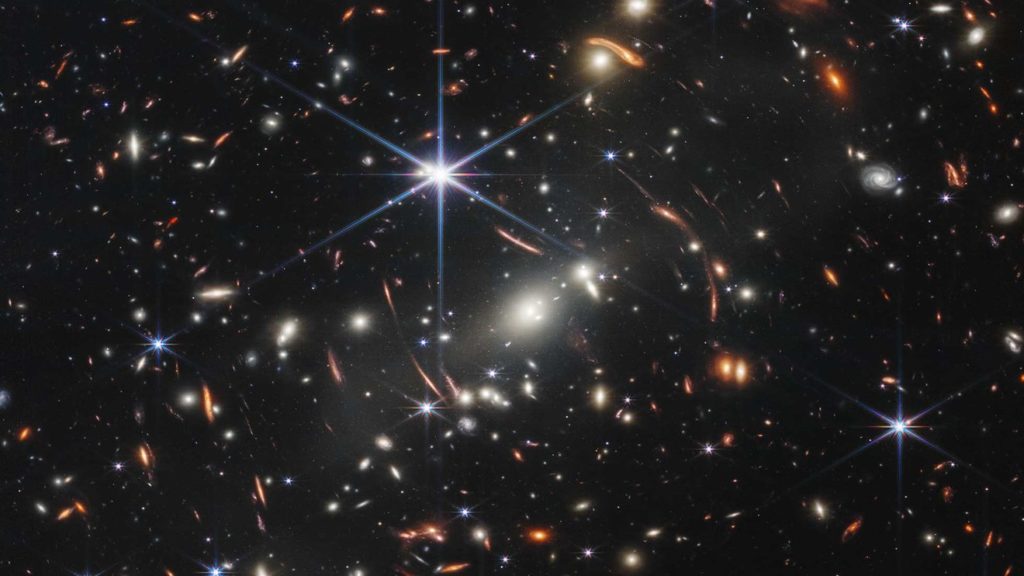 Gravitational lensing, like what's seen in the first James Webb image, is helping scientists explore dark matter and gravity in distant systems. Image: NASA, ESA, CSA, STScI
What's next?
Einstein's theory still stands, but researcherscontinue to test its strength. A new attempt to explain the nature of dark energy will be made by satellite missions. The European Space Agency plans to launch the Euclid space telescope in 2023. The device's instruments will measure the redshifts of galaxies located at different distances from Earth and explore the relationship between redshift and distance.
Developers expect Euclid to be able tolook back 8 billion years. With the help of ultra-precise measurements, he will be able to find out how things were with gravity, dark matter and dark energy in this era.
NASA is planning a similar mission:in 2027, it plans to launch the Nancy Grace Roman space telescope into Earth orbit. The researchers believe that he will be able to study galaxies located at a distance of 11 billion light years and study the earliest universe.
Read more:
The first images of the underground part of Mars surprised scientists
From the body to the mouth: scientists have understood where the teeth came from
Where on the planet will be the most dangerous by 2100: a new map has been published
Cover: Design Alex Mittelmann, Coldcreation, CC BY-SA 3.0, via Wikimedia Commons