Observing the galaxy with the Atacama Large Millimeter/submillimeter Array (ALMA)
As galaxies move through the universe, sometimes theyface others. When this happens, the gravity of each pulls the other. During this process, they eject gas and stars, leaving behind streams of material. They are known as tidal tails.
This is exactly what happened with SDSS J1448+1010, buta little differently. A massive galaxy that was born when the universe was about half its current age has nearly completed its merger with another. During the study, scientists discovered tidal tails, which contain about half of the cold star-forming gas of the entire system. As a result, astronomers discovered material that was forcibly ejected, which is 10 billion times the mass of the Sun. Scientists came to the conclusion that the merger led to the cessation of star formation and its death. Astronomers did not expect this.
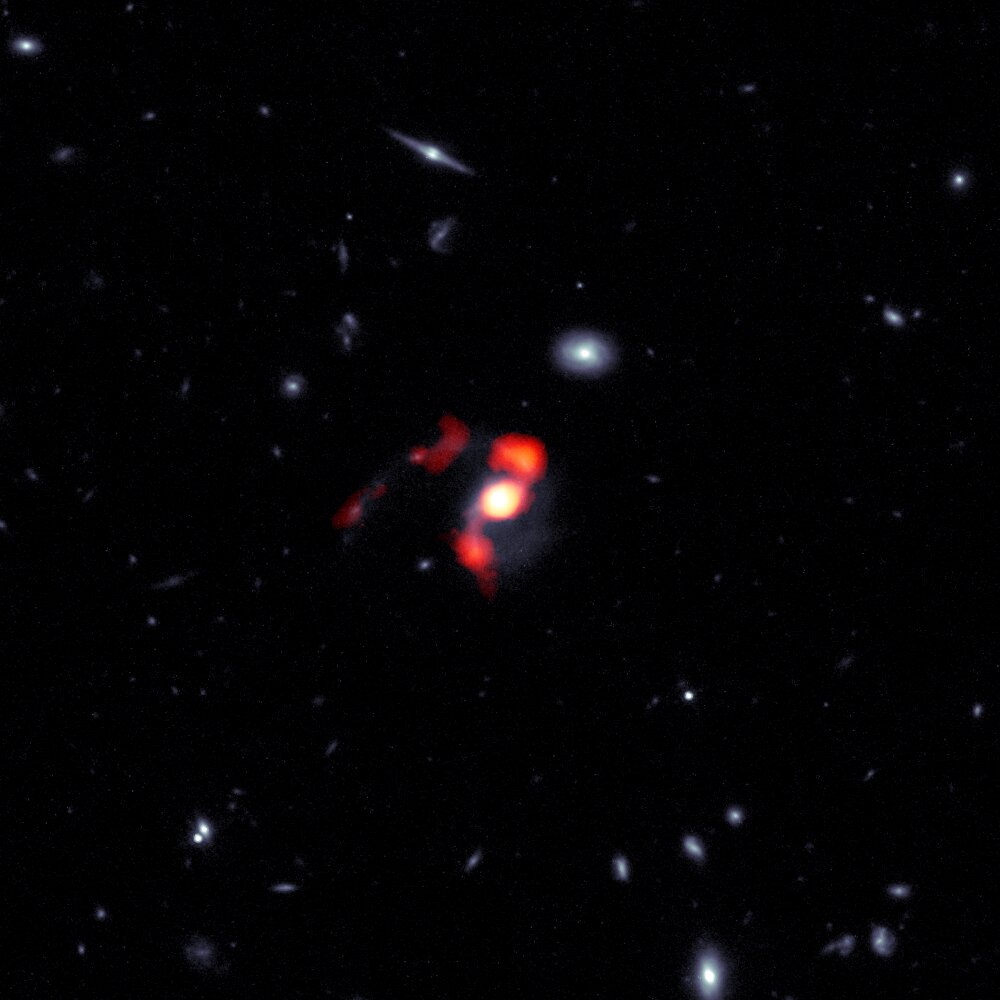 The blue and white colors are HST data, and the red and orange colors are ALMA data. The photo shows the distribution of gas and stars during the cosmic “tug of war.”
Photo: ALMA (ESO/NAOJ/NRAO), J. Spilker et al (Texas A&M), S. Dagnello (NRAO/AUI/NSF)
So far, scientists have made only one observation.Therefore, it is not yet clear how widespread this cosmic “tug of war” is in the Universe. It is also unclear how this process causes stars to cease to be born in galaxies.
However, the new discovery challenges long-held theories about exactly how star formation stops and galaxies die. Now scientists have a new challenge - to find more examples in the universe.
Read more:
The first images of the underground part of Mars surprised scientists
From the body to the mouth: scientists have understood where the teeth came from
Where on the planet will be the most dangerous by 2100: a new map has been published
Cover photo: ALMA (ESO/NAOJ/NRAO), S. Dagnello (NRAO/AUI/NSF)