The consequences of the coronavirus outbreak in China are beginning to impact various areas of human life. In
Let us recall that the outbreak of the epidemic began during the periodChinese New Year celebrations. This year, workers were supposed to return to factories on February 3. But since workers returned home for the holidays and movement in the country was limited due to quarantine, workers could not return to isolated areas. The authorities extended the weekend until the 10th, some production began to recover, but this was immediately followed by an outbreak of diseases and, probably, the government decided that they had gone overboard.
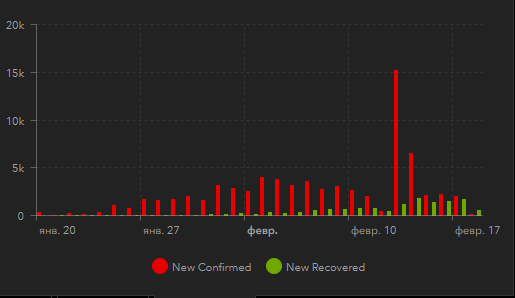
A source:Coronavirus COVID-19 Global Cases by Johns Hopkins CSSE
</i>
As of February 17, production has not startedin full. According to various sources, only about 10%-30% of capacity is working. One of the editors’ interlocutors said that their partner can only assemble 15% of the workers at the factory. According to BusinessKorea, even if production management believes it can launch the assembly line, local authorities in China do not allow this.
Earlier this week, Apple changed its revenue forecastfor the current quarter, including due to the fact that the iPhone assembly has not yet been launched in the right amount. There are various rumors about the production of Huawei. Samsung insiders believe that the company will also suffer due to the stoppage of production of smartphones. On the other hand, there is information that the production of communication equipment did not stop.
So far, those who collect the least have receivedelectronics outside of China. Manufacturers started the story of transferring production a long time ago - some even before the US introduced trade duties on goods produced in the Middle Kingdom. Samsung, by the way, is precisely why it is called one of the least affected companies; it produces about half of smartphones in Vietnam, while OPPO and Xiaomi are one of the most affected. According to TrendForce, Samsung's production will decrease by 3%, Apple by 10%, and Huawei by 15%.
There is something else.
Despite the fact that production conveyorselectronics industries are spread across many countries in Asia, China remains where most components are produced. Irreplaceable. Or if they are replaceable, then with losses for business. Including in quarantine Wuhan.
Although electronics production lines are spread across many countries in Asia, China remains where the majority of components are produced
For those who have not read our transference articleproduction from China, as well as the report from the opening of the new Jabil site (which is also relevant for this material), I will briefly recall the main points regarding components:
- Most components are manufactured in factories in China; they are transported to other countries to assemble devices.
- For the manufacturer, replacement of any componentmeans a large number of repeated stages of design and testing. Depending on how important this is, this may already be a new device. It is long and expensive. Much more problematic than transferring an assembly.
- China has a huge variety of components,therefore, if one factory cannot deliver the right product of the right quality in the right amount, you can quickly find an alternative. For this reason, many manufacturers, especially new young companies, chose production in China. All variety at hand and affordable. Now with diversity, everything is not so rosy.
- Large contract manufacturers are also inmost do not bother with the production of components in their locations around the world. For example, the Flex factory in Ukraine opened a plastic injection plant, and Jabil said components were not their business. This once again demonstrates that the component problem goes far beyond China.
With interruptions in the supply of components alreadyfaced by many manufacturers. South Korean companies thought about moving production of components from China back to their country, even when workers did not enter the factories after the New Year holidays. BusinessKorea writes that problems for business will begin if production does not work in full on February 10th. It did not work.
LG suffered a lot last year with chainssupplies due to Japanese sanctions and set a course to diversify suppliers of materials and components for the divisions of LG Electronics, LG Chem, LG Display, LG Innotek, and LG Household & Healthcare, but now the company is worried that there may be problems with China due to the virus and is looking for new contracts. The company estimates that problems with Chinese suppliers could have a negative impact on 30% of production outside the country, while the conflict with Japan affected only two products.
A Swiss company withUkrainian roots PocketBook. In order not to be unfounded, I’ll cite the story of Yaroslav Levinsky, head of the Logistics and Supply Department of PocketBook: “In the province of Hubei, where Wuhan is directly located, one of the components of the flagship PocketBook model is manufactured. Today, its deliveries are suspended. The nearest shipment, according to our partners in China, is possible in late February or early March. Thus, we get a delivery delay of almost a month. If the plans come true and the delay does not exceed a month, this is not critical for the company and will not lead to a deficit. We always have a small supply of components. But if the delay is delayed, and we lose March, then it is likely that some PocketBook models may soon disappear from store shelves. "
Factories accept orders for new components but cannot guarantee delivery times.
Other hardware companies with Ukrainian rootsalso talk about delivery delays. PetCube CEO Yaroslav Azhnyuk says that most factories for assembling and producing components have delays. At the moment, they are about two weeks. There is hope that production will recover this week, but no one can say for sure. Valentin Gritsenko, marketing director of Ajax Systems, says that factories accept orders for new components, but they cannot guarantee delivery times.
Customs does not give a go-ahead
Logistics is another challenge for assembling equipment.There are restrictions on the movement of trucks and railcars carrying cargo within China itself, so finished components and materials for their production cannot get to the places where they are needed. Supplies abroad are also limited. And other countries are reluctant to accept Chinese cargo. For example, Vietnam Customs has tightened its requirements.
If one of the suppliers cannot deliverpart and it is impossible to find a replacement, everything stops. If there are two such suppliers and one of them does not work, then the second one needs to carry out twice as large volumes
Which areas will be most affected
"If one of the suppliers cannot deliverpart and it is impossible to find a replacement for it, everything stops. If there are two such suppliers and one of them does not work, it means that the second one is required to fulfill twice the volume,” explains one of the Reuters experts. Where there is greater demand, there are higher prices.
The market is already experiencing an increase in prices for memory andchipsets, shares of Korean chipset manufacturers who are ready to take over production are rising in price. Analysts predict an increase in prices for LCD panels with a diagonal of 32-75 inches (and therefore televisions along with them), since the production of CSOT, Tianma and BOE, world giants, is concentrated in Wuhan. Before the outbreak of the epidemic, panel price increases were moderate. Against this background, LG and Samsung plan to expand the production of displays using their proprietary technologies - OLED and Quantum Dot, respectively.
TrendForce analysts studied the situation in differentelectronics segments and indicated which specific industries and components are most at risk. According to analysts, things are not so bad for chip and memory manufacturers due to the high automation of production, as well as the fact that they stocked up on materials before the New Year holidays.
It will be hard for a telecom. Due to the development of 5G, the need for fiber will double, compared with 4G. 25% of global production is concentrated in Wuhan (Fiberhome, YOFC, and Accelink). Also in the infected region is the main production of components for 5G base stations. There should be no problems with the devices of the Internet of things, in any case, if the crisis does not drag on.
Most likely, there will be no particular problems with the production of LED lighting and most lithium-ion batteries, since there are factories not only in China.
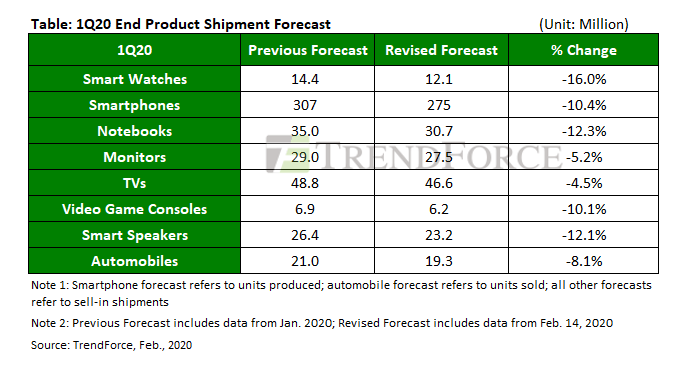
In the consumer electronics segment, the biggest drop in production is waiting for smart watches, laptops, smartphones, video consoles and smart speakers
Also, the crisis may affect solar cells, since most of the production is carried out from materials extracted in China. Current reserves will be enough until the end of February.
In the consumer electronics segment, smart watches, laptops, smartphones, video consoles and smart speakers await the biggest drop in production.
</ img>
A source:TrendForce
Spring will show
If now the situation is far from critical andrather, the vendors are excited, and the factories are operating at partial capacity on old stocks, then by spring, if production does not recover, the electronics market will face a real huge crisis. With stock shortages and rising costs. Samsung is still assembling existing components. According to two Business Insider sources, if nothing changes in the near future, even the Vietnamese factory will have nothing to assemble smartphones from.
If this situation persists for 3-4 months, this will affect the cost of production and the availability of a large number of products on the market.
“If a similar situation persists for 3-4months, this will affect the cost of production and the availability of a large number of products on the market, ”commented Oleg Naumenko, CEO of Hideez. At MTI hi-tech distribution, they say that vendors accept orders for new deliveries of electronics to the country, but they can’t confirm the production time and availability, they introduce quotas. “According to some estimates, the power loss from large manufacturers of PCs and laptops will be 50-60%,” says Sergey Yakovlev, commercial director of MTI hi-tech distribution.
Expert says if accessibility failureSince the goods will fall in the traditionally low season, April-May, this will not be a problem for our market. There is still enough goods in the warehouses of distributors, problems with the assortment may begin in May-June. “Most likely, manufacturers will find a solution to the production problem in the coming month, and availability will improve by the season. If the story lasts, a good deficit will appear - with quotas, a limited assortment, and price increases. Since autumn is already a high season, ”explains Sergey Yakovlev.