Because of the enormous distances between observers and distant galaxies, they appear flat. International
The scientists built a three-dimensional graph by measuringthe movement of stars that move around the galaxy's supermassive central black hole. They used observations from the Keck Observatory to study a region about 70,000 light-years in diameter surrounding the supermassive black hole at the center of the galaxy.
Although the telescope cannot resolve individual starsdue to the large distance to M87, the spectra can show a range of speeds to calculate the mass of the object they are orbiting. The researchers mapped the spectra of stars and studied their movement. It gives an idea of the shape of the galaxy and its rotation. Tracking the speeds and positions of the stars allowed the researchers to build a three-dimensional image of the galaxy.
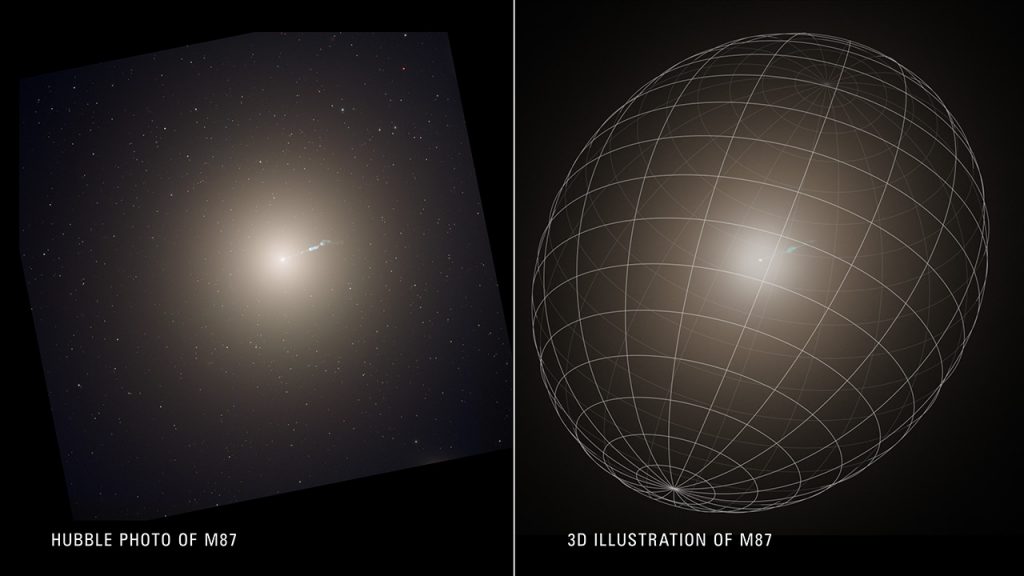 A Hubble image of M87 and a 3D model of the galaxy. Image: NASA, ESA, Joseph Olmsted (STScI), Frank Summers (STScI), Chung-Pei Ma (UC Berkeley)
In addition, the researchers took data for the periodfrom 2020 to 2022, as well as earlier measurements of the brightness of M87 stars using Hubble and compared them with the predictions of a computer model of how stars move around the center of a triaxial galaxy. A better fit with these data allowed them to calculate the mass of the black hole: 5.4 billion solar masses.
Unlike flat disk spiral galaxiesthe real shape of elliptical structures is very difficult to estimate. The new observation will help refine astronomical models and explore more distant objects.
Read more:
Scientists have studied an ultra-bright object that violates the law of physics
"Sea" of quarks inside one proton: what does an elementary particle consist of
Look at the highest resolution map of Mars: 110,000 frames and 5.7 trillion pixels
Cover image: NASA, ESA and the Hubble Heritage Team (STScI/AURA)