Researchers at Stanford University have developed the LightHash photonic integrated circuit, which
LightHash uses silicon photonics toreducing energy consumption while maintaining a high level of security. The development is based on a previous version of the HeavyHash photonic scheme developed by the same team and currently used by individual cryptocurrency networks.
To securely create bitcoin oroperating its network requires computing a hash function such as SHA256 or Heavyhash to convert input data into a single output number in a way that is too hard to reverse, the engineers explain. It is this encryption that makes up the bulk of the energy consumption when mining cryptocurrencies.
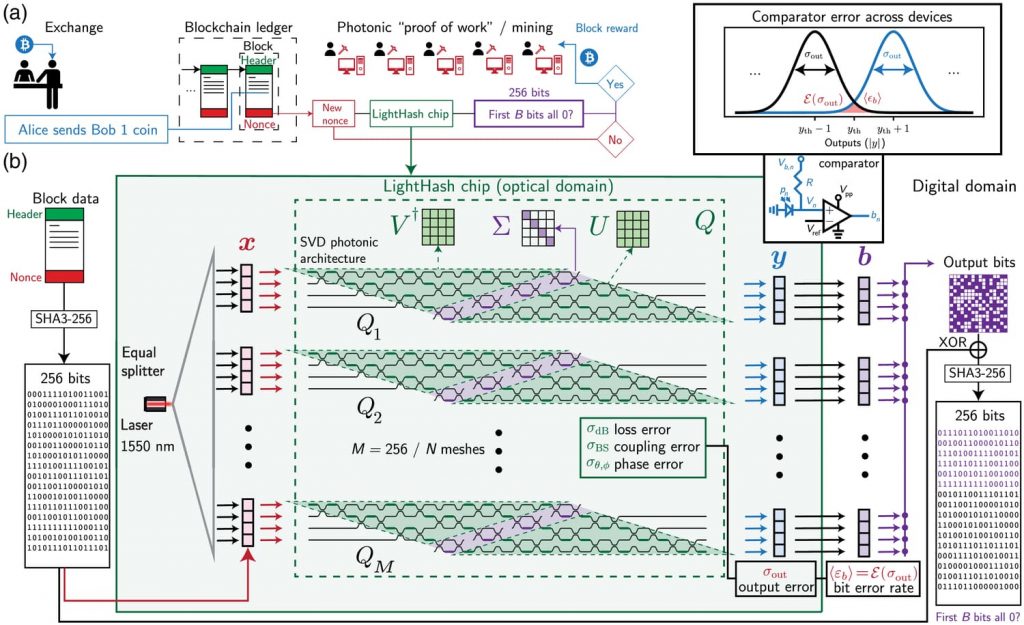 How LightHash works. Illustration: Sunil Pai et al., Optica
Researchers modified Heavyhash to workwith a jointly developed silicon photonic chip carrying a network of 6×6 programmable interferometers. The analysis showed that this modification allows low-energy optical processing of matrix multiplications, which forms the basis of hash function calculations, while maintaining accuracy and reducing susceptibility to hardware errors.
To evaluate the possibility of using LightHashFor matrix multiplication, the researchers built an optical setup to control and track the propagation of light by adjusting heating elements and displaying grating spots on an infrared camera. They implemented an error elimination algorithm and established feasibility criteria for scaling the technology. The results of the experiment confirmed the calculated efficiency of the technology.
Basically, we have developed a way to useanalog optical circuits to perform multiplication operations with near zero power dissipation, but accurate enough to be used in a digital encryption scheme.
Sunil Pai, one of the authors of the development
Researchers note that in order toLightHash has a significant advantage over digital counterparts, the photonic circuit needs to be scaled up to 64 inputs and outputs. They will continue to work on scaling and optimizing power consumption in the photonic circuit.
Read more:
Bears separated in childhood reunited: the zoo told how it all went
A photo appeared inside the second deepest underwater sinkhole in the world
Light in the early universe: a new theory changes the way it was
On the cover: a chip for a photonic blockchain. Image: Stanford University