Researchers from the Korea Advanced Institute of Technology (KAIST) and the Catholic University of Korea
 The principle of operation and the device of the piezoelectric pressure sensor. Image: KAIST
To increase the sensitivity of the sensorThe researchers transferred the highly sensitive inorganic piezoelectric membrane from the bulky sapphire substrates used in most commercial applications to flexible substrates. Ultra-thin devices a few micrometers thick (about 100 times thinner than a human hair) provide better contact with the skin and allow you to record blood pressure with high accuracy from the pulsation of blood vessels.
Researchers have developed a prototype wearabledevice (watch) in which a new sensor has been integrated to continuously collect readings. Clinical tests have shown that the device measures both systolic and diastolic pressure with an error within ± 5 mmHg. Art. and a standard deviation of less than 8 mm Hg. Art. This is in line with international standards for related medical devices.
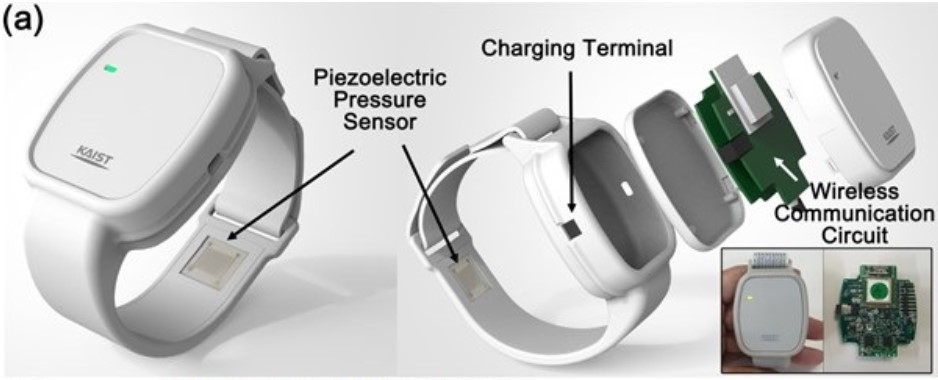 Schematic design of a wrist watch with a built-in piezoelectric sensor. Image: KAIST
Blood pressure is an important indicatorto assess general health and predict stroke or heart failure, the authors of the development note. Periodic blood pressure measurements can help identify potential problems early. But most modern instruments are either too bulky for continuous monitoring in everyday life, or have poor accuracy.
Read more:
Scientists have called the main “trick” of the brain: how it deceives a person
In space, no one will hear your cry: 7 action-packed books about the secrets of the universe
"Sea" of quarks inside one proton: what does an elementary particle consist of