Engineers at the U.S. National Institute of Standards and Technology have developed chip-scale devices for
Traditional optical systems thatallow you to control even one laser beam, represent a large-scale structure the size of a dining table. It houses many lenses, polarizers, mirrors and other devices. To create portable sensors and quantum computers will require miniature chips.
The researchers combined the two technologies at the levelmicrochips: integrated photonic circuits that use tiny transparent channels and other micro-components to guide light; and a source of unconventional optics known as the optical metasurface. Such surfaces are made up of glass plates with millions of tiny structures only a few hundred billionths of a meter high that manipulate the properties of light without the need for bulky optics.
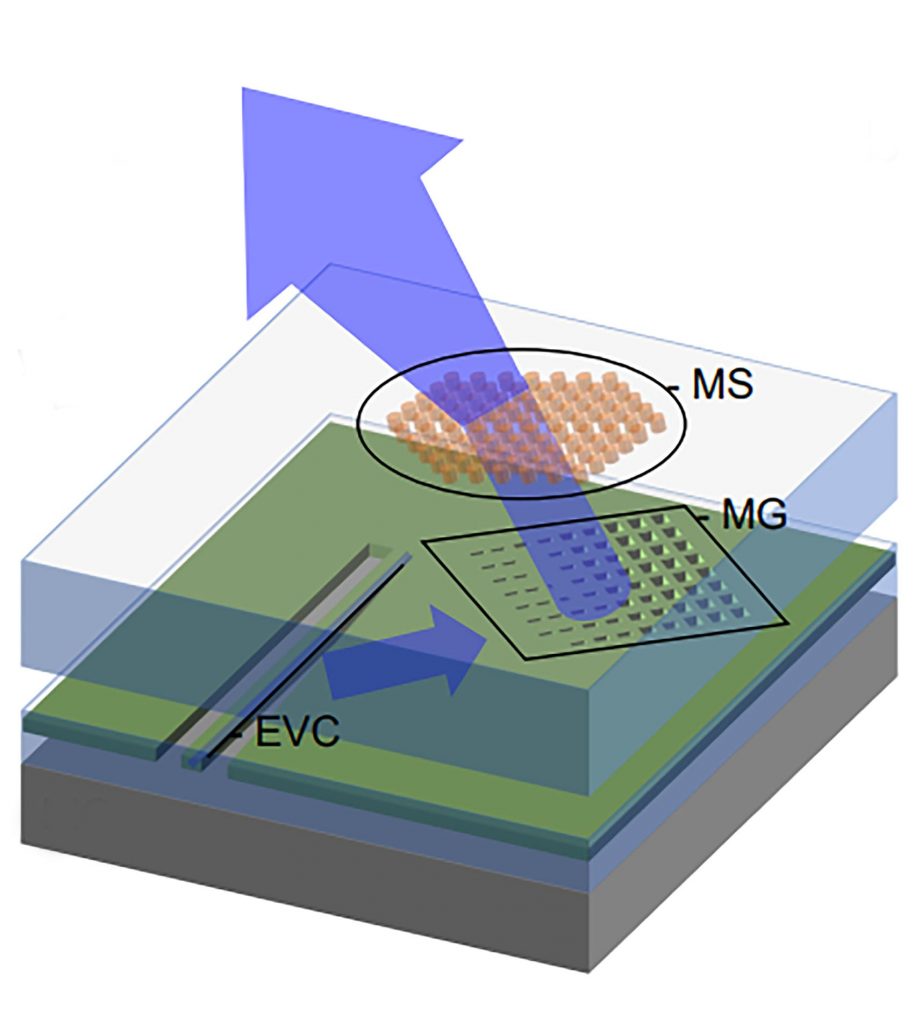 System for forming multiple laserbeams (blue arrows) and control of their polarization consists of three components: an evanescent coupler (EVC), which directs light from one device to another; Metagrid (MG), which scatters light; and the metasurface (MS), a small glassy surface studded with millions of pillars that act as lenses. Image: NIST
In a series of experiments, researchersdemonstrated that a single photonic chip did the work of 36 optical components while simultaneously controlling the direction, focus, and polarization (the plane in which a light wave oscillates as it moves) of 12 laser beams separated into four different colors. They also showed that a tiny chip could direct two beams of different colors to run in parallel. This is necessary to create atomic clocks.
The researchers note that they continuework on a full-fledged optical system based on the chip. So far, laser light is not yet powerful enough to cool atoms to the ultra-low temperatures needed for miniature advanced atomic clocks.
Read more:
New image of Hubble puzzled scientists
Scientists have deciphered the mysterious manuscript of Ptolemy. It was hidden under other text
Look at the highest resolution map of Mars: 110,000 frames and 5.7 trillion pixels