Researchers at Northwestern University have developed a smart pendant-like device called SmokeMon.
To study people's willingness to useThe new device scientists recruited nineteen participants. They took part in 115 smoking sessions, during which scientists studied their smoking in controlled and free-ranging experiments. While smokers wore the device, scientists trained a neural network to detect smoking events and generate topography. Among other things, the device detects and tracks the number, duration and volume of puffs, the interval between puffs and the duration of smoking.
This goes far beyond mere valuation.how many cigarettes a person smokes per day. We can determine when a cigarette is lit, when a person brings it to his mouth and takes a puff, how much he inhales, how long between puffs, and how long he keeps the cigarette in his mouth.
Nabil Alshurafa, assistant professor of preventive medicine at Northwestern University Feinberg School of Medicine and study co-author
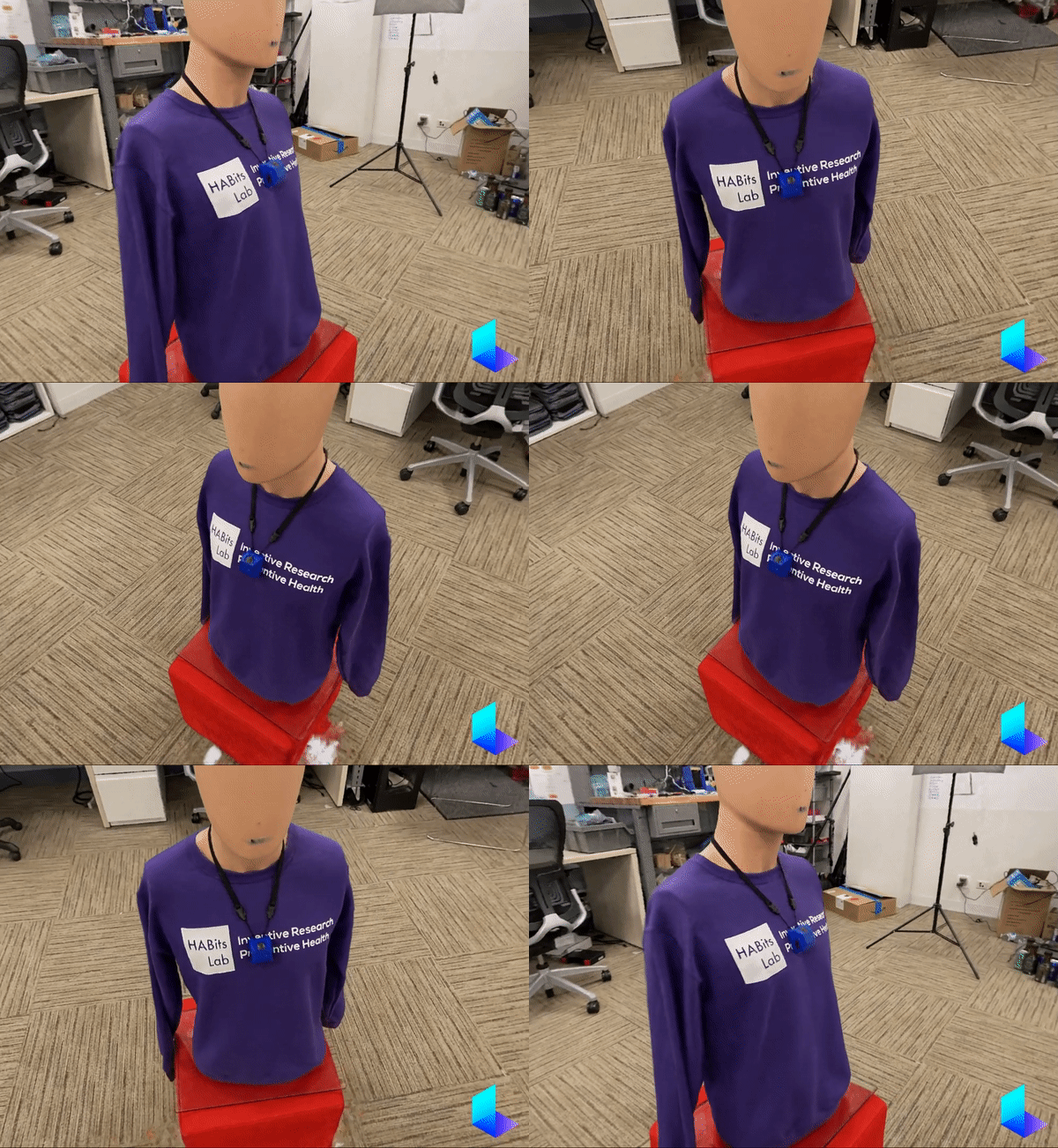 SmokeMon on the manikin. Image: HABits Lab, Northwestern University
Analysis of smoking topography allows scientistsmeasure and evaluate the harmful effects of carbon monoxide on smokers and better understand the relationship between chemical exposure and tobacco-related diseases. In addition, scientists believe that the new device will help people quit smoking by showing which signs are associated with relapse after quitting smoking.
Researchers plan to determine which factorscause a return to smoking. This may be five puffs or five full cigarettes, while this is not known, the authors of the work note. They plan to collect the necessary information to understand when to intervene. For example, if a pattern of behavior associated with the risk of relapse is detected, the user may receive a call from a healthy lifestyle consultant, a text message, or a video recording.
For many people who are trying to quitsmoking, a breakdown is one or two cigarettes or even one puff. But relapse is not the same as relapse (regular return to smoking). A person can learn from mistakes, realizing that he did not suffer a complete, but only a temporary failure.
Nabil Alshurafa
Read more:
A powerful flare erupted on the Sun: it has already affected the Earth
Medieval fortress accidentally discovered in the forest: the find surprised scientists
Scientists have found a new genetic disease in children: how it manifests itself