Engineers from Dalian University of Technology in China have developed artificial skin
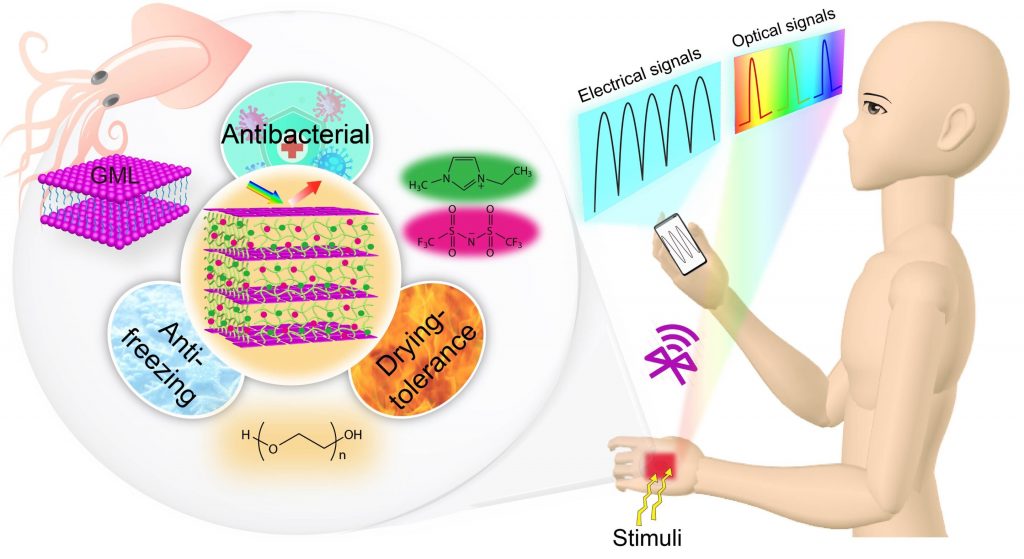 Artistic illustration of development. Image: Yunpeng Wang et al., Chemical Engineering Journal
Electronic skin is based on photon-iona system that allows synchronous output of optical and electrical signals. In addition, it also uses monoglyceride laurate molecules that have antibacterial properties. The analysis showed that such a surface destroys more than 99.9% of bacteria and fungi.
Squid skin has a bright structural color,arising from the multilayer photonic nano-assembly of reflective proteins within the iridophores. We successfully constructed a squid-like photonic nanostructure using a hierarchical self-assembling antibacterial molecule, namely monoglyceride laurate. This photonic nanostructure is localized in an elastic gel network.
Wenbin Niu, co-author of the development commentary for Tech Xplore
When artificial leather is exposedexternal stimuli, for example, when it touches a surface, the lattice of its photonic nanostructure changes rapidly, resulting in a rapid color change. At the same time, the mobility and direction of movement of the ions change, which ultimately provides a synchronous optical and electrical response.
Thanks to the monoglyceride it containsLaurate photonic skin is able to kill almost all gram-positive bacteria and fungi, scientists say. This is important for medical applications of the technology, such as prostheses. Additionally, the researchers introduced PEG200 antifreeze, which has a low freezing point. This protects the skin and its optical properties when working in harsh environments.
Read more:
The key theory of quantum physics has finally been proven. Main
NASA helicopter showed sunset on Mars. It doesn't look like earth.
'Legendary' cat-fox that lives on an island in Europe may become a new subspecies