American engineers have developed a cryogenic magnetoterahertz scanning optical microscope
The nanoscope can focus down to about 20 nm,operating at temperatures below the temperature of liquid helium and in strong magnetic fields. This is enough to get an idea of the superconducting properties of materials under these extreme conditions, the authors say. The study will help and improve the performance of quantum computing.
The device consists of a control system,a laser source, a labyrinth of mirrors that form an optical path for light that pulses at trillions of cycles per second. A superconducting magnet surrounding the space with the sample generates a magnetic field of up to 5 T, and a custom-made atomic force microscope makes it possible to study materials cooled to liquid helium temperature (about 1.8 K).
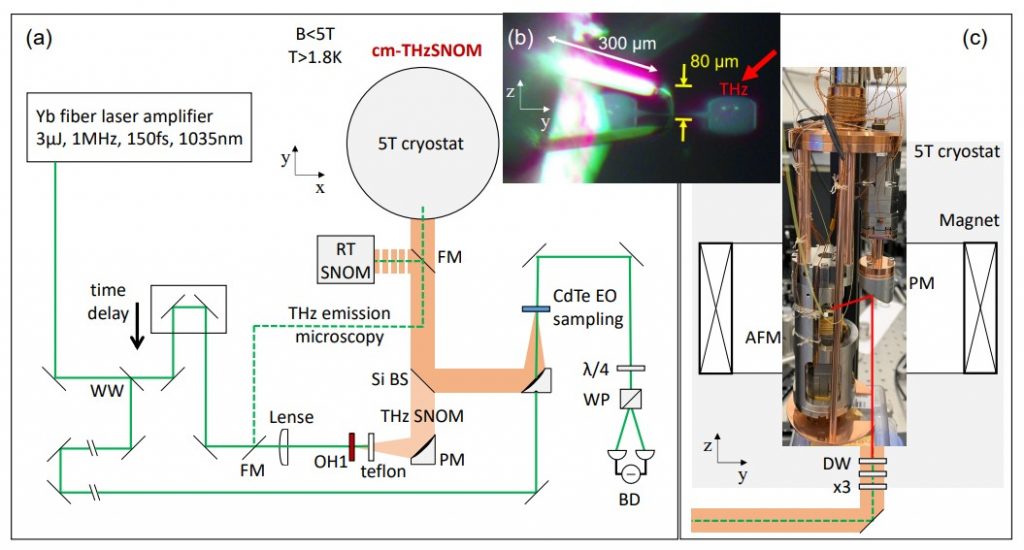 Scheme of the experimental setup. Image: Richard H. J. Kim et al., arXiv
Technology made possible by the discoverylight-induced vibrations in semiconductors. The possibility of controlling superconductivity in iron-based semiconductors with the help of light, the researchers report in an article published in the journal Nature.
Potentially, the device is able to visualizetunneling of supercurrents in single Josephson junctions, that is, to display the movement of electrons through a barrier separating two superconductors, the researchers note. Understanding these processes will help improve the performance of qubits and the efficiency of quantum computing, they add.
By analyzing new sets of experimental data, we can develop advanced tomography techniques to observe quantum entangled states in light-controlled superconductors.
Ilias Perakis, professor of physics at the University of Alabama at Birmingham and co-author of the project
Read more:
Scientists from the permafrost zone: how they develop smart clothes and a cancer vaccine
"The Walking Dead" existed millions of years ago: scientists told how they appeared
The egg was dropped from space: look what happened to it