What is a diamond?
Diamond is a mineral, a cubic allotropic form of carbon. Under normal conditions
Diamond is a wide-gap semiconductor.It has a very low coefficient of friction on metal in air - only 0.1, which is associated with the formation of thin films of adsorbed gas on the crystal surface, which play the role of a kind of lubricant.
One of the important properties of diamonds is luminescence.Under the influence of sunlight and especially cathode, ultraviolet and X-ray rays, stones begin toTo luminesce is to glow in a variety of colors.
Under the influence of cathode and X-rayall types of diamonds glow with radiation, and under the influence of ultraviolet - only a few. X-ray luminescence is widely used in practice to extract stones from rocks.
 Diamond in parent rock
Diamond is similar to many colorless minerals -quartz, topaz, zircon, which are often used as its imitations. Differs in hardness - it is the hardest of natural materials (on the Mohs scale - 10), optical properties, transparency for X-rays, luminosity in X-rays, cathode, ultraviolet rays.
Diamond is a rare, but at the same time quite widespread mineral.Industrial deposits are known on all continents except Antarctica.Several types of stone deposits are known.
For several thousand years ago, diamonds inon an industrial scale, they were mined from alluvial deposits. Only by the end of the 19th century, when diamondiferous kimberlite pipes were first discovered, did it become clear that they did not form in river sediments.
The origin and age of diamonds are still poorly understood.Scientists adhere to different hypotheses - magmatic, mantle, meteorite, fluid, there are even several exotic theories.
Most lean towards magmatic andmantle theories, to the fact that carbon atoms under high pressure (usually 50,000 atmospheres) and at a great (about 200 km) depth form a cubic crystal lattice - the diamond itself. Stones are carried to the surface by volcanic magma during the formation of the so-called explosion tubes.
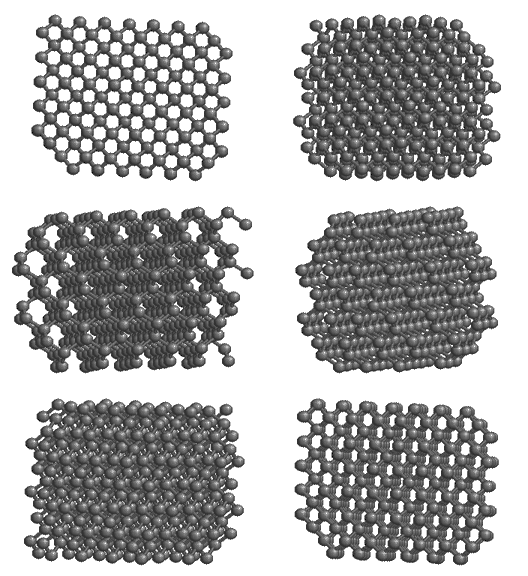 Schematic representation of the crystal lattice of a diamond
Exceptional hardness finds its application in industry: the gemstone is usedfor the manufacture of knives, drills, cutters and similar products.
The need for industrial applications is forcing the expansion of the production of artificial diamonds.cluster and ion-plasma deposition of diamond films on cutting surfaces.
Diamond powder (both waste from natural diamond processing and artificially obtained) is used as an abrasive for the manufacture of cutting and sharpening discs, wheels, etc.
What is special about diamonds?
The main distinguishing features of diamond are the highest hardness among minerals (and at the same time brittleness), the highest thermal conductivity among all solids (900–2300 W/(m·K), high refractive index and dispersion.
Diamond is a wide-bandgap semiconductor with a very low coefficient of friction for the metal in air – only 0.1, which is due to the formation of thin films of adsorbed gas on the surface of the crystal, which play the role of a kind of lubricant.When such films are not formed, the coefficient of friction increases and reaches0,6–1,0.
High hardness results in exceptionalabrasion resistance of diamond. It is also characterized by the highest (compared to other known materials) modulus of elasticity and the lowest compression ratio.
The melting point is about 3 700-4000 ° C at a pressure of ~ 11 GPa. In air, the diamond burns at 850–1,000 ° C, and in a stream of pure oxygen it burns with a faint blue flame at 720–800 ° C, completely converting into carbon dioxide.
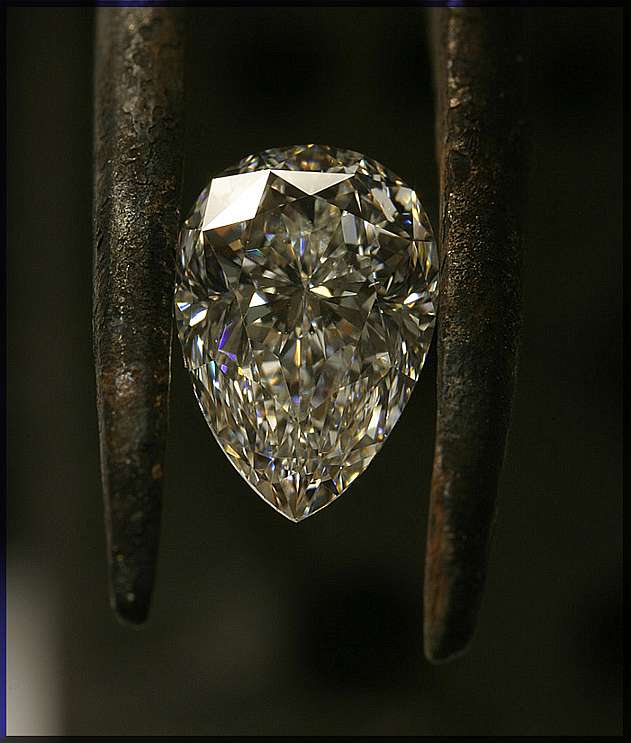
A diamond can withstand five times the pressure in the Earth's core
At the end of January 2021, scientists found that a diamond can withstand a pressure five times higher than the pressure in the Earth's core: the structure of the material is preserved even when compressed to 2 trillion pascals.
Research suggests the stone ismetastable at high pressures: it retains its structure, despite the fact that under such conditions the dominance of other, more stable structures is expected. Studying the quirks of a diamond under extreme pressure could reveal the inner workings of carbon-rich exoplanets.
Carbon-rich planets can be made of diamonds
Outside our solar system, there may be many planets made of diamonds.This is the opinion of scientists from Arizona State University and the University of Chicago.
They hypothesized that carbon-rich exoplanets might be composed of diamonds and silicon dioxide. On Earth, silicon dioxide is found primarily in the form of sand and quartz.
Stars and planets are formed from gas clouds and cosmic dust.And it's the composition of the gases that determines what a star or a planet looks like.
A planet with a low carbon to oxygen ratiolike the Earth, it will be composed of silicates (salts and esters) and oxides and will contain few diamonds. The share of diamonds on Earth is only 0.001% of its composition.
Unlike our Sun, other stars may have a higher ratio of carbon to oxygen.And when combined with water, carbon-rich planets can form in this environment.
To test this hypothesis, researchThe group conducted an experiment simulating the chemical origins of these carbonaceous exoplanets using high temperatures and pressures. The results of work in the laboratory showed that at high temperature and pressure, silicon carbide reacted with water and turned into diamonds and silica.
What do we know about carbon planets?
A carbon planet is a theoretical type of exoplanet-like planet that was predicted by American astrophysicist Mark Küchner.
A condition for the formation of planets of this typeis a high content of carbon in the protoplanetary disk and a low content of oxygen. In terms of chemical properties, such a planet will be quite different from terrestrial planets such as Earth, Mars and Venus, which are built mainly on the basis of silicon and oxygen, and there is not much carbon in their composition.
The planet is expected to have an iron-containing core, similar to other terrestrial planets.The surface will be based mainly on silicon and titanium carbides, as well as pure carbon.
It is also possible that there are areas completely covered bykilometers of diamonds. The atmosphere will be composed of hydrocarbons and carbon dioxide. Life on a planet of this class is potentially possible if the planet has water, but life forms will differ sharply from the terrestrial one due to the small amount of oxygen, which will not be enough to form organic matter of the terrestrial type.
PulsarPSR 1257 12 may have carbon planets that formed after a supernova explosion from the carbon layer of a former star.Planets of this type may lie near the galactic core, where stars containa lot of carbon.
The diameter and mass of carbon planets do not differ from ordinary planets, containing mainly water and silicon compounds, so it is not yet possible to separate them in case of detection.
In 2014, astronomers at Yale University, led by John Moriarty, developed a model to estimate the composition of exoplanets based on changes over the years in the composition of the gaseous disks in which planets form.
According to their findings, in disks where the ratio of carbon to oxygen exceeds0.8, carbon-rich planets can form farther from the center of the disk.In addition, scientists believe that carbon planets can form in disks where the ratio of carbon to oxygen is quite low (0.65), but in this case such planets form close to their star.
Accordingly, carbon-rich planets may be much more common than previously thought.
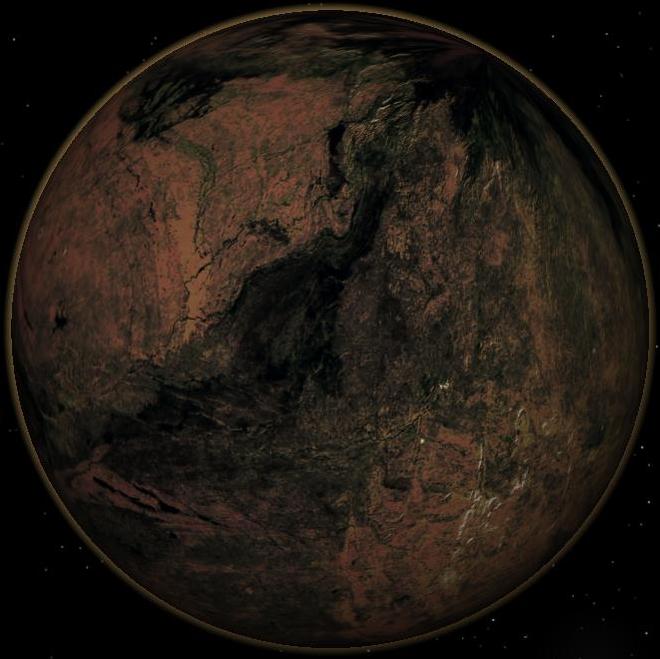 An artistic depiction of a carbon planet. The planet's color is dark and reddish due to the presence of hydrocarbons.
Read more
Abortion and science: what will happen to the children who will give birth
Radars have found the last Tlingit fort in Alaska. They've been looking for him for over 100 years
A third of those who have recovered from COVID-19 return to the hospital. Every eighth - dies