The First Chess Robot: The "Automatic" Chess Player
The history of chess goes back about one and a half thousand years.
The first chess innovation can be calledchess "automaton", which appeared in Vienna in the XVIII century. It was a wax figure of a chess player with a wooden box on which a board was placed. A man was sitting in the box: he followed the game using magnets attached to the figures from below, and made moves with the help of a special lever. Later, such "machines" appeared in France and Germany.
 “The first chess innovation can be called a chess “automaton”
Time control: chess clock
The first clock to limit the time of the game was designed by the English amateur chess player Thomas BrightWilson, they were first used at a tournament in London in 1883.A year later, Amandus Schierwater received a patent for the industrial production of chess clocks.In 1899, for the first time, a "flag" appeared on a chess clock, signaling the imminent end of time.The prototype of a mechanical chess clock with two push-button switches was created by Wienhoff in 1900.
In 1989, Bobby Fischer, world champion inchess, received a patent for the creation of the Fisher clock. The idea of Fisher's clock was to at least partially equalize the chances of opponents at the end of the game, when one player (or both) has a "flag hanging" in time trouble. Fischer's clock adds a few seconds for each move. If you keep within this limit, the "flag" on the clock will never fall.
 "Fischer's clock adds a few seconds for each move"
In the 1990s, electronicchess clock. They displayed the exact time in seconds and provided a variety of time controls. Now electronic clocks are the standard in all tournaments under the auspices of FIDE.
Digital Dash: Chess Programs
In 1951, the Englishman Alan Turing wrotethe first chess program algorithm. In 1952, the first computer chess machine appeared - MANIAC I, which, using the MiniMax algorithm, optimized the move search tree. Eight years later, the American scientist Allen Newell developed a computer program for solving mathematical and chess problems - the General Problem Solver.
In the late 1980s, the Deep Thought computerdefeated grandmaster Jörgen Bent Larsen. In 1997, the reigning world champion Garry Kasparov lost to the Deep Blue computer, which was able to process up to 200 million positions per second and had access to a huge database of opening positions from real games of grandmasters. Since the 2000s, chess players have ceased to have hopes of superiority over chess engines.
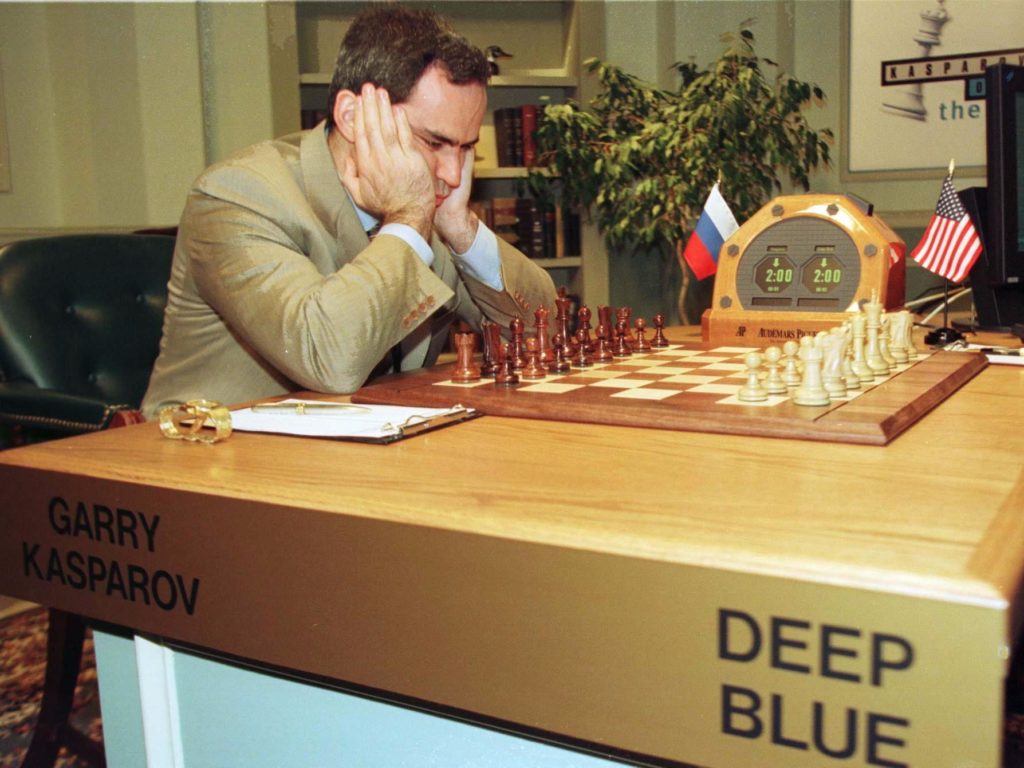 "In 1997, the reigning world champion Garry Kasparov lost to the computer Deep Blue"
Since 2008, the first places of the majorityrating lists and competitions among computer chess programs were occupied by the Stockfish chess engine. Thanks to an advanced algorithm for finding optimal moves and a large chess database for analysis, it has become the strongest chess program that does not use a graphics processor (GPU). Stockfish's idea of being a free and open source engine has made it popular for modifications and embedding into various systems, such as the Lichess service.
In 2017, DeepMind developed the self-learning neural network AlphaZero. After only 24 hours of training, she defeated the strongest programs in chess, shogi and go.
This is not a traditional chess engine:for AlphaZero, complex algorithms for calculating the score were not prescribed, as, for example, for Stockfish. Machine Learning technologies were used in his training. Through trial and error to learn each new game, the untrained neural network played millions of games against itself at random.
This approach is called reinforcement learning.At first, the neural network plays completely randomly, but over time it learns from wins, losses, and draws to adjust the parameters and increase the likelihood of choosing profitable moves in the future. To select the most promising moves, the neural network used Monte Carlo tree search (MCTS).
The AlphaZero neural network was used in the preparationMagnus Carlsen for matches and championships. The lack of reference to algorithmic and analytical evaluation when choosing a move made it more inventive and unpredictable for opponents. AlphaZero beats the strongest chess engines by a margin, including Stockfish. At the same time, it evaluates only about 60 thousand positions per second, while Stockfish - 60 million.
Online chess: websites, mobile apps, smart boards
With the possibilities that appeared at the end of the 20th century,you can play with an opponent from anywhere in the world at any time. In 1995, the chess.com service appeared, which today has more than 83 million users worldwide.
During the pandemic, the service has grown:in March 2020 alone, the number of new participants exceeded 700 thousand, and the number of parties increased to 10 million per day. Currently, an average of about 11 million games are played on the platform per day. The chess.com app for iOS is in the top 3 of the App Store in the board games category. And the total number of mobile application users exceeds 25 million people.
In 2010, French programmer Thibault Duplessislaunched the free chess service lichess.org, a site where you can play with opponents around the world with different time controls. There is one of the largest open databases of games played.
Another innovation that came to chessalong with the development of technology, smart chessboards. For example, Square Off allows you to play on a real board both with a computer and with opponents from different parts of the world. When a chess player makes a move on the board, the "invisible hand" moves the pieces from the opponent's side.
Chess and innovation: how the oldest game became more technologically advanced
If in athletic sports dishonest play is associated with doping, then in intellectual competitions dishonest players use a computer instead of biologically active substances.
In 1998, at a major open tournament inBöblingen amateur with a rating of 1925 Clemens Alvermann beat grandmaster Sergei Kalinichev. Analysis of the game showed a great agreement between the moves of the chess player and the recommendations of the computer program Fritz 5.32. Alvermann was disqualified, but it was not possible to take away his impressive prize money.
In 2006, the match for the title of world champion inchess was accompanied by the so-called toilet scandal: Topalov's team accused Kramnik of using electronic prompts while visiting the toilet. Due to the scandal, the continuation of the match was in jeopardy. The conflict was resolved through long and intense negotiations.
In the 21st century, with the development of technology, new ways of cheating have appeared: for example, Bluetooth transmitters and smartphones on which you can download chess programs.
To fight cheating, on majorIn competitions, players are checked with metal detectors, jammers are installed, and broadcasts are broadcast with a delay. It is more difficult to control the integrity of the game online, but online chess is also working on the fight against cheating. For example, chess.com and lichess.org have their own anti-cheat systems. The services do not reveal the algorithms, but it is known that out of the many parameters collected and analyzed, matches between players' moves and recommendations for the best move from chess engines occupy a special place. If the percentage of such matches is extremely high, the site may block the account. In August 2020 alone, almost 17,000 users were banned from chess.com.
In the same year, during the online European Championship on chess.com
of the six winners of the tournament of the lowest ratingfive categories were disqualified, and the total score of cheaters who used special programs went to tens. Players affected by the foul play wrote complaints and denunciatory posts on social media.
Chess for fans: broadcast of chess games
- Demo boards
Before the advent of technology for digitizing chessparties for their broadcast used demonstration boards. Specialists watched what was happening on the game board, and then made the appropriate moves on the demo board.
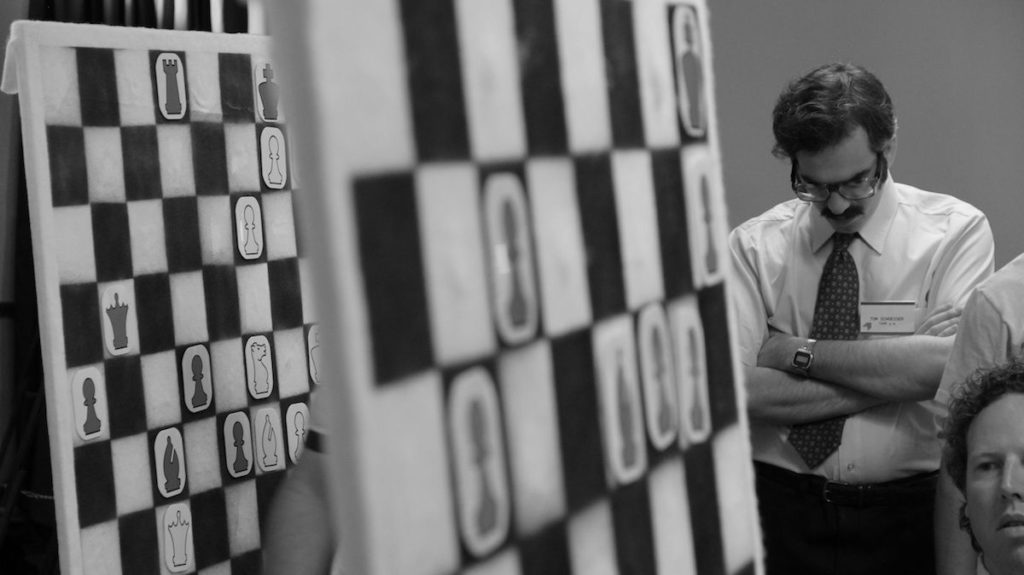 “Specialists watched what was happening on the game board”
- DGT
In 1998, FIDE expressed its desire for the first timeto use electronic chess boards at the Olympiad in Elista. DGT began developing technology for a system of 300 electronic boards, which were later successfully used to digitize games and broadcast them on screens. Since then, DGT electronic boards have been used in major competitions that can afford to buy chess sets costing from 40,000 rubles apiece.
- idChess
Until recently, there was no availabledevelopment that would allow digitizing and broadcasting games during tournaments. Everything changed when, in February 2019, Freeflex introduced idChess, an AI platform for recognizing, analyzing and broadcasting chess games played on a real board.
idChess digitizes the game in thereal time and can broadcast the game to any digital media. This allows you to create comfortable fan zones anywhere. For example, at children's competitions in chess schools, parents can watch their children play in real time.
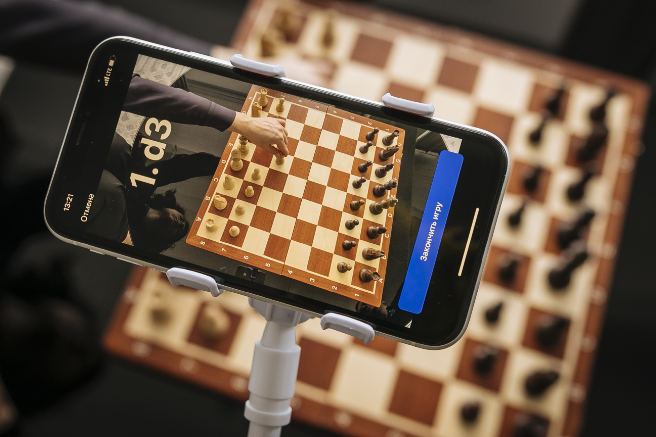
 "idChess digitizes the game in real time and can broadcast the game to any digital media"
The idChess platform opens up new possibilities notonly for organizing tournaments, but also for personal use. It records the games played in chess notation, saves the games to the library and makes it possible to analyze the progress, as well as share the games with friends and the coach.
idChess is based on computer technologyvision and machine learning. Game recognition occurs from the video stream through the mobile application. To determine pieces and moves, several neural networks are implemented on the platform. The algorithm is trained to take into account many factors that are difficult for artificial intelligence that may arise during the game.
To record a game, all you need to do is download idChess from the app store and mount your smartphone on a tripod so that the chessboard is completely in front of the camera.
Chess and entertainment
Chess is also developing as one of the formatsentertainment. At the same time, the public prefers rapid and blitz chess competitions as the most spectacular. For example, FinChess is held annually in Moscow, a team blitz tournament that gathers representatives of the financial and IT communities around the chessboard. Participants not only play, but also get to know each other, establish business ties. Many companies also hold corporate chess tournaments.
Culture also develops interest in the game - theater,cinema, photography. Recently released in Netflix's The Queen's Move (2020), Philipp Stölzl's The Royal Game (2021) and Alexei Sidorov's World Champion (2021). In October 2020, the Broadway musical Chess was presented on the stage of the Moscow Palace of Youth in Moscow.
Learning to defeat grandmasters and championsworld, technologies have entered into a duel with each other. No one is surprised anymore by matches between AI chess engines, in which neural networks play combinations from the best grandmasters.
The development of technology has given a tremendous impetus todevelopment of chess. They can be called a real IT phenomenon: chess programs are now on more than a billion smartphones. And then even greater and active development awaits it.
Read more
Voyager 1 is sending strange data. NASA doesn't understand what's going on
The “fifth force” creates invisible “walls” in the universe. The main thing about the new theory of physicists
How dark matter "communicates" with the one we are made of. Key points about the new study