Dinosaur food intake and digestion
The earliest dinosaurs were almost certainly carnivores and
Relatively small abdominal cavities becauseCarnivores do not require large digestive systems. Later, carnivorous dinosaurs reached much larger sizes, but retained the same set of characteristics.
Instead of chewing food, these predators tore off pieces and swallow them whole, like modern crocodiles or birds of prey.
Eating habits of ornithomimosaurs andOviraptorosaurs are not obvious: although they evolved from carnivorous theropods, their jaws are relatively small and they do not have the razor teeth of typical carnivorous dinosaurs. Also, there is no evidence of their diet in the form of petrified stomach contents.
The characteristics of other groups of dinosaurs clearly indicate that they were adapted to eat plant foods. These traits include:
- jaws with a small opening angle and teeth closely spaced to each other;
- large abdominal cavities, which can accommodate a large amount of plant material and store it for a long time required for digestion;
- long intestines, which probably containedendosymbiotic microorganisms that secrete enzymes to digest cellulose: no vertebrate can digest this tough material with its own enzymes.
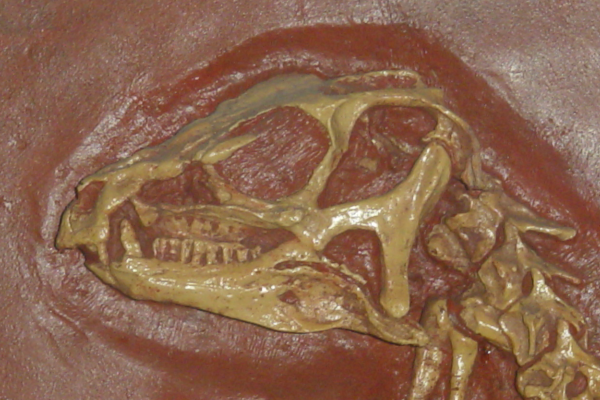 The herbivorous heterodontosaurus showed tooth differentiation similar to that of mammals.
The herbivorous sauropods did not grind their food,since their teeth and jaws were only suitable for removing leaves from plants. Poultry dinosaurs, also herbivores, exhibit many different adaptations for consuming plant foods.
Armored ankylosaurs and stegosaurs hadsmall heads, weak jaws and teeth, and most likely fed like sauropods. Pachycephalosaurids had small heads and weak jaws and teeth, but the lack of large abdominal cavities suggests a different diet, perhaps consisting of fruits, seeds or young shoots, which were much more nutritious than leaves.
On the other hand, some ornithopods, suchlike hypsilophodons, iguanodonts and various hadrosaurs, they had horny beaks for tearing off vegetation, jaws and teeth adapted for chewing food. Horned ceratopsians had similar adaptations for feeding.
It has often been suggested that,at least some dinosaurs swallowed rocks known as gastroliths to grind up food in their stomachs, a feature they shared with birds.
In 2007, Oliver Wings reviewed the descriptionsgastroliths in the scientific literature and found considerable confusion, including the lack of an agreed upon and objective definition of gastrolith.
He found that swallowed hard stones orsand may aid digestion in birds that eat primarily grains, but may not be essential for birds that eat insects in the summer and seeds in the winter, and usually get rid of rocks and sand in the summer.
Gastroliths were often described as important elements for sauropods, whose diet of vegetation would require very careful grinding in the stomach.
But Wings came to the conclusion that this idea was wrong:gastroliths occur in only a small percentage of sauropod fossils; the number of gastroliths found was small, and in many cases the stones were too soft to effectively grind food; Most gastroliths are heavily worn and relatively smooth, but gastroliths used by modern animals to grind food, in contrast, tend to be rough from wear and eroded by the acidic environment of the stomach.
Therefore, sauropod gastroliths were probably swallowed by accident. On the other hand, Wings concluded that gastroliths found with theropod fossils such asSinornithomimusand Caudipteryx, resemble those of birds, and that the use of gastroliths for grinding food may have evolved early in dinosaur evolution leading to birds.
Effect of diet on appearance
In 2010, scientists from the Natural History MuseumField (Chicago) came to the conclusion that the appearance of beaks in dinosaurs was evolutionarily significant. Thanks to the development of the beak, theropods gained access to new food products.
They made this conclusion by summarizing data on the diet of theropods. Predators are always less common than herbivores. Therefore, according to scientists, many theropods (for exampleCaudipteryx zoui,Beipiaosaurus inexpectus) and their relatives had to be content with a vegetarian diet.
Fossil manure testifies to this,stomach contents, teeth, etc. The researchers also identified other anatomical features associated with a plant-based diet, such as tooth loss and neck lengthening.
Predator-prey ratio
Roberta T.Becker, the authors of The Dinosaur Renaissance, argued that cold-blooded predators require much less food than warm-blooded ones, and therefore the same biomass of prey can support more cold-blooded predators than warm-blooded ones.
At the same time, the ratio of the total mass of predators to the totalThe mass of prey in the ecosystems of dinosaurs, earlier archosaurs, and therapsids was closer to the ratio of modern or recently extinct ecological communities to warm-blooded predators than the ratio of modern or extinct ecological communities. with cold-blooded predators.
This may indicate that carnivorous dinosaurs were warm-blooded. And since the earliest dinosaurs (e.g.StaurikosaurusAndHerrerasaurus) were predators, all dinosaurs were originally supposed to be warm-blooded.
This argument has been criticized on several grounds.reasons, and is not considered by some authors. Estimates of the weight of dinosaurs vary widely, and even a small change can significantly affect the calculated ratio of predators to their prey.
Becker arrived at his estimates by citingmuseum specimens, but they are biased toward rare or well-preserved specimens and do not provide a complete picture of the fauna preserved in the fossil record.
Even the fossil layers themselves may not accurately represent the size of actual populations due to conservation conditions and the incompleteness of the fossil record.
For large ectothermic predators, with the exception ofKomodo dragon, there is no high-quality data on the ratio of the number of predators and their prey. Large ectothermic herbivores are completely absent in our time.
For this reason, Becker had to compareThe predator-prey relationship of mammals is similar to that of fish, small reptiles, and invertebrates, where organisms have much shorter life expectancies and other differences may also skew the comparison.
This argument assumes that populationspredators are limited only by the availability of prey, although there are other factors such as a lack of nesting sites, cannibalism, competition, or predation by other predators that can keep predator populations below the limit imposed by prey biomass.
Many environmental factors are unknown thatcould affect the ratio of the number of predators and their prey in dinosaur communities: some predators can specialize in certain types of prey, including at different stages of growth; prey numbers can be influenced by disease, parasites and hunger, which will reduce their numbers before predators can prey on them.
Apex predators among dinosaurs
- Who are the apex predators?
Typically, apex predators are placed on the fourth orfifth level of the food chain, above producers, herbivores and other predators, although in local, particularly island systems, the role of superpredators can be played by mid-level predators, such as coyotes, eagles, monitor lizards, dingoes, feral domestic dogs, and even lower predators links, in particular, large snakes and domestic cats.
Removing apex predators from the ecosystem orexcessive reproduction leads to a cumulative effect, known as a trophic cascade, in which significant changes in the numbers and lifestyle of not only middle-level predators, but also herbivores and plant life of the system occur.
Сверххищник не обязательно должен быть exclusively carnivorous. It can eat plant foods or carrion, as is the case with the grizzly bear. The superpredator is capable of taking other people's prey and exterminating competitors.
- Tyrannosaurus
A team of morphogeneticists from the University of New Mexicopointed out that a more detailed and detailed study of the remains of tyrannosaurs not only established the truth of their highest position in the food chain of their relatives as a whole, but also pointed to the fact that tyrannosaurs evolved as apex predators so effectively that they virtually left no chance for a similar genus to emerge predators of any size.
New research indicates that it is more likelyIn general, early studies about dinosaurs and their evolution - and in particular about the evolution of the Tyrannosaurus rex - were not entirely realistic and in some senses even erroneous, and therefore at this point in time the team of researchers speaks of their desire to continue studying their topic and provide interested scientific and general the public with even more information and scientific information regarding dinosaurs.
What do we know about the diet of Tyrannosaurus rex?
Tyrannosaurus is the largest species of its kindfamily, one of the largest representatives of theropods and one of the largest land predators in the entire history of the Earth. One of the largest specimens of a tyrannosaurus named Sue during life reached about 12.3-12.8 meters, height to the hip - 3.6 meters, and the mass of this individual, according to experts, during life reached approximately 8.4-9.5 tons.
As the largest carnivore in its ecosystem,Tyrannosaurus Rex was most likely an apex predator that hunted hadrosaurs, ceratopsians, and possibly even sauropods, although some researchers suggest that it fed primarily on carrion.
Moreover, the debate over whether Tyrannosaurus was a full-fledged hunter and superpredator or a scavenger was one of the most intense and protracted in the history of paleontology.
Now most experts believe that the tyrannosaurus was an opportunistic predator - it could both hunt and feed on carrion.
- Predator or scavenger?
Debate over whether Tyrannosaurus was an active predatoror a scavenger, began at the same time as the dispute about the peculiarities of his movement. In 1917, Lambe described the skeleton of Gorgosaurus, a close relative of Tyrannosaurus, and concluded that Gorgosaurus and, by extension, Tyrannosaurus were purely scavengers, since Gorgosaurus's teeth were almost unworn.
However, this argument is not accepted these days.seriously, since it is known that theropods quickly grew new ones in place of worn-out teeth. Since the discovery of the tyrannosaurus, it has become clear to scientists that it was a predator, and like most modern large carnivores, it could feed on carrion or, if possible, take prey from other predators.
Other evidence suggests thatTyrannosaurus was an active predator. The eye sockets of the Tyrannosaurus were located so that the gaze was directed forward, and the lizard had good binocular vision - even better than that of hawks. Horner also noted that the lineage of tyrannosaurs showed a steady improvement in binocular vision.
It is not known why this long-terma tendency if Tyrannosaurus was an exceptional scavenger (scavengers do not require heightened depth perception). Moreover, in the modern world, good stereoscopic vision is characteristic of fast-running predators.
- Cannibalism
Study conducted in 2010paleontologists Curry, Horner, Erickson and Longrich, raised the question of whether cannibalism was characteristic of tyrannosaurs. They studied several specimens of tyrannosaurs with marks left by the teeth of dinosaurs of the same genus.
Similar marks were found in the shoulderbones, foot bones and metatarsals. However, they do not indicate intraspecific clashes, but that tyrannosaurs could feed on the remains of their relatives (since in a fight it was difficult for the lizards to get to these parts of the body).
That the marks were left at the leastfleshy areas of the carcass, means that either the fleshy parts have already been eaten, or by the time the corpse is found, they have already rotted. It is possible that similar behavior was observed in other tyrannosaurids.
- Hunting in a pack
Philip John Currie, a paleontologist at the University of Alberta, suggested that tyrannosaurs may have lived in packs. Curry compared Tyrannosaurus rex with closely related species -Tarbosaurus bataarAndAlbertosaurus sarcophagus, for which Curry had previously found fossilized evidence of pack life.
Curry noted that South Dakota was madethe discovery of the skeletons of three tyrannosaurs in close proximity to each other. After performing a CT scan, Curry stated that the Tyrannosaurus rex's brain size was three times the normal size for an animal of its size, therefore, the lizard was capable of complex social behavior.
In particular, the brain size ratioTyrannosaurus rex to total body size exceeded that of crocodiles and was three times higher than that of herbivores such as Triceratops. According to Curry, Tyrannosaurus was six times smarter than most other dinosaurs and reptiles.
Curry explained the need for pack hunting by the fact that the victims of tyrannosaurs were either well armed (Triceratops and Ankylosaurus) or could run quickly.
The scientist also noted that juveniles and adultsindividuals hunted together: small and, therefore, agile young individuals chased the prey, and adults used their strength to kill it (this hunting strategy is also observed in modern schooling predators).
Read more:
Physicists have created an analogue of a black hole and confirmed Hawking's theory. Where it leads?
The first panorama of Mars appeared. It consists of 142 photos!
A giant iceberg has separated from Antarctica. Its area is 1270 square kilometers