Dmitry Madera, Head of the Department of Molecular Genetics at BIOCAD, Senior Lecturer at SPCFU, Ph.D.
In 2002 he graduated from the Faculty of Biology of Moscow State Universitymajoring in genetics. He defended his thesis for the degree of Doctor of Phylosophy in Biology on the program for the study of function and gene expression at the University of Massachusetts, after which he worked at the National Institutes of Health, studying the molecular aspects of the development of cancer and how to influence them. In 2015, he headed the molecular genetics laboratory at BIOCAD, and has been developing gene therapy products since then. He is the author of an international patent describing a new nuclease of the Cas9 family and articles in the field of cancer development.
He Jiankui experiment, oncology risk in girls born and target mutations
What do you think about the experiment of the Chinese biophysicist He Jiankui, who edited the genome of two embryos?Expertsclaimthat born girls might have mutations. How to avoid this?— Having studied the original source (the MIT — Hi-Tech study) and the commentary of geneticist Fyodor Urnov, I realized that the media are a little distortedYes, girls are more likely to have mutations.This refers to those mutations that are not known where exactly they will arise.And now it is difficult to establish exactly where the random mutations that resulted from CRISPR/Cas9 arose.To do this, you need to make a comparison with the parents of the girls.
Formally, this is a correct statement: there really can be ophtargeted mutations, and there is nothing you can do about it.And current gene editing methods don't prevent this.be dangerous.
At the end of 2018, Chinese scientist He Jiankuiannounced that he was able to create genetically modified twin girls with innate immunity to HIV. He said that he edited the embryos of couples undergoing IVF, and one of the seven attempts was successful. The experiment triggered a new wave of discussions about the ethics of interfering with the human genetic code.
However, Fedor Urnov, editing specialistThe University of California genome, in an interview with MIT Technology Review, noted: “The claim that it reproduced the prevailing CCR5 is a blatant misrepresentation,” and added that this can only be described as “intentional misrepresentation.”
A new study from MIT showed that scientists do notwere able to reproduce the prevailing version of CCR5. Although the team aimed at the right gene, the researchers did not copy the desired variation of the Delta 32, but instead created new editions, the effect of which is not clear - while they can cause mutations.
Claim that He Jiankui was unable to mutate the CCR5 gene (the gene that allowsIt has indeed achieved its goal, and CCR5 has indeed been mutated and no longer works, which means that HIV cannot infect human cells.Yes, it apparently failed to replicate a specific natural allele found in human populations, but nevertheless, CCR5 is "knocked out" and does not work, which means that Jiankui has achieved the minimum goal.
To prevent off target mutations,it is necessary to improve methods for editing the genome, to increase their accuracy. Thus, in the future, it will be possible to reduce the risk of mutations to the background level, and then calm down on the fact that mutations occur naturally. As they say, it is not necessary to be holier than the Pope.
- That is, when these girls grow up, it will be unrealistic to understand exactly what mutations they had as a result of the actions of Jiankui?
- Speaking specifically about CCR5, then, of course,can. And for the whole genome - in principle, it is possible now, if you take the genetic material of their father and mother and compare it with their own. Then it will become clear what options parents have, and which of those that are present in the genome of girls, neither mom nor dad have. Another thing is that it will be impossible to find out which mutations arose as a result of CRISPR / Cas, and which randomly. You can only compare the frequency of these mutations: how many normal mutations occur at birth and how many of these girls have them. If there will be an order of magnitude more, then everything is clear.
CRISPR/Cas9 genome editing technology has the potential to eliminate thousands of inherited diseases that were previously thought to be incurable.
The main difference between a gene toolediting CRISPR / Cas9 from other, long enough existing methods - this is the possibility of directional DNA changes. CRISPR / Cas9 allows you to specifically influence the DNA sequence and even change the broken gene to the correct one. To do this, a special enzyme, nuclease, introduces a gap in the right place in the genome, after which the repair system is turned on - the internal mechanisms of the cell to restore the genome. In this case, DNA is repaired at the site of the break, as a rule, with random errors, which is most likely to lead to the loss or insertion of several letters in the sequence and the appearance of mutations. Therefore, she searches as a sample for the desired sequence in neighboring genomes. According to technology, the cell must find this sequence in special DNA fragments. Their genetics introduced into the cell in order to take it and independently introduce it into itself. However, random mutations at the rupture site occur much more often than directed reparation along the sample.
Another question, Konstantin Severinov (a Russian specialist in the field of molecular biology and CRISPR/Cas – Hitech) once expressed an interesting idea that if there was something completely terrible there, the girls simply would not have survived at the stage of embryogenesis.Most likely, nothing fundamental about their genome was affected.The only thing that scares me is oncology.similar diseases.
- Why? Does oncology become more likely as a result of editing the human genome?
Let's take a look at the causes of cancer.There are three of them: hereditary mutations, that is, special alleles that carrythe likelihood of an increased risk of cancer, such as Angelina Jolie; viral causes – human papillomavirus, for example; and random mutations.It is the occurrence of mutations of the latter type in the girls in the Chinese experiment that I am afraid of, especially if there was a high frequency of mutations.In this case, the probability of any type of tumor occurrence is different from zero.
 Dmitriy Madera. Photo: Science Bar Hopping
How to edit the human genome, leading countries and the fate of Russian genetics
- How much easier is it to conduct such experiments with animals?
— To edit the genome of each animalyou need your own protocol. You need to edit a mouse or a cow using different protocols. And man, like another animal, requires its development for himself in order to edit his genome most effectively. Therefore, it cannot be said that it is more difficult to edit a person than a cow. You just need to do it differently than with a mouse or rat. But the approaches remain the same. There is nothing very different about us.
- That isthe problem lies only in the field of ethics and laws? And if it were decided, would there be more experiments?
- Undoubtedly.And then, there are actually quite a lot of experiments. I go to conferences and often meet colleagues. For example, the University of Oregon is conducting excellent experiments on editing the human genome and growing embryos. They are simply subsequently destroyed at a certain, early stage. Such experiments are not prohibited. In fact, the only limitation is the implantation of an embryo and its cultivation until birth.
- Which countries are leaders in research on editing the human genome today?
— There are two such leaders now, between them and everyonethe rest are an absolute abyss. These are the USA and China. No one is even closer, they are so far removed from the rest of the world in their research.
- Is it connected with financing or scientific base?
- With both.China is investing a lot of money in research, their government is very concerned about this. And if earlier they were simply copying technology, now Chinese scientists are doing interesting things. And in the USA there is simply a very strong scientific base. Actually, where were all these CRISPR/Cas discovered? Most of the discoverers of this method, except for Jennifer Doudna, are Chinese, but they work in the USA. Therefore, there was such a synergy between the two countries.
— What prevents Russia from developing in this area? Even the presidentdeclaredabout the priority of research in the direction of genetics.
- I will say this, today there is already fundingresearch - a lot of money is allocated. But, of course, all this is not done in one hour. We need a scientific base and school. In Russia, in terms of genetics, everything is sad after Lysenkoism. Before Lysenko, the Soviet school of genetics was one of the best in the world. Vavilov went to Morgan (Thomas Morgan - one of the founders of genetics, the Nobel Prize laureate - “High Tech”), and they communicated on equal terms. After Lysenko, everything was destroyed in a barbaric way. And since then we cannot recover. Yes, money is very important. But it is also necessary that the children go to study, so that foreign specialists are involved. And if there is a school, there will be genomic editing in Russia.
- How will this be influenced by recent recommendations regarding communication between Russian and foreign scientists - to report all contacts, to practically communicate, as in the Soviet Union?
- It's very scary. The worst thing that can be done for Russian science and kill it completely is these recommendations. And I understand that these are just recommendations, and they do not have to be followed. But people, you know, are afraid. And they begin to carry out them proactively. Especially not scientists, but bureaucrats from science. They will begin to stop communicating with foreign scientists. I know the story when scientific spouses from Germany came to some conference in Russia for some time, and foreign scientists do not often come to us, and they were not allowed into the event due to these requirements. Science is international, and you need to communicate and interact with colleagues as much as possible, and then it will be good. I strongly condemn these requirements.
Treatment of deafness, dangerous diseases and drug delivery
— Russian geneticist Denis Rebrikovgoing toedit the genome of embryos for couples with hearing impairments. How likely is the success of such an experiment?
— Denis Vladimirovich took into account all his mistakesChinese colleague. He's going to do whole genome sequencing. And the experiment itself will take place in a more controlled environment, not in semi-underground conditions, as was the case with Jiankui. I think that success, in principle, from a methodological point of view, is possible, and it turns out that everything is not so scary, especially when using modern methods. And the level of mutation may be at the background level. As for these sick children, yes, this is a monogenic mutation, and it is dominant, that is, it is quite easy to destroy it, which geneticists are already doing well. And, in fact, that’s it, nothing stands in the way further.
— How does this fit in with Russian legislation?
- Regarding the legislative aspects, Rebrikovit just works on this. And in this sense, it’s very interesting to know what happens there. I would really like him to succeed in breaking through this legislative wall. Although his example and the disease that he chose, in the opinion of many of my colleagues and mine, are not so relevant. But the field is opening huge, so let it be the first and show a good result. And further it will be possible to expand the "repertoire".
- What other dangerous diseases can be treated with CRISPR / Cas?
— Of course, cystic fibrosis is a very seriousdisease. It is possible to use gene editing in the treatment of Duchenne muscular dystrophy, at least in some patients who have a mutation more or less suitable for this. In general, there are more than 10 thousand monogenic genetic diseases. And here the question is which method is more convenient and simpler for treatment. For example, spinal muscular atrophy should not be treated with editing, but simply with gene replacement therapy.
Cystic fibrosis- systemic hereditary disease,caused by a mutation in the gene for the transmembrane regulator of cystic fibrosis and characterized by damage to the exocrine glands and severe dysfunction of the respiratory organs. Cystic fibrosis is of particular interest not only because of its widespread prevalence, but also because it was one of the first hereditary diseases to be treated. Cystic fibrosis was first recognized as a distinct entity by Dorothy Andersen in 1938.
Duchenne myodystrophy- caused by deletions or duplications of oneor several exons or point mutations in the dystrophin gene. The main manifestation is muscle weakness, difficulty moving from childhood, which progresses over time. Death usually occurs in the second or third decade of life. Its average duration is 25 years, but there are people who live longer.
- When will scientists be able to do this? What is the time range?
- Look, the animals are already being treated.True, first they “mutilate”, of course (that is, they make model animals to study diseases), and then they treat. But all this only comes to a conscious clinic, and it, as a rule, lasts from 5 to 15 years. And as I understand it, since this is a completely new approach, the first clinical studies will take a very long time. This means we will have to wait 15–20 years. Then it will look like this: come, get diagnosed and treated immediately.
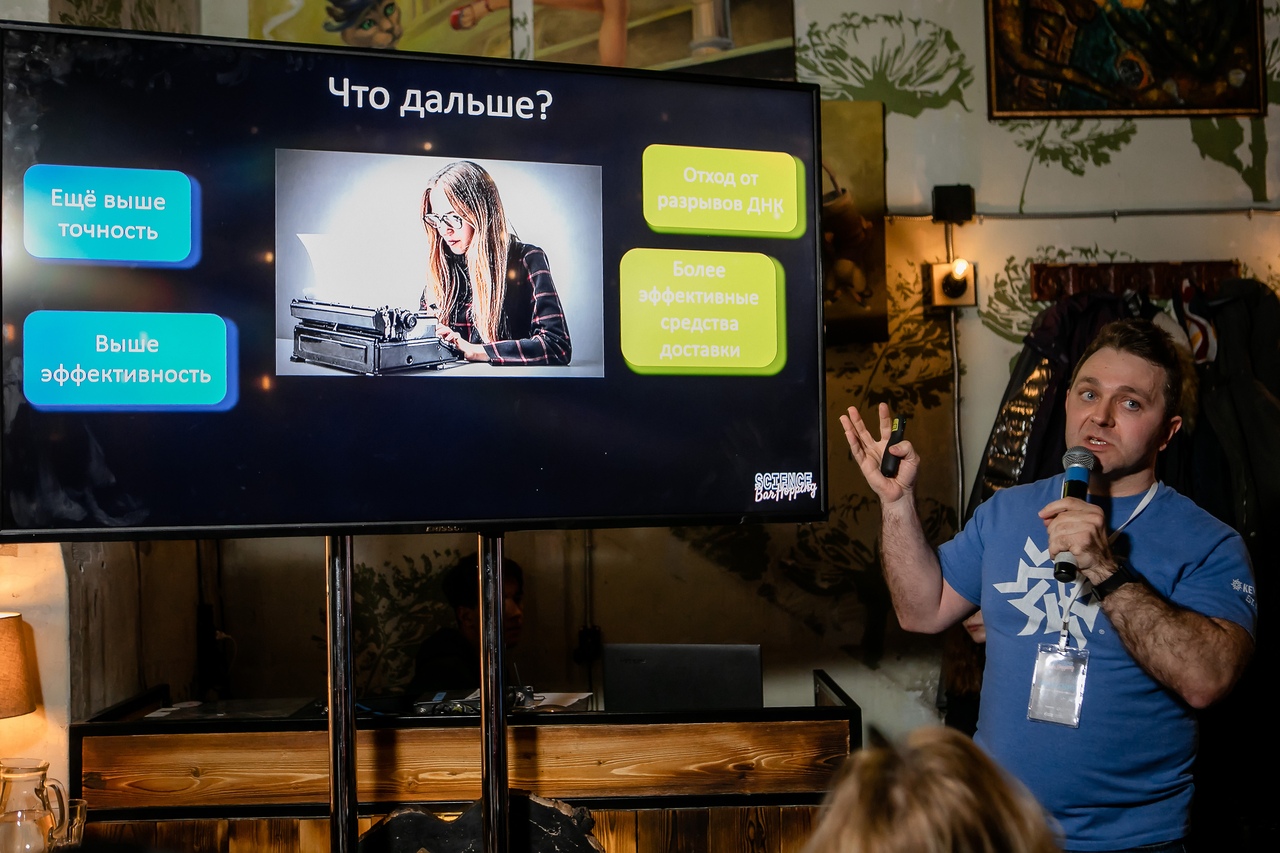 Dmitry Madera. Photo: Science Bar Hopping
- That is, it is not about editing the genome of the embryos, but about the treatment of adults?
— Both approaches will be possible.
- Let's talk aboutgene editingwithout double breaking. Why couldn't scientists do it before?
“The thing is, it’s not easy at all.”When I first read the Nature publication, I thought, “Oh, how did I not think of that?” Jokes aside, it was a lot of work, because initially there was a similar idea, but when scientists tried it, they didn’t succeed. Then they started changing the reverse transcriptase, essentially mutating it to make it work differently. And already at a certain iteration it started working and began to produce something like that. It was a process that required a lot of time and funding. Therefore, I am not surprised that time passed between the invention of simply CRISPR/Cas and the advent of the method using reverse transcriptase. Because it's non-trivial.
- What opportunities are opening up thanks to this new method?
- The opportunities are great, because nowit turns out that we can, with minimal risks of occurrence of offset mutations, very specifically change any gene, allele. For example, if we want to establish a point mutation, create a deletion or a complex replacement. This gives us great opportunities, because, by and large, usually one or two mutations or deletions that arise are small, and they can be restored within 40-50 nucleotides.
In fact, there were technologies a bit earlier -nucleotide editors who simply took and replaced, for example, “A” with “G” or “C” with “T”. Such works were and they are still used, but, of course, everything is not simple there, because it turns out that they edit not only DNA, but also RNA, too, and they don’t say that they’re very accurate - they’re not editing exactly one nucleotide, and the whole "window". Maybe this will also subsequently develop into practical use. But so far there are many problems. I remembered this method because it also does not involve double-stranded breaks. And it arose a little earlier than these recent studies.
— Engineers from MIT and Harvard UniversitiesusedCRISPR to create a drug delivery system that releases them only at a specific moment. How exactly does this happen?
- Speaking specifically about this method, then itthe essence is that DNA is a polymer, and Cas12a cuts it, thereby destroying the polymer structure. If DNA is incorporated into the hydrogel, then substances that were previously fixed in the hydrogel with DNA strands are then released from it. That is, here DNA acts simply as physical material that can be decomposed in a controlled manner. In general, hydrogels are used on wounds and other injuries when a gradual release of drugs from them is necessary.
In principle, CRISPR/Cas could deliver somethingnecessary to a position in the genome. That's all he can do. But it cannot deliver the medicine into the cell. So it is not entirely correct to talk about its use for drug delivery.
But to deliver CRISPR / Cas asdrugs into the cell; delivery methods are needed. And they exist - they can be viral and non-viral. Viruses, of course, have evolved throughout their history in order to deliver certain genetic material to the cell. They multiply so. And non-viral methods are simply chemical methods, when some carriers are created containing inside themselves nucleic acid molecules, not necessarily DNA, by the way, it can even be RNA or protein. Usually they are some droplets of fat that shield what they need to deliver from nucleases and proteases, and antibodies can also be hung on them to give them specificity for a particular cell. And these lipophilic complexes deliver drugs to the cell. And there are works related to complex polymers or gold nanoparticles, which, like a cannon, scorch cells, they fly into them and deliver their contents, such as a genomic cannon.
- Is it possible to significantly extend a person’s life thanks to gene editing? How much can this be done and what diseases need to be cured in this way?
- Complex issue.The fact is that there are mutations that in animals cause a certain prolongation of life, a slowdown in aging. They are usually associated with the DNA repair system. In many ways, aging is a consequence of the accumulation of random errors that lead to the activation of retroviral elements, and as a result the genome is not regulated and begins to work against its host. There’s a point here, we don’t know how it will work in people. Unfortunately, and this came as a big surprise, the mechanisms of aging and protection against it are very species specific. And for humans, the same mice turn out to be not an entirely adequate model. And the more adequate the model is and the longer it lives, the more difficult it is to work with it. For example, the same SIRT6 - in long-lived species it is one, and in short-lived species it is different, there is a clear correlation. It seemed that take and insert SIRT6 from an elephant to a person. Or several copies of human SIRT6 (the gene encoding the sirtuin-6 protein helps correct DNA damage - double strand breaks and substitutions in genetic nucleotide letters - Hi-Tech). This may work, or it may not. There is such a possibility, and of course I would try. But if we talk about extending life, then most likely we need to edit genes associated with DNA repair. Today, however, for such an organism as a person, this is only a hypothesis.