Huge amounts of money are now being invested in scientific research into CRISPR-Cas and growing organs from stem cells.
1. Sequencing
Since scientists discovered that DNA is the main keeper of hereditary information, the most interesting and important task has been to “read” its message.
This opportunity was provided to scientists by the appearancesequencing technologies - determining the DNA sequence. Since its inception in the late 1970s, knowledge in this field has advanced greatly. Currently, the third generation of sequencing methods and technologies has come, but the goal of all these methods is the same: to “read” the DNA chain. And knowing the DNA sequence, you can learn everything about the advantages and disadvantages of the body, its abilities and potential. In other words, today it is possible to draw up a complete genetic passport. Nevertheless, after deciphering the DNA sequence, it is still necessary to understand exactly how changes in it affect the shape / work / amount of the protein and the properties of the organism. It is this understanding that will give a qualitative leap in genetic research.
2. Genome editing: CRISPR-Cas
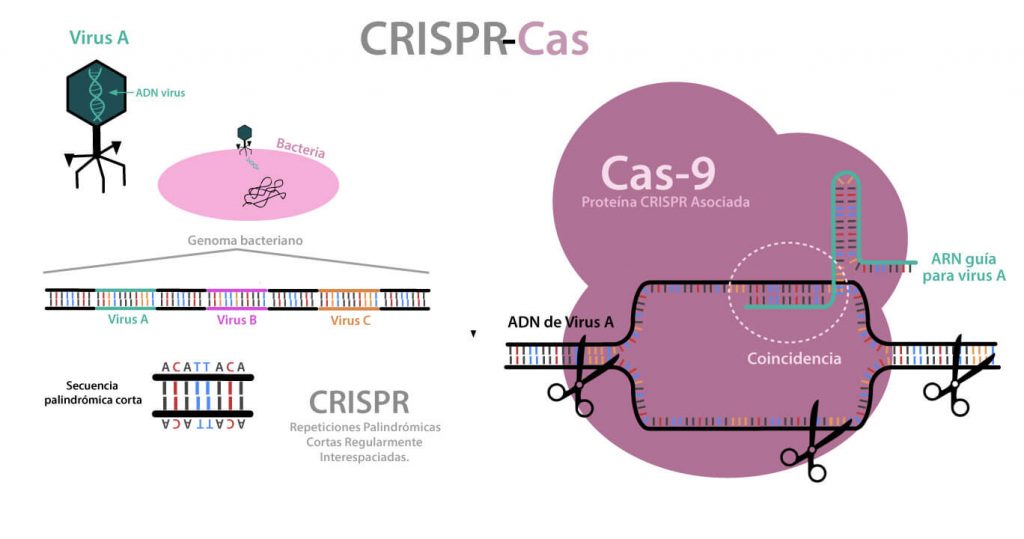
In general, all genetic engineering would be worthclassified as a breakthrough in biotech. Today, it has a number of techniques in its arsenal. But one of them attracts special attention. As it turned out, bacteria have their own "immunity" to viruses (more precisely, to phages - that's what bacterial viruses are called). A special system consisting of the caspase protein (or several proteins) and DNA sequences (“cassettes”) CRISPR fights against intruders in bacteria. This system recognizes and "cuts out" the virus from the DNA of the bacterium quite accurately. Real scissors for DNA. Already in our time, scientists have found a way to make this system work for the benefit of man. For example, with the help of this protein, it is possible to purposefully change genes with great precision. In the future, this could be a breakthrough in the treatment of genetically determined diseases and oncology. To give the desired properties and get rid of unwanted ones in agricultural plants and animals - and here CRISPR-Cas will find application.
3. Stem cells
Stem cells are those cells that cangive rise to and develop into other more highly specialized cell types. In the process of growth, development and life of the body, cells undergo a process of differentiation, that is, a narrow specialization in structure and function: erythrocyte (red blood cell that carries oxygen), neuron (nerve cell that transmits a signal in the brain), pancreatic beta cell ( the one that produces insulin) and others. However, stem cells are the progenitors of special cells. If you learn to control the process of differentiation, you can get any type of cell. This, in turn, will make it possible to grow organs (and even whole organisms) in a test tube from a single cell taken from the person himself. For example, an organ for transplant could be obtained using the patient's own cells. Such organs will be, as they say, "like relatives."

4. Bionic prostheses
Star Wars, Fullmetal Alchemist and moreother science fiction films show us the wonders of prosthetics (when a mechanical arm or leg successfully replaces a lost one). Some of them are quite real here and now. Modern bionic or bioelectric prostheses are able to read the signal from our muscles and nerves, transmit them to the moving parts of the prosthesis and thus make them move as their owner needs. That is, the prosthesis is controlled and moves in almost the same way as a normal human hand, it is mobile and much more comfortable than usual. Moreover, modern prostheses can be either simple, allowing only to squeeze and unclench all fingers at once, for example, hands, or more complex, allowing more diverse finger movements separately. With such a prosthesis, the most complete motor activity is possible. So now people who have lost an arm or leg (or part of them) as a result of an accident have a chance to compensate for the lost and, as they say, return to duty.
5. DNA computer
In fact, using the DNA circuit, one can alsosolve many mathematical problems. Let us recall that DNA is a very long chain molecule consisting of only four types of units, which can be conventionally designated A, T, G and C (by the first letters of their names). The sequence of these “letters” encodes information about proteins (and not only), and, therefore, the entire human body, which is read and implemented further. And with the help of special proteins, this information can also be purposefully changed. What if we encode any other information this way? In 2019, the first DNA hard drive was created. Special molecular algorithms for programming are being developed. Such a DNA computer can store a huge amount of information and simultaneously perform a very large number of computational operations at high speed.
Read more:
Does science exist in extreme conditions? We answer in numbers
The Yellowstone supervolcano turned out to be many times more dangerous than scientists thought
The egg was dropped from space: look what happened to it