Astrophysicists have built the first three-dimensional model of the Cat's Eye. The study showed that the outer shell
A planetary nebula is formed whena dying solar-mass star ejects its outer layer of gas, creating a colorful cocoon-like structure. The Cat's Eye Nebula (NGC 6543) is one of the strangest and most unusual. It is located at a distance of more than 3 thousand light years from Earth in the constellation Draco.
Hubble telescope image in high detailshowed that it consists of a complex interweaving of knots, spherical shells and arcuate threads. The mysterious structure of the Cat's Eye has baffled astrophysicists because it could not be explained by previously accepted theories of the formation of planetary nebulae.
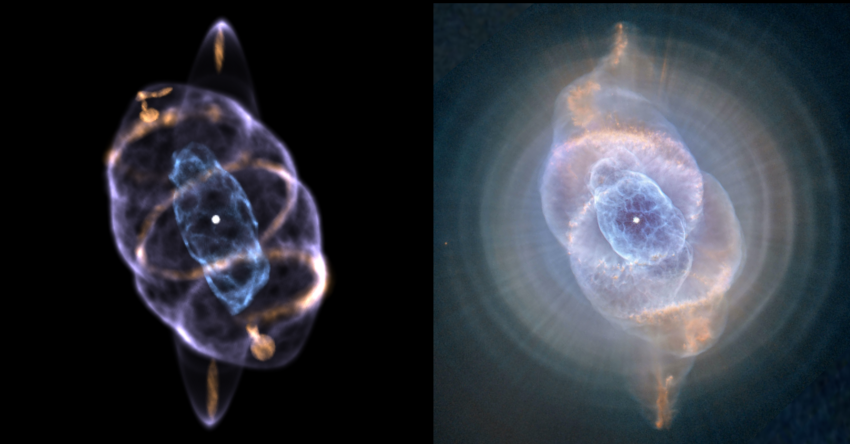 Computer simulation results (left) andHubble Telescope image of the Cat's Eye Nebula. Image: Ryan Clairmont (left), NASA, ESA, HEIC, and The Hubble Heritage Team (STScI/AURA) (right)
To reconstruct a 3D structurenebulae, the researchers used spectral data from the San Pedro Martir National Observatory in Mexico. Observations have shown how gas moves in the nebula. Based on the collected data, scientists built a three-dimensional model.
It turned out that high-density gas ringswrapped around the outer shell of the cat's eye. However, they are almost symmetrical. The researchers modeled possible reasons for the formation of such a structure: it could only be created by a jet (a stream of high-density gas ejected in opposite directions from the central star of the nebula).
Only binary stars can feed the precessingjet in a planetary nebula, which means that such a system exists in the center of the Cat's eye, scientists conclude. They believe that the change in the tilt and direction of the jet over time has shaped all the features observed in the nebula.
Read more:
Mysterious 'blue goo' at the bottom of the sea baffles scientists
Developed generator for wind farms without expensive magnets
Look at a phenomenon that is simply impossible on Mars
Cover image: J.P. Harrington and K.J. Borkowski (University of Maryland), and NASA, Public domain, via Wikimedia Commons