In Russia, aerial surveys of rare and protected species have been practiced for more than 50 years. This is almost the only one
The use of drones of various classesallows to reduce the cost of aviation observations in comparison with manned aircraft at times. For comparison: an hour of operation of a helicopter costs 30 thousand rubles, and a drone - 1 thousand rubles.
However, the quality of monitoring using suchdevices can be even more efficient. Equipping UAVs with modern navigation systems, high-resolution photo and video cameras in the visible and infrared ranges makes it possible to obtain real-time data on the distribution of biological resources: numbers, migration routes of protected animals, and the ecological situation in separate regions.
How drones work in nature
Lightweight and silent devices allow you to observeover large areas. This helps to combat poaching, the accidental death of animals in traps and other anthropogenic threats in the habitats of protected species.
For example, in 2021, in this way,aerial survey of the Baikal seal across the entire water area of the lake. Thanks to drones, it was possible to quickly explore vast areas, reduce the error and improve the accuracy of accounting.
Silent devices operating at high altitude,do not disturb the animals and allow you to observe their natural behavior. UAVs also completely eliminate risks in areas dangerous to humans - in cold or, conversely, hot regions, on water or in swampy areas.
So, last year Orlan showed itself well induring the scientific expedition "White Bear Census", organized with the support of Norilsk Nickel on Wrangel Island. Specialists observed polar bears for the first time in the world using long-range unmanned aerial vehicles. The researchers recorded 358 individuals of this species.
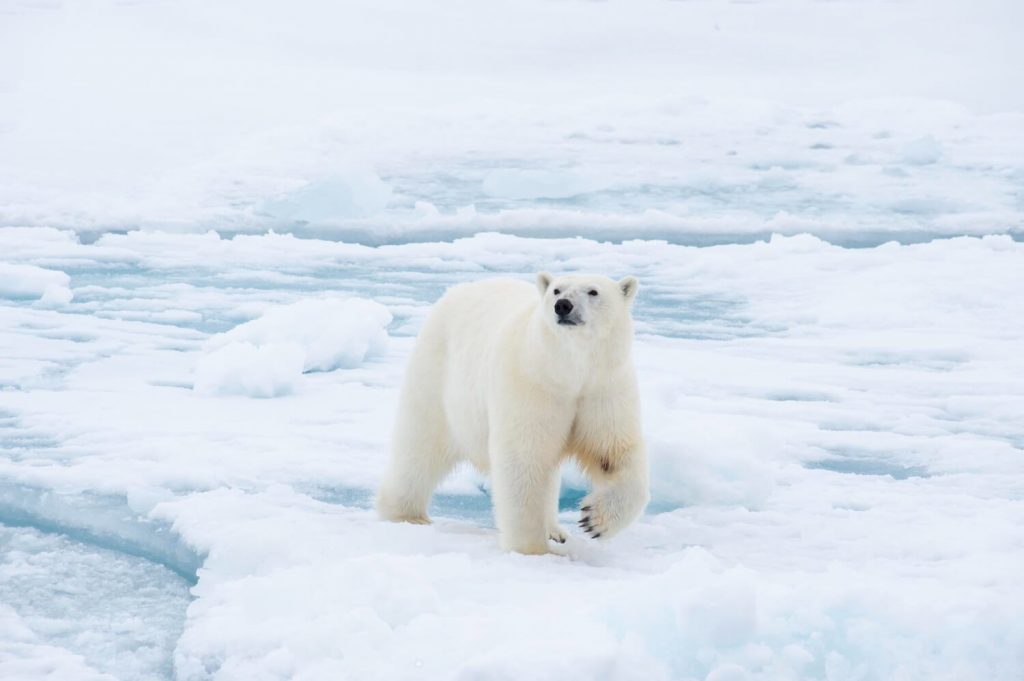 More than 300 polar bears found using drones
For a simple accounting of animals, it is enough to seton the drone navigation system and photographic equipment with a matrix of 24 megapixels. Additionally, a video camera is used. Shooting is carried out in winter and strictly with snow cover - so the animals are clearly visible on the records.
Modern UAVs for research tasksequipped with more serious equipment - thermal imagers help to “see” animals in the dark or on difficult terrain, 5G transmitters allow you to broadcast a picture in resolution up to 4K in real time, and connected artificial intelligence (AI) technologies help analyze the image. All these innovations greatly facilitate the work of scientists and increase the efficiency of monitoring.
How environmental monitoring using UAVs is developing
Already last year, according to general estimates, manufacturingof special-purpose vehicles has grown by 200%: today in Russia there are about 200 thousand drones in the civil service, and in the next 10 years their number will increase tenfold. In September 2022, the UAV market was predicted to grow to 50 billion rubles by 2025. Domestic companies producing UAVs distinguish several main directions of their development.
First of all, it is the improvement of technology.If cheap Chinese devices are used today as consumables, then the models developed by Moscow enterprises are created with the expectation of decades of constant work.
For example, the SeaDrone drone from the companySkyStream was tested in the Kara Sea in 2021 with wind gusts up to 18 m/s and waves up to 1.5 m high. The drone can land on the water, hold a person on the surface and take off calmly. In 2023, SeaDrone will take part in several expeditions to mark icebergs and monitor possible oil spills.
 UAV-equipped monitoring systems can learn about oil spills faster than experts
The second direction is the development of infrastructure andmaintenance of the drone base. Aeromax, a member of the Moscow Innovation Cluster, seeks to expand its presence in the market: it now provides territory monitoring services using unmanned aerial systems in more than 50 regions of the country. In addition, it is planned to launch the Mission Control Center (MCC), which will provide control and monitoring of the entire fleet of the company.
The third direction is improvementtechnologies used. The Dron Solutions company introduces the Sky Stream View system. Neural networks are trained to recognize animals, oil spills and other objects on photos and videos taken by drones. Monitoring is accelerated many times and eliminates manual observation errors. And the new drones, which will go on an expedition to the Arctic Ocean this year, are not afraid of salt water due to their complete tightness and do not get lost in conditions of abundant geomagnetic anomalies thanks to an improved navigation system.
The plans of other Russian developers include:large-sized transport UAVs capable of transporting up to 500 kg in Arctic conditions, a civilian unmanned helicopter capable of carrying up to a ton of payload, and a device with a flight duration of up to four days. Developers today also face a number of priority tasks, including, for example, the development of DAA technology (Detect-And-Avoid-System) - the ability of drones to independently avoid collisions with objects in flight - and swarm scenarios for managing groups of UAVs as a single “organism”.
Growing need for unmanned aerial vehiclesdevices coincided with the shortage of foreign components and the transition to domestic components. Market participants note that in order to grow the fleet of unmanned aerial vehicles to the volumes required in different segments, it is necessary to develop the production of domestic components. First of all, investments are required in the production of engines, electronic equipment and autopilot systems.
For companies engaged in innovationproduction, there are preferential lending and support programs, especially in the SME sector, and this, of course, is an additional incentive for the development of their own production capacities. Moscow enterprises operating in the field of science, industry and IT, with the help of special grants, compensated up to 30 million rubles invested in the expansion or modernization of production. Such a grant from the Moscow Innovation Cluster, for example, was received by the company Agrimax.Aero, which produces drone sprayers for solving agricultural problems.
But it is clear that it is important not only to developtechnologies that meet the needs, but also to convey to the potential beneficiaries of such solutions the full benefits of the work of drones. At the end of 2022, industry enterprises note an average increase in the volume of services rendered by 12%. This indicates a growing consumer interest in the capabilities of unmanned aircraft and its growing contribution to the conservation of the planet's biodiversity.
Read more:
Two photos of the Earth with a difference of 50 years were compared at NASA: what scientists found
Scientists transplanted human “brain” into rats and told what happened in the end
ChatGPT interviewed at Google for $183,000 engineer