Biologists have discovered an unusual reaction in female fruit flies after mating. They, unlike males and
The researchers used a video tracking systemto track the behavior of insects on a special test site. Monitoring of rest-activity patterns during light-dark (LD) cycles showed that mated females lose the ability to anticipate the change of night and day, unlike males and virgin individuals.
Most animals have endogenous circadian rhythmscoordinate physiological and behavioral processes to keep the entire body in sync with the 24-hour day/night cycle, the scientists explain. In Drosophila melanogaster, the circadian clock consists of approximately 150 neurons. They are responsible for two periods of pronounced activity - morning and evening, interspersed with daytime and nighttime rest.
At the same time, insects normally demonstrate earlierthe beginning of morning activity, which indicates the ability to “anticipate” the change of day and night, and not reactions to lighting, biologists say. In mating females, this ability was impaired, in addition, they showed increased activity and “missed” daytime sleep.
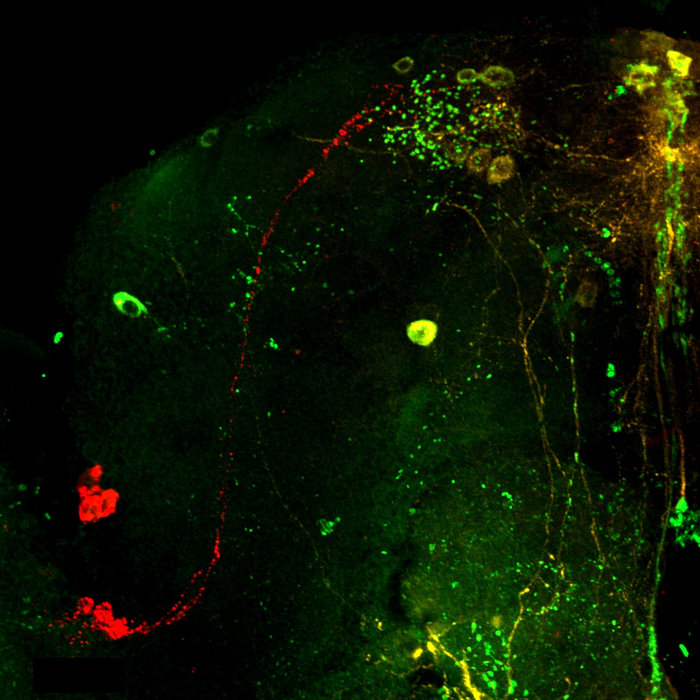 Visualization of neurons and dendrites responsible for daily activity in the brain of a fly after mating. Image: Riva et al., PLOS Genetics
In a series of experiments, scientists found thatthe change in circadian rhythms is associated with a sex peptide that is transferred from males during mating. Tiny molecules act on special receptors that influence the neurons of the circadian clock and thereby change the level of proteins that control the “sense of time.”
The researchers do not explain why such an evolutionary mechanism is needed, but note that postcoital changes in behavior and physiology are observed in females of many animal species.
Read more:
It turned out how old the water we drink today
17-year-old engineer came up with a magnetless motor: it can be used in electric vehicles
Two planets have been found not far from Earth. Perhaps they are inhabited