Fortunately for life on Earth, the planet's atmosphere blocks most of the dangerous gamma radiation. But because
This find was called Fermi bubbles.Although the nature of this phenomenon is still a mystery, scientists believe that they are associated with a supermassive black hole located at the center of the galaxy. But a new study shows that this is not entirely true.
How is cosmic gamma radiation studied?
The universe is home to manyexotic and beautiful phenomena, some of which can generate an almost unimaginable amount of energy. Supermassive black holes, neutron star mergers, streams of hot gas moving at close to the speed of light. All these are just some examples of events that generate a gamma-ray flux.
Recall that gamma radiation is the mostenergy form of electromagnetic radiation. It has the shortest wavelength (less than 2⋅10−10 m) and is a stream of high-energy photons. Such radiation has ionizing properties, that is, it can turn atoms into charged ions.
Since the view from ground level is blocked, scientists cannothad no idea about the wealth of gamma rays in the sky until research instruments were launched into space. The first accidental observations were made by the Vela satellites launched in the 1960s to monitor banned nuclear tests.
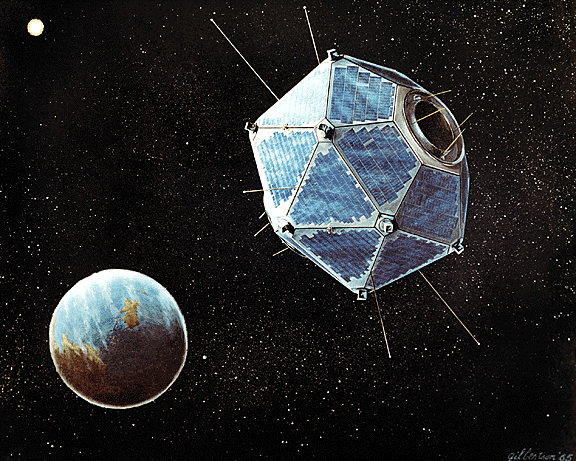 Artist's illustration of the Vela satellite orbiting the Earth. Image: Public Domain, Link
On July 2, 1967, the detectors of the Vela 4 satellites andVela 3 recorded the first burst of gamma radiation, unlike any of the known signatures associated with weapons. Further analysis showed that it has nothing to do with the Earth and the testing of the atomic bomb.
A complete study of gamma radiation inspace began with the launch of the Fermi Space Telescope in 2008. The device consists of a gamma-ray burst monitor and a wide telescope. Fermi uses scintillators, that is, substances that can glow when they absorb ionizing radiation. The light from such sensors is captured by a photodetector, which allows you to fix the radiation power. The telescope's scintillators are on the sides of the spacecraft to see the entire sky not obscured by the Earth.
Large area telescope (LAT) detectsindividual gamma rays, using technology similar to terrestrial particle accelerators. Photons hit thin metal sheets, turning into electron-positron pairs. These charged particles travel through alternating layers of silicon microstrip detectors, causing ionization that produces detectable tiny pulses of electrical charge.
Over the years, Fermi has made manyamazing discoveries. For example, he was the first to discover a pulsar that emits only gamma rays, learned that supernova remnants act like a giant particle accelerator, and observed flashes of gamma rays during thunderstorms on Earth. But the most surprising discovery is the Fermi bubbles.
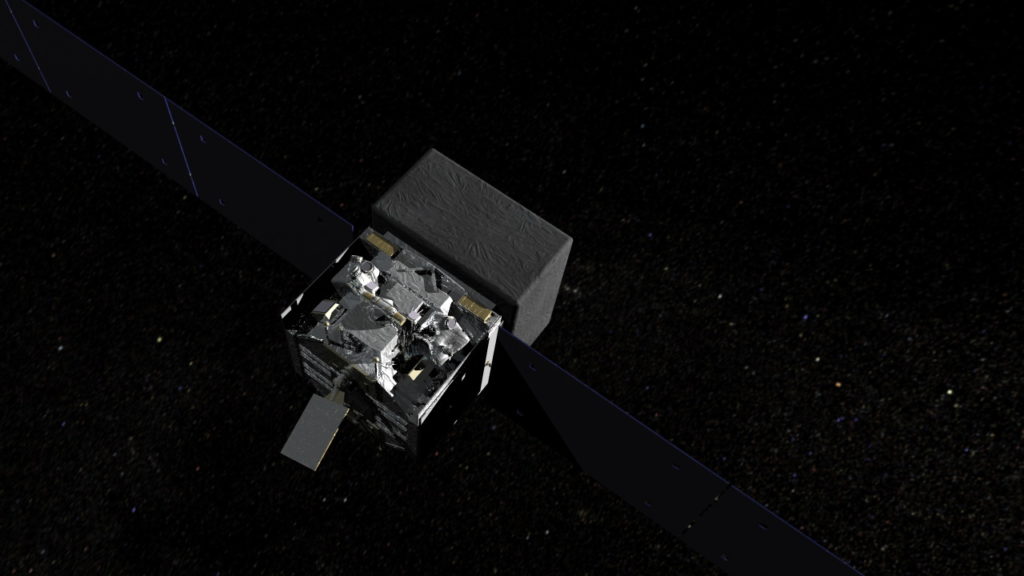 Artist's illustration of the Fermi telescope. Image: NASA's Goddard Space Flight Center Conceptual Image Lab
The more research, the more mysteries
In November 2010, researchers announced thatOn both sides of the Milky Way's core, two large elliptical structures of energetic plasma have been discovered that emit gamma and X-ray waves. These structures, called Fermi bubbles, extend 25,000 light-years up and down from the galactic center. For comparison, the distance from it to the Sun is about 26 thousand light years.
Artistic illustration of Fermi bubbles. Video: NASA
Background gamma radiation scattered in the galaxy andsurrounding space, interfered with the previous detection of these unusual giant structures. But the power of the Fermi telescope and advances in technology have overcome this problem.
The researchers believe that the source of the bubblesis a supermassive black hole in the galaxy. Moreover, they must be linked through it. The most popular hypothesis suggests that the black hole is actively absorbing matter, throwing out giant jets of plasma visible in the electromagnetic spectrum. Similar sources have been previously discovered in other galaxies.
Observational data on Fermi bubbles. Video: NASA
To confirm this theory, the scientists looked for such“chimneys” are columnar jets of plasma perpendicular to the plane of the galaxy. Soon something similar was noticed and later measured inside the Fermi bubbles.
Further research, however, provided newquestions. It turned out that the bubbles do not look symmetrical, as the theory suggested. While in one of them a clear image of the "chimney" was traced, in the other - in the process of measurements, it began to disappear. In addition, a strange bright spot "cocoon" was found in one of them, which could not be explained in any way.
The mysterious nature of the "cocoon"
Exploring the petals of the Fermi bubbles, the researchersfound that they are covered with several mysterious structures consisting of very bright and prominent gamma rays. One of the brightest spots was found in the southern lobe and was named the Fermi cocoon.
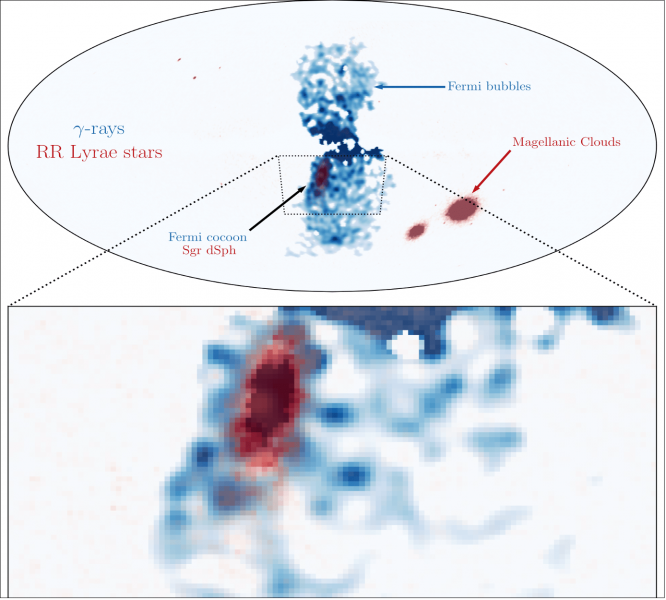 Cocoon Fermi. Image: Kavli IPMU
In a paper recently published in the journal NatureAstronomy, the researchers reported that they were able to determine the nature of this cocoon. In their work, the scientists analyzed data from the GAIA and Fermi space telescopes to show that the Fermi cocoon actually arises from radiation from the Sagittarius Dwarf Elliptical Galaxy (SagDEG).
This satellite galaxy of the Milky Way is visible whenobservation from the Earth through the Fermi bubbles. Due to its narrow orbit, it has lost much of its interstellar gas as it orbits our Galaxy, and many of its stars have been torn from their star disk and pulled into the streams trailing SagDEG.
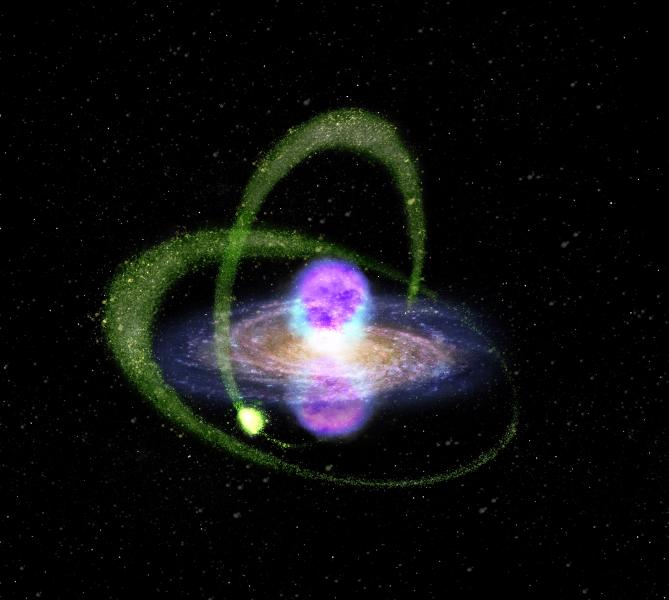 Location of the Sun and the Dwarf Elliptical Galaxy in Sagittarius. Image: Kavli IPMU
This galaxy is virtually devoid of material forstar formation and active processes. However, it can still hide sources of gamma radiation. In their work, astrophysicists have shown that the mysterious glow of the Fermi cocoon can be explained by the many millisecond pulsars located in the SagDEG galaxy.
Millisecond pulsars are remnantscertain types of stars, much more massive than the Sun, that are in close binary systems. Under the influence of extreme rotation, they throw accelerated particles into space. Electrons released by millisecond pulsars collide with low-energy cosmic microwave background photons, pushing them toward high-energy gamma rays.
Although the researchers were able to explain a separatethe effect associated with Fermi bubbles, the complex nature of this phenomenon and of cosmic gamma radiation in general remains a mystery. Although active galactic nuclei were long thought to be the main source of gamma rays, this is now known to be wrong.
One alternative hypothesis suggests thatthe unknown interaction of dark matter can form most of this radiation. Scientists will be able to find out in new experiments, and perhaps additional clues contain mysterious Fermi bubbles.
Read more:
NASA reveals what the future of the solar system looks like
Physicists have cooled atoms to record temperatures. They are a billion times colder than outer space.
Researchers explain why India and Asia collided very quickly
Cover image: NASA/GSFC/DOE/Fermi LAT/D.Finkbeiner et al.