Scientists estimate that the earthquake caused a gap between the Anatolian and Arabian plates by more than
Where is the epicenter of the earthquake in Turkey?
The epicenter of the earthquake is located26 km east of the Turkish city of Nurdagi, 18 km below the Earth's surface on the East Anatolian Fault. The earthquake struck early Monday morning and spread northeast of the epicenter, devastating central Turkey and Syria.
Then, at about 1 p.m.:On 30 local time, another magnitude 7.5 earthquake occurred approximately 7 km from the Earth's surface in the Elbistan district of Kahramanmaras province, causing further destruction.
According to a Hi-Tech correspondentfrom Turkey, residents of other regions are collecting humanitarian aid for earthquake victims - blankets, clothes, personal hygiene items, food, batteries and other essentials.
A News showed the moment of the second earthquake live, the recording is published by The Guardian.
What are the consequences of the earthquake so far?
According to official data, more than 5 000people died as a result of the earthquake. Authorities are counting the number of victims and there may be even more. In a recent statement, Turkey's Disaster and Emergency Management Authority (AFAD) said that to date, rescuers have rescued about 8,000 people from more than 4,700 destroyed buildings.
Let us recall that a magnitude 7.8 earthquake in Nepal in 2015 led to the death of almost 9,000 people.
Why was the earthquake so deadly?
Of the ten deadliest earthquakesIn the period from 2013 to 2022, only two were of the same magnitude. Moreover, in addition to the second shock with a magnitude of 7.5, the region also experienced several aftershocks, including one with a magnitude of 6.7 on the Richter scale.
The Richter magnitude scale is used to measure the strength of earthquakes. In 1935, it was proposed by the American seismologist Charles Francis Richter.
As Roger told in an interview with ReutersMonsoon, an honorary research fellow at the British Geological Survey, "earthquake activity is spreading to adjacent faults." The expert noted that “seismicity is expected to continue for some time.”
The East Anatolian Fault is a strike-slip fault.This means that two solid slabs of stone collide with each other in a vertical line, creating enormous pressure over time. The same picture is observed in the San Andreas Fault in California. Scientists warn that a strong earthquake is also brewing in this region.
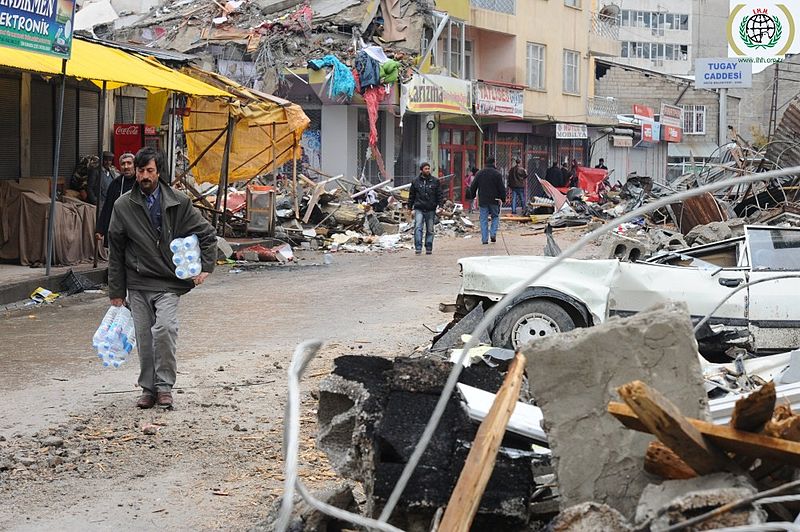 IHH Humanitarian Aid Fund, CC BY 2.0, via Wikimedia Commons
Other factors include problemswith infrastructure in the region, as well as adverse weather conditions that affect rescue operations. “One of the reasons for such a high number of victims is the poor quality of the buildings,” said Mustafa Erdik, a professor at the Kandilli Observatory at Bogazici University and the Earthquake Research Institute in Istanbul.
Are such earthquakes normal for this region?
According to AFAD, Turkey recorded almost 33,000 earthquakes in the region in 2020. The magnitude of 332 of them was 4.0 or higher
The region affected by the earthquakethroughout history it has encountered numerous strong earthquakes. In 1822, there was an earthquake of magnitude 7.0, which killed about 20,000 people. More recently, in 1999, the Izmit earthquake became one of the country's deadliest disasters, killing approximately 17,000 people.
Read more:
Two photos of the Earth with a difference of 50 years were compared at NASA: what scientists found
Scientists transplanted human “brain” into rats and told what happened in the end
ChatGPT interviewed at Google for $183,000 engineer
On the cover: 2012 earthquake, EU Civil Protection and Humanitarian Aid