In 1963, mathematician Roy Kerr found a solution to Einstein's equations that accurately described space-time
Recall that angular momentum is a physicala quantity that characterizes the amount of rotational motion and depends on how much mass rotates, how it is distributed in space, and with what angular velocity the rotation itself occurs.
What are black holes?
There are four known types of black holes that helppresent solutions to Einstein's equations that describe the force of gravity in general relativity. Two of them rotate: the Kerr and Kerr-Newman black holes.
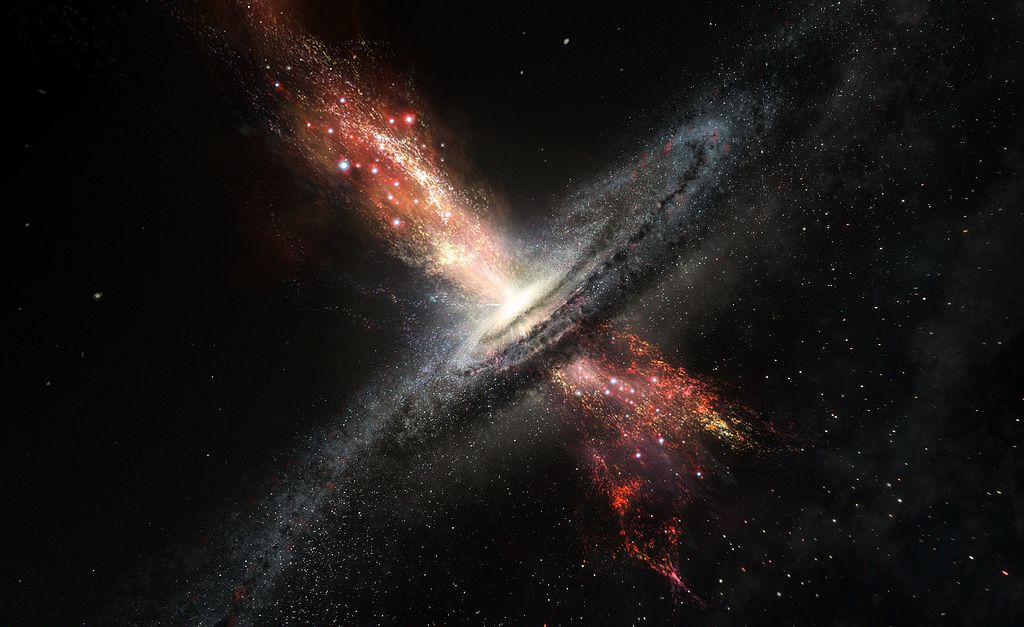 Photo: ESO/M. Kornmesser, CC BY 4.0, via Wikimedia Commons
Kerr black holes are named after the famousmathematician Roy Kerr. It was he who found solutions to the equations that described the behavior of a rotating black hole. Subsequently, they were supplemented by Ezra Newman. He accurately described the geometry of space-time, in which there was a massive object, which is characterized by rotational motion. It is the latter factor that distinguishes Kerr-Newman black holes from Schwarzschild holes, which are usually static. In addition, Kerr-Newman black holes have an ergosphere. Recall that this is a region of space-time near a rotating black hole, which is located between the event horizon and the static limit. Objects within the ergosphere inevitably rotate with the black hole due to the Lense-Thirring effect.
What is the problem?
If a black hole is stable, it will eventuallywill return to Kerr's mathematical description even after being hit hard by gravitational waves. If these space giants were unstable, Einstein's theory of gravity would have to be changed at a fundamental level, and the scientific community would have to revise all knowledge about space giants. Everything suggested that Kerr's stability was justified, but it could not be proved.
What did the scientists find out?
To solve the problem, scientists looked at the questionabout whether gravitational waves falling into a black hole can change or completely destroy it. For example, imagine a wine glass, writes Quanta Magazine. It will begin to vibrate and even break if enough sound waves are directed at it, exactly matching the resonant frequency of the capacitance. As a result, physicists wondered whether a similar resonance-type phenomenon could occur when gravitational waves hit a black hole.
 Photo: NASA Goddard Space Flight Center
During the study, the scientists presented thatwould happen if a gravitational wave crossed the event horizon of a Kerr black hole and ended up "inside" it. Calculations showed that this could change its mass and spin, but it would still be an object described by the Kerr equations.
Thus, the researchers showed that slowlyrotating black holes do not "collapse" under small gravitational wave influences. Theorists hope to generalize their results to arbitrary angular momentum in the next few years.
What's the bottom line?
So far, stability has been proven only forslowly rotating black holes, where the ratio of the black hole's angular momentum to its mass was much less than 1. As for rapidly rotating objects, scientists were not so sure. In addition, physicists did not know how small the ratio of angular momentum to mass must be in order to provide the same stability.
Considering there's only one step in their longproof is based on the assumption of small angular momentum, Sergiu Kleinerman of Princeton University, co-author of the study, noted that "it would not be at all surprising if, by the end of the decade, a complete resolution of the Kerr hypothesis of stability appears."
Read more:
Scientists have found a black hole that is 50 times larger than galaxies
Physicists have shown that water turns into two liquids at low temperatures
Russia has invented an alloy that can withstand the energy of a thermonuclear reactor
Cover photo: ESO/L. Calçada, CC BY 4.0, Wikimedia Commons