A group of researchers has developed a technology for modifying laser waveguides that increases the time
Quantum memory is the most important device inquantum networks. To build such networks over existing fiber optic infrastructure, such devices must operate at telecommunications wavelengths. But due to fixed read times, previous quantum memory systems at telecommunications wavelengths could not implement on-demand storage, the scientists explain.
To implement storage and retrievalrequest, the engineers glued and integrated conventional single-mode fibers at both ends of the waveguide. They used electron evaporation technology to make embedded electrodes on both sides of the waveguide. To further increase storage efficiency, they polarized the electron spin of the erbium ion and initialized the state of its nuclear spin.
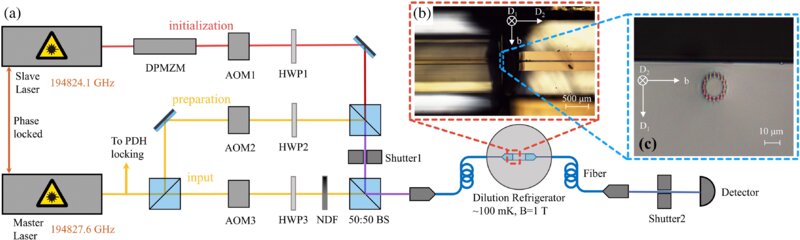 Scheme of the experimental setup. (a) Optical path in front of the cryostat, (b) micrograph of the storage device.
On the left is a single-channel fiber array, on the right is an erbium crystal, (c) cross-section of a laser waveguide. Image: Duan-Cheng Liu et al., Physical Review Letters
The modification carried out led to a fivefoldan increase in photon storage efficiency compared to previously published results, the scientists report in their article. In addition, the reliability of on-demand quantum storage has reached 98.3%, which greatly reduced the loss of long-distance optical fiber transmission.
The researchers note that the created deviceis highly reliable and easy to scale. In addition, it can be directly integrated into fiber optic networks, which means that the creation of quantum networks does not require huge investments in infrastructure.
Read more:
Does science exist in extreme conditions? We answer in numbers
The Yellowstone supervolcano turned out to be many times more dangerous than scientists thought
The egg was dropped from space: look what happened to it