Engineers from the University of Massachusetts at Amherst have invented a fabric with high heat-insulating properties.
Polar bears live in some of the harshestconditions on Earth, regardless of arctic temperatures. Scientists know that part of the secret of bears is their white fur. It seems that the black coating should absorb heat better, but studies have shown that polar bear fur is extremely efficient in transmitting solar radiation to the skin of bears.
The second part of the "puzzle" is the black skin of animals.Polar bear fur is essentially a natural fiber optic cable that conducts sunlight to the skin, which absorbs the light, heating the bear. But fur is also exceptionally good at preventing heated skin from radiating that heat. When the sun shines, it's like a thick blanket that warms itself and then keeps that warmth close to the skin.
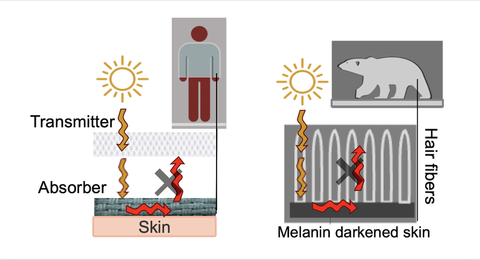 An illustration of the working principle of polar bear fur and artificial fabric. Image: UMass Amherst
Engineers have developed a two-layer fabric,mimicking these properties. The top layer consists of filaments that conduct visible light to the bottom layer, made of nylon and covered with a dark PEDOT material. It effectively converts light into heat and keeps it close to the surface.
While retaining their familiar textile properties, these layersprevent the dissipation of body heat and maximize the absorption of visible light. With a moderate light of 130 W/m², the fabric achieves a heating effect of +10 °C compared to a conventional cotton structure. The researchers note that they are already working with manufacturing companies to bring the new material to market.
Read more:
Special diet triggers self-destruction of brain cancer cells in mice
Scientists have deciphered the mysterious manuscript of Ptolemy. It was hidden under other text
New image of Hubble puzzled scientists