Researchers have developed a slippery surface that responds to moisture. For demonstration scientists
Carnivorous plants can catch and digestsmall insects through complex mechanisms attributed to the unique wettability of the surface. This feature has inspired the development of many devices: anti-icing surfaces, anti-fouling, and devices for condensation and manipulation of droplets.
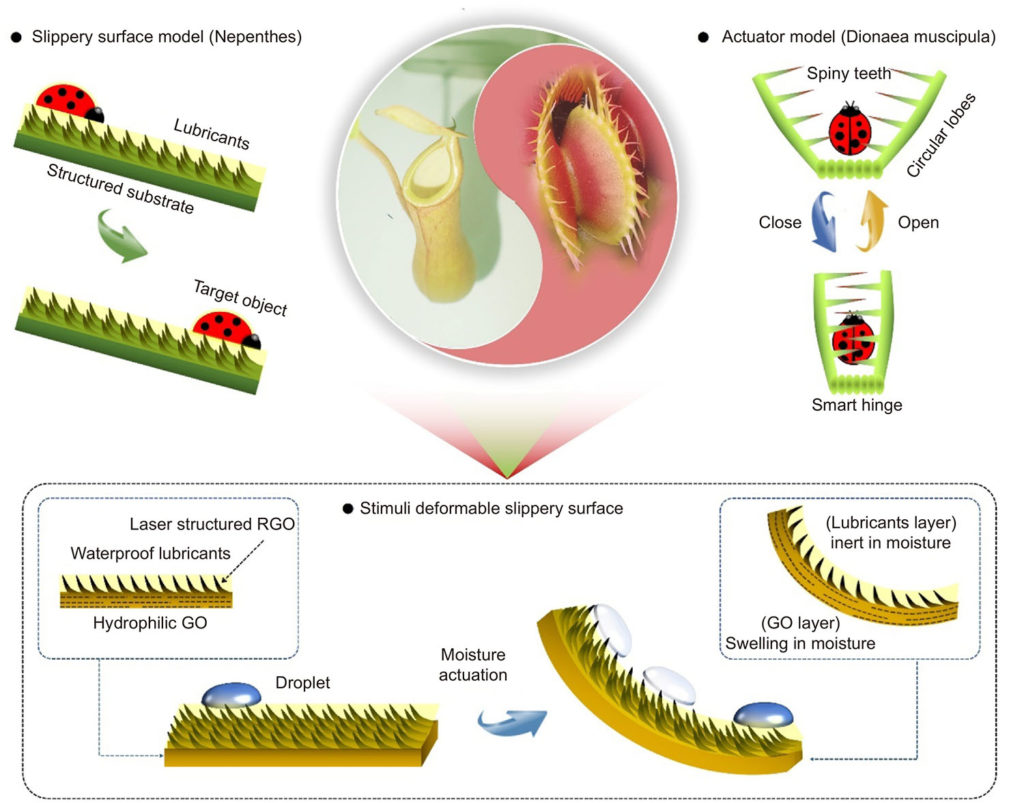 Active and passive strategies in wildlife and their implementation in a mechanical drive. Image: Han et al., Opto-Electronic Advances
In the new work, scientists combined two strategies of carnivorous plants at once: active and passive. The first of these provides a response to stimuli, and the second provides a slippery surface that captures prey.
The scientists used direct photorecovery withusing a femtosecond laser and simultaneous structuring to create a bilayer GO and LRGO actuator that enables dynamic deformation under moisture. The lubricated slippery surface was then integrated with the graphene actuator using a special lubricant and capillary forces.
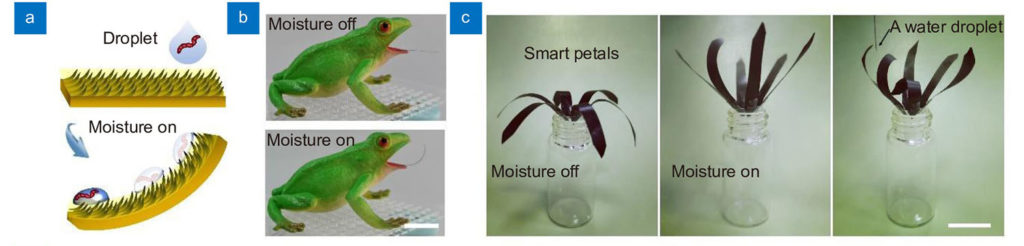 Active and passive surface operation (a),droplet trapping with a flexible frog tongue (b) and an artificial droplet trapping plant (c). Image: Han et al., Opto-Electronic Advances
The study of prototypes showed thatthe sensing surface can interact with moisture droplets and living organisms in them in two ways, allowing them to passively glide or actively engage with a drive. The developers believe that the new technology can be applied to collect and determine the amount of precipitation, in bionic robotics and smart tissues.
Read more:
The space plane will deliver cargo to the ISS and land at a regular "airport"
The star approached the black hole and it was torn apart: scientists observed this from three telescopes
Scientists have found traces of genetic mutations in the blood of every person who has been in space