A team of engineers led by Professor of Electrical Engineering and Applied Physics Marko Loncar
The researchers combined the laser witha 50 GHz electro-optic modulator made of lithium niobate to create a powerful transmitter up to 60 mW in waveguides. The lasers are placed in small depressions engraved on the surface of the modulator plate.
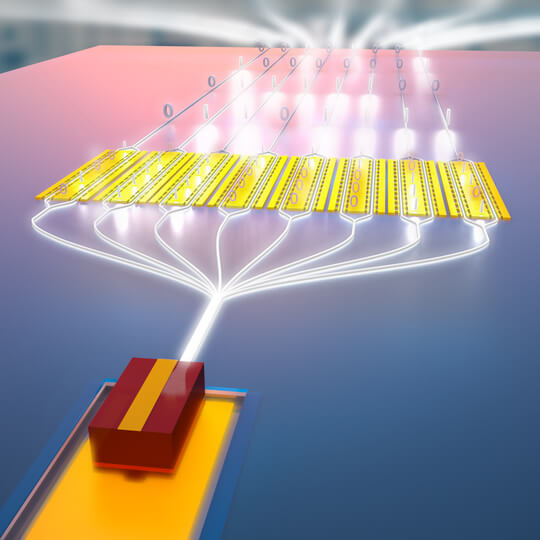 Built-in laser combined with a 50 GHz lithium niobate electro-optical modulator. Source: Second Bay Studios/Harvard SEAS
Long-distance telecommunication networks,data center optical connections and microwave photonic systems use lasers as the basis for data transmission. In most cases, as the researchers note, lasers are devices external to the modulators. Such a distributed system is more expensive and less stable than an integrated one. In addition, it is more difficult to scale.
Integrated thin film photonics onLithium niobate is a promising direction for the implementation of high-performance optical systems at the chip scale, the scientists note. It is already actively used in the work of many modulators, frequency combs and frequency converters. However, so far it has not been possible to create a laser on a chip.
“In this study, we applied all the techniques andnanofabrication techniques used in previous developments in lithium niobate integrated photonics to overcome these challenges and integrate a high-power laser into a lithium niobate thin-film platform,” says Prof. Lonchar.
Integration of thin-film devices and high-powerlasers, according to engineers, opens up the possibility of creating powerful, inexpensive and high-performance transmitters and optical networks. The technology enables the development of powerful telecommunications systems, fully integrated spectrometers and efficient frequency converters for quantum networks.
"Integration of High-Performance Laserswill significantly reduce the cost, complexity, and power consumption of future communication systems,” said Amirhassan Shams-Ansari, co-author of the study. “It’s a brick that can be integrated into larger multi-directional optical systems such as sensors, lidars, and telecommunications networks.”
Scientists will continue to work to increase the power of the laser and the possibilities for its application in other areas.
Read more:
There is another “planet” inside the Earth: how it saved nascent life
New study refutes light energy transfer theory
Scientists added silicon to a quantum computer: calculations became record-breakingly accurate