Researchers from the Harvard School of Engineering and Applied Science used a classic patternorigami
The Kroesling motif is a cylinder,assembled from triangles. On the surface of such an element, ribs and depressions alternate. The researchers first created simple monostable modules based on the Kroesling template.
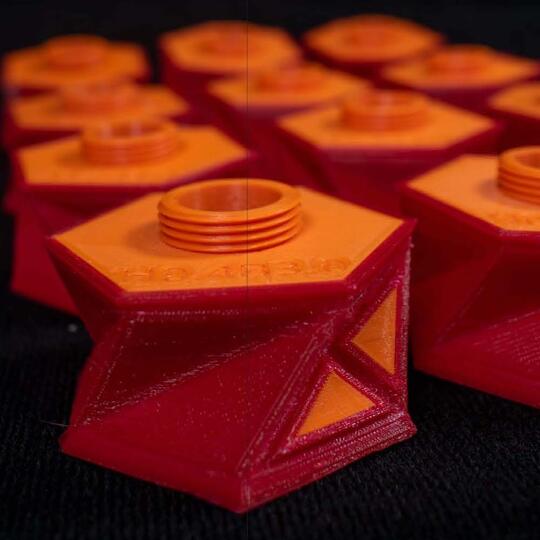 Additional node on the module (small yellow triangles). Photo: Bertoldi Lab, Harvard SEAS
To unlock bistability (stabilityin two different positions), they added a defect to the origami motif: an additional knot that creates a dome of four triangles. It can open or close under positive or negative pressure.
It works very simply.First, we inflate the structure at a certain pressure to push out certain cells, which will remain bulging even when the pressure is released. Then, in this new configuration, as we break the symmetry, we can simply use the vacuum to cause bending, contraction, or twisting.
Antonio Elia Forte, study co-author
Researchers note that by collecting variousmodules and adjusting their geometry so that they are fixed at different pressures, you can create complex shapes and deformation modes. As a result, using only a pressure source without wires and electronics, programmed movements can be controlled.
The developers built the drive with 12 differentmodules and showed that it can perform up to eight different complex movements. The team also developed an algorithm that can determine the optimal modulus combination for the desired deformation modes.
Read more:
The James Webb telescope took the first picture of Jupiter: it shows 9 moving targets at once
Physicists have found a universal "clock" in space: they are more accurate than atomic
A huge comet flew past the Earth, but became larger and headed towards the Sun