A team of researchers from the Columbia School of Engineering and Applied Sciences and the Columbia Medical Center
The authors of the work say that a serious problemwas to ensure communication between tissues while maintaining their individual phenotypes. The researchers created an individual environment for grown tissues and simulated vascular flows that carry circulating cells and biologically active factors. The engineers note that the recirculation of vascular flow allows organs to communicate in the same way they do in the human body.
“Because we are focused on usingof patient-derived tissue models, we need to individually grow each tissue to function in a way that mimics the responses you might see in a patient, and we don't want to sacrifice that advanced functionality when joining multiple tissues,” says Casey Ronaldson -Bouchard, co-author of the study.
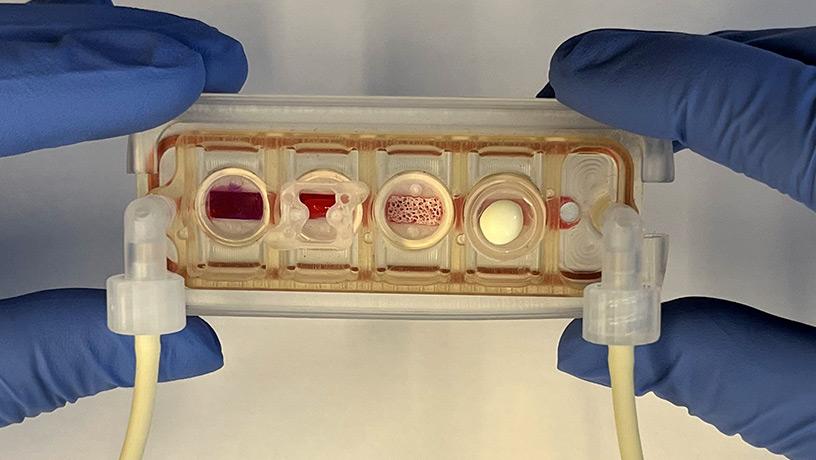 Photo: Kacey Ronaldson-Bouchard/Columbia Engineering
The developers have created tissue modules, each intheir optimized environment, and separated them from the general vascular flow by a selectively permeable endothelial barrier. Individual tissue media communicate through endothelial barriers and through the vascular circulation. The researchers also introduced monocytes, which give rise to macrophages, into the vascular circulation because of their important role in directing tissue responses to injury, disease, and therapeutic outcomes.
Engineers note that all fabrics were obtained fromthe same line of human induced pluripotent stem cells obtained from a small blood sample. This approach opens up opportunities for individualized studies for specific patients.
Scientists have demonstrated the operation of the model forcancer drug research. The scientists manipulated their model with doxorubicin, an anticancer drug. The measured effects replicated those reported in cancer treatment clinical trials using this drug.
For us, this is a huge achievement:we spent ten years, conducted hundreds of experiments, exploring countless great ideas and creating many prototypes, and now, finally, we have developed this platform that successfully reflects the biology of organ interaction in the human body.
Gordana Vunjak-Novakovic, Project Leader, Professor at Columbia University, Professor of Biomedical Engineering and Health Sciences at the Mikati Foundation
Read more
Look at the "silent" drone with a new generation of ion propulsion
Ancient trilobite males strapped females on during mating
Russia and the United States have Doomsday planes: how and where they will fly in the event of the end of the world