Engineers from the University of California at Berkeley (UC Berkeley), the universities of Montreal and Mila developed
Recent advances in roboticsmade it possible to create more reliable equipment and improved algorithms for controlling robots, the authors of the work note. As a result, mechanical devices have become more flexible and can potentially solve complex tasks, including, for example, playing football with people.
The solution proposed by the engineers combines twokey components: motion control and motion planning. The first of them tracks the trajectory of the toe that hits the ball, and the second one selects the optimal trajectory of the hook for throwing a nearby soccer ball (detected by an external camera) to a given place.
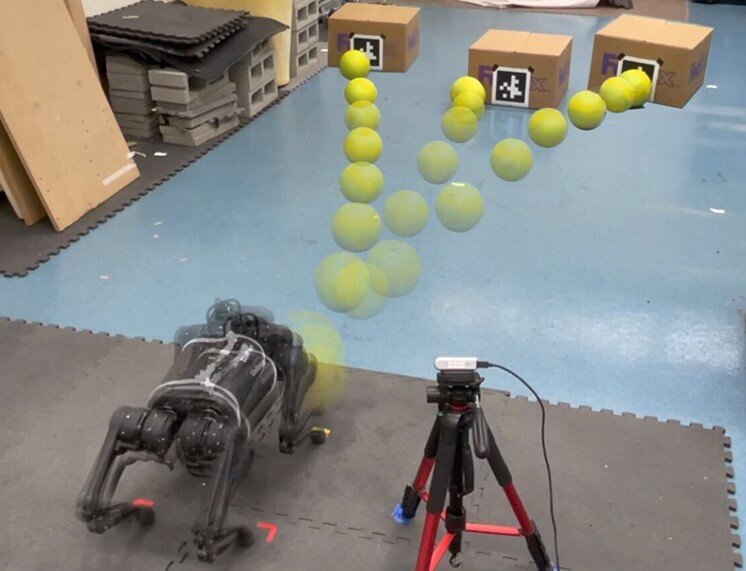 The system identifies a potential target. Image: Ji et al., ArXiv
The researchers note that the implemented approachallows you to divide a complex task into two components: control and planning. Thanks to this, you can first train the robot to perform the correct movements “in a vacuum”, having worked out the control technique, and then move on to real tests and further train the network during the game.
The scientists tested their model in a seriesreal test using the four-legged robot A1. They found that when using the new approach, the accuracy of movements is significantly improved. This is a very difficult task, as the robot must quickly swing its leg and gain momentum without losing balance, they add.
The soccer ball creates more problems becausethe robot must deal not only with difficult to model soft contact with a deformable ball, but also with the uncertainties of rolling friction between the ball and the ground.
Zhongyu Li, study co-author
The researchers note that this learning technique is suitable not only for playing football, but also for other tasks in which robots interact with soft objects.
Cover image: Ji et al., ArXiv
Read more:
Scientists have found a black hole that is 50 times larger than galaxies
Physicists have shown that water turns into two liquids at low temperatures
Russia has invented an alloy that can withstand the energy of a thermonuclear reactor