Engineers at the California Institute of Technology have developed materials consisting of many
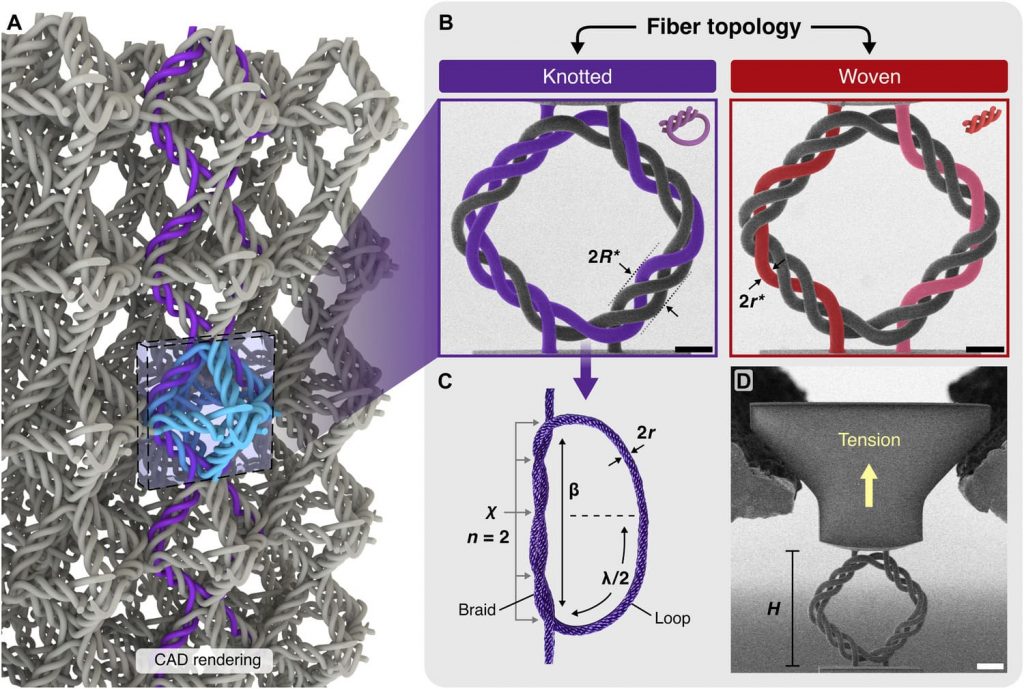 The structure of the material with a hierarchical lattice inthe shape of an octahedron, where each elementary cell consists of three rhombuses. The rhombus is formed by two knotty fibers, colored in different colors. Image: Widianto P. Moestopo et al., Science Advances
The structure of the polymer material isa network of nanofibers linked into knots. The radius of such a thread is only 1.7 microns (about 100 times thinner than a human hair), and the thickness of the knot is 70 microns. The knots were not tied, but were fabricated in a knotted state using advanced high-resolution 3D lithography capable of creating structures at the nanoscale.
Nodal materials created from polymers,have a tensile strength that is far superior to classical materials. A study of the samples showed that, compared to their classical counterparts, materials with knots absorb 92% more energy and require twice as much force to break under tension.
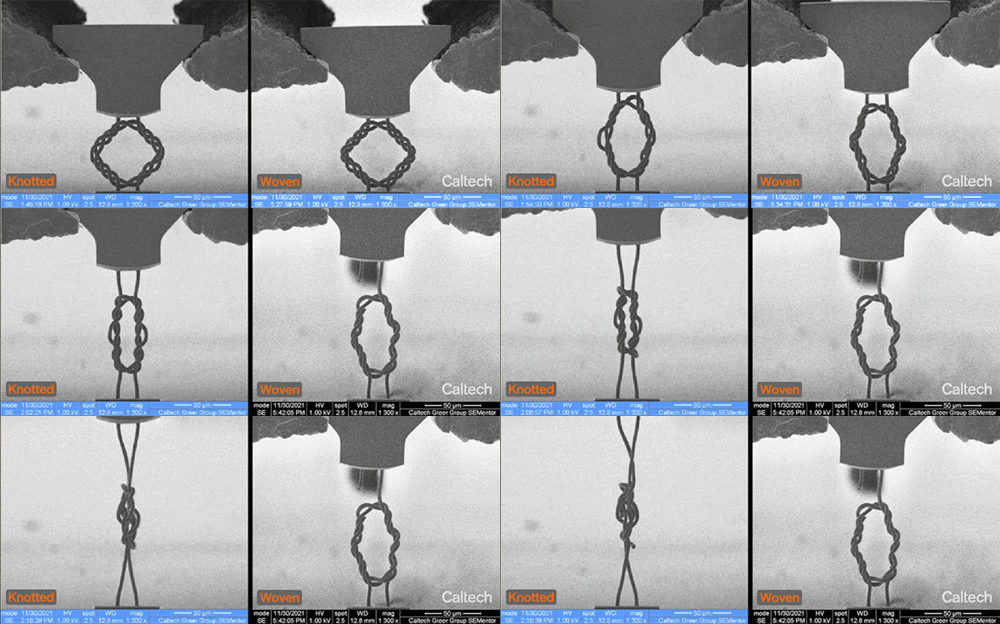 Tensile strength testing of knotted (left) and interlaced (right) threads. Image: Caltech
In their study, the engineers presentedtechnology for printing materials from several simple types of nodes. For example, an extra twist knot provides friction to absorb extra energy when the material is stretched. In the future, scientists plan to explore materials consisting of more complex knots.
The ability to overcome the compromise betweenmaterial deformability and tensile toughness offers new ways to design devices that are extremely flexible, durable and can operate under extreme conditions.
Vidianto P. Moestopo, study co-author
Read more:
A treasure with 1,000 coins was accidentally found on a farm: what could they buy
Named a vitamin that protects the brain from dementia
It turned out which men are the most fertile: their sperm is 50% better than the rest