Researchers from the Event Horizon Telescope (EHT) project presented the results of their observations of
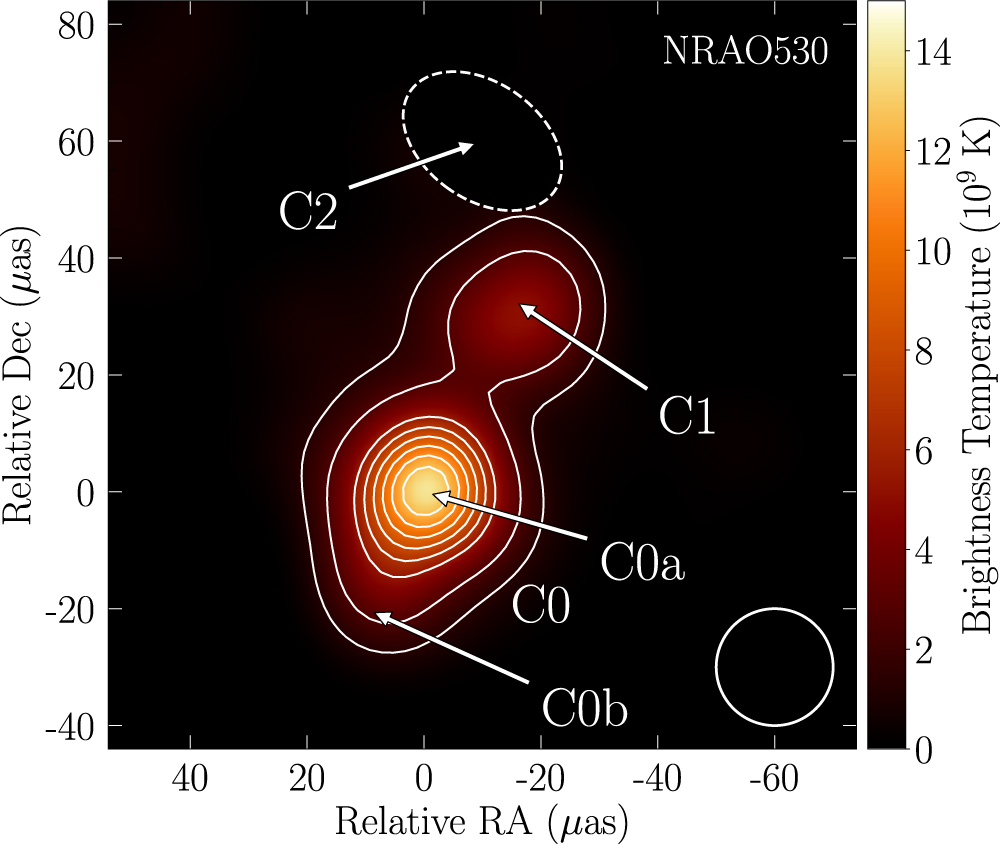 An image of quasar NRAO 530 taken by the Event Horizon Telescope team. Image: Jorstad et al., The Astrophysical Journal Letters
Quasars are some of the brightest objects in the world.Universe. It is believed that these are active galactic nuclei that are at the initial stage of development. At this moment, the supermassive black hole at the center of such an active nucleus absorbs surrounding matter, forming an accretion disk.
NRAO 530 is a rare type of quasar known asoptically active variable quasar (OVV quasar). This is a subtype of a blazar - an active galactic nucleus with a powerful relativistic jet or jet directed towards the observer. Images taken by the Event Horizon Telescope show a bright feature located at the south end of the jet.
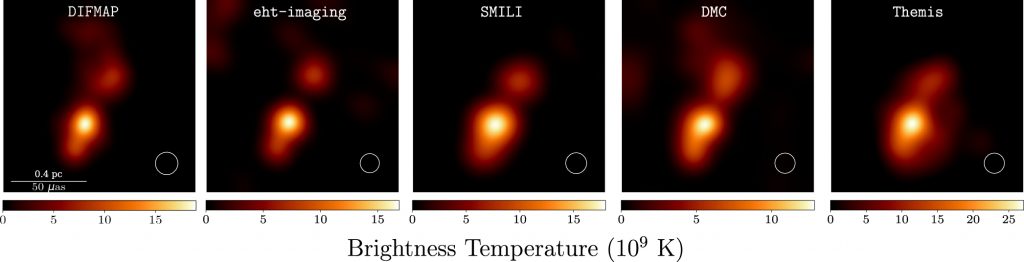 An image of the quasar NRAO 530 obtained using various imaging techniques. Image: Jorstad et al., The Astrophysical Journal Letters
The NRAO 530 core has a substructure consisting oftwo components, which is visible only in short-wavelength radiation. The quasar jet extends in projections on the plane of the sky for a distance that light travels in about 1.7 years. The researchers noted two features: orthogonal polarization is observed in parallel and perpendicular directions with respect to the jet. Scientists believe that this indicates a helical structure of the magnetic field in the jet.
The outermost feature has a particularly high degree of linear polarization, indicating a very well ordered magnetic field.
Svetlana Yorstad, Senior Fellow at Boston University and project leader for the NRAO 530 study
Astrophysicists believe that further observations of the quasar will help to understand how the characteristics of the innermost jets change over time and their relationship with the production of high-energy photons.
Event Horizon Telescope - Internationala collaboration that brings together radio telescopes around the world to observe supermassive black holes. Previously, the project researchers showed what such objects look like in the center of the M87 galaxy and the Milky Way, and also found a photon ring in the M87 galaxy.
Read more:
A powerful flare erupted on the Sun: it has already affected the Earth
Medieval fortress accidentally discovered in the forest: the find surprised scientists
Scientists have found a new genetic disease in children: how it manifests itself