On November 20, 1985, Windows 1.0 was released - the debut version of the famous Microsoft operating system. Discuss
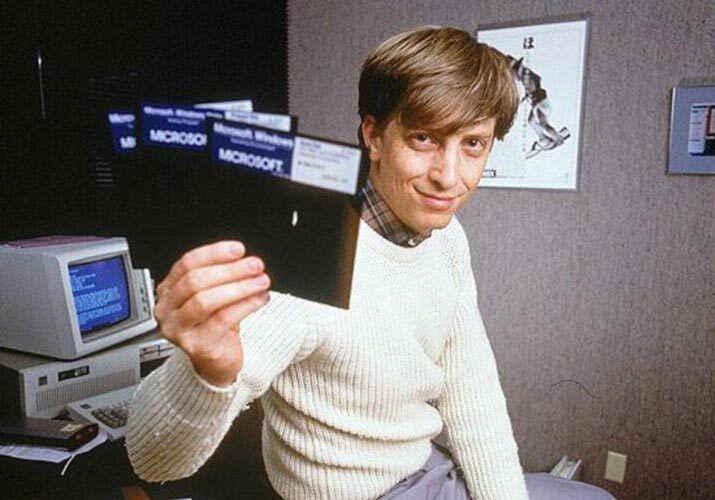
Being inherently a graphical add-on foralready released "operating system" MS-DOS, it was wildly gluttonous for its time (a graphics adapter, a mouse in the system requirements and installation from two floppy disks in the 1980s were a serious luxury!), but it was still able to declare itself as the main the intuitive rival of Apple computers.

Windows 1.0 logo
Initially, the name of the system sounded like Interface Manager, but Microsoft marketers caught on in time and were able to highlight the main distinguishing feature of their system - windows (English Windows).
Working with multiple windows instead of commandthe lines then left an impression of unprecedented luxury and even justified the high system requirements. Paint, Notepad, Calculator, Notepad and Write text editors, Control Panel, as well as the clipboard for text / files were formed already in the debut version of Windows. Dialog boxes, scroll bars, and drop-down menus from this system have become the unwritten standard of computer interfaces for years to come.
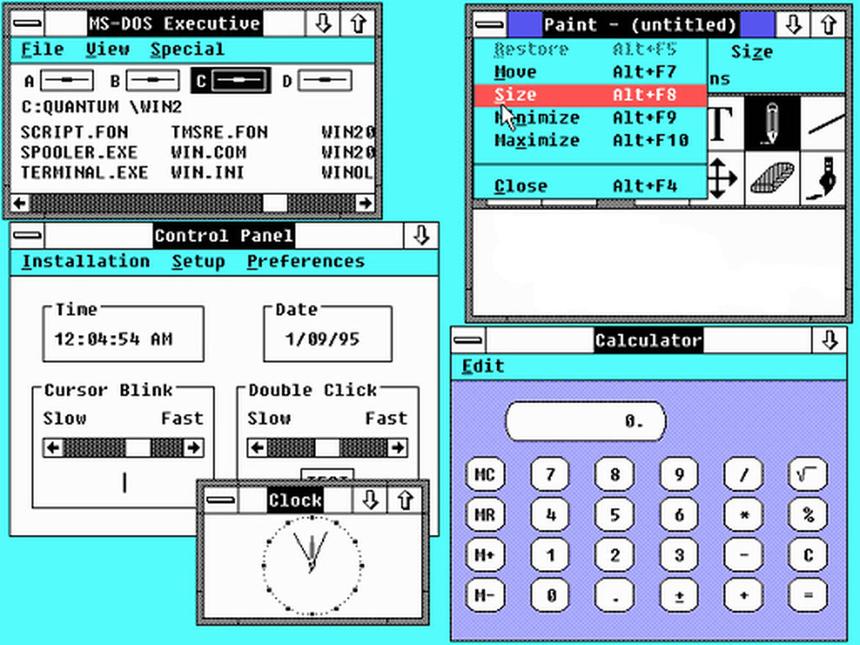
Windows 1.0 interface
A joke that has set my teeth on edge today thatonly the first service pack (a set of fixes / improvements) can be used in Redmond systems. already fixed versions 1.01 began to be delivered.
Despite hardware support issues andshortage of "software", the debut version of Windows sold very vigorously - from November 1985 to April 1987, over 500 thousand copies were sold. Support for Windows 1.0 lasted a staggering 16 years and ended on December 31, 2001.
And also on November 20…
…1914 The US State Department began requiring a photograph in the passport.Debate over which country was the pioneer inSuch demands have not subsided to this day, but given that the history of photography in the United States dates back almost a century, and since the 1980s, Americans have had access to Kodak film cameras, there was nothing surprising in such an early adoption of passport photography.
Passports began to circulate in the Russian Empirefrom 1721 (by decree of Peter I) - initially they were intended for peasants who were temporarily excommunicated from their estates. Instead of a photograph, they contained a verbal description of the owner, more like a composite sketch (special signs were indicated - moles, gait defects, scars, etc.), religion, marriage status. Such a passport was replaced annually and was not cheap.
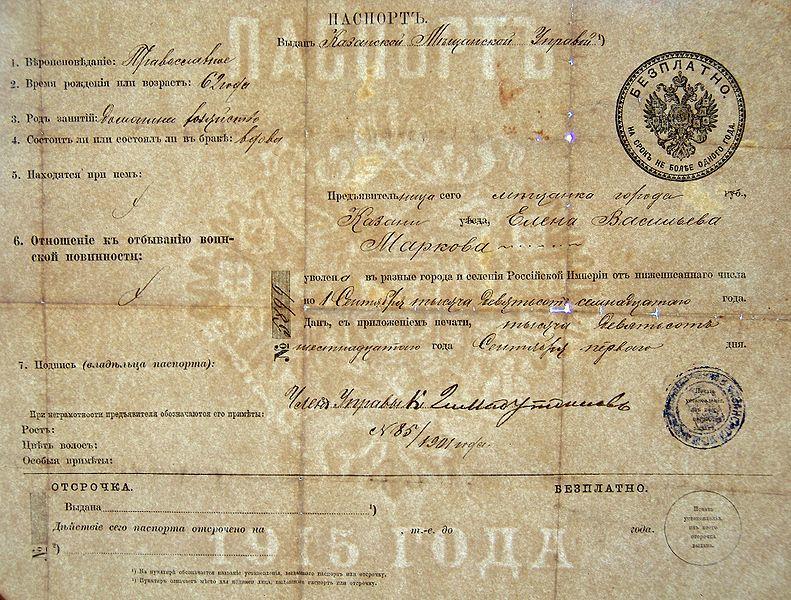
Internal passport in the Russian Empire (1910)
In general, this Russian tradition was sharply different.from the world - if abroad the passport was relied on to aristocrats and all kinds of nobility, then in domestic practice, disenfranchised serfs were supplied with passports. To travel within the country (and industrialization contributed to this), they were equipped with "travel certificates". If the traveling peasant did not have such, he was exiled to hard labor.
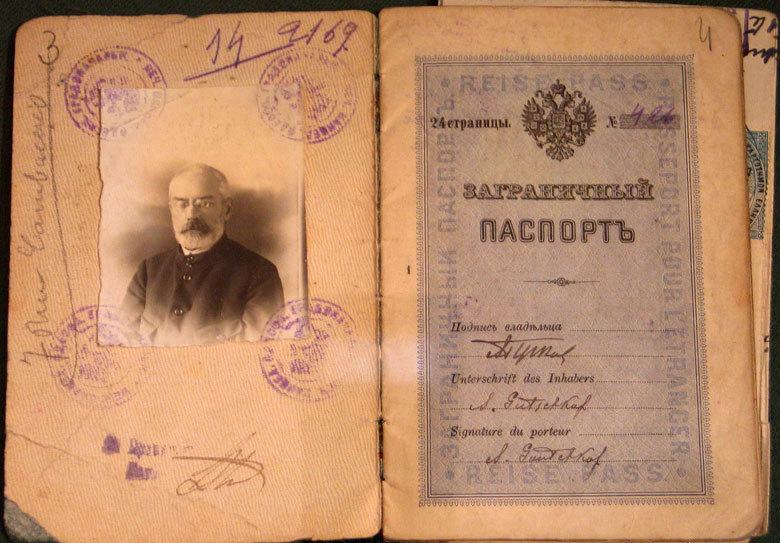
International passport in the Russian Empire
The criminals and "extremists" of those timesthere were no passports, but there were, let's say, more noticeable "documents": the criminals of that time were branded in a special way. They burned letters on their foreheads (they repeatedly rubbed the inscriptions with gunpowder) in accordance with the crime: the thieves had the letter "B" on their faces, the murderers had the letter "U" and so on.
At the same time, passports have already been used in fullprogress, and at the beginning of the 20th century in the Russian Empire, such documents with a photograph were received by Russian consuls abroad, as well as other official representatives of the authorities. Since 1917, the Bolsheviks introduced an analogue of a passport - work books, in which photography was also not required. It was only in 1933 that Soviet citizens began to receive modern passports.
On November 20, 1998, Russia launched the first module of the International Space Station, Zarya, into orbit.It is from the Russian functional cargobloc began the deployment of a grandiose near-orbital complex, for which Russia, the USA, Canada, Japan and the countries of the European Union joined their efforts.
The Zarya block became the base for the subsequentconstruction of the ISS. At first, this block regulated the power supply and temperature regime at the station, and today it serves as a fuel storage. Its development was funded by $ 150 million from the Russian side and $ 250 million from the United States.
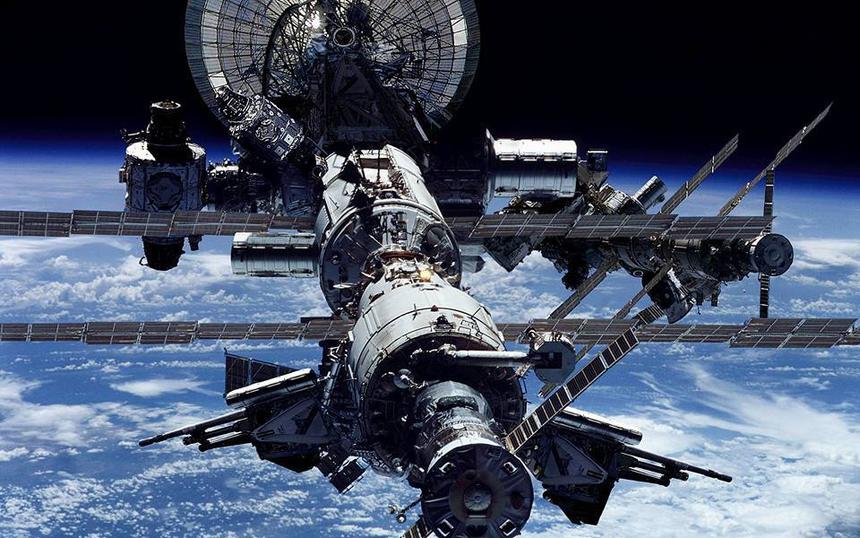
International space station
The original construction of the International Spacethe station was planned without the participation of Russia - the project was supposed to involve the European Space Agency, the USA, Canada and Japan. But the cost of the project turned out to be such that the project participants, as they say, "did not pull" the budget on their own, and the lack of experience in the construction of orbital complexes affected. At the same time, the Russian cosmonautics in the 1990s fell into decay due to economic problems, and a similar project of the Mir-2 space station was idle due to lack of funding. Under such conditions, the principle of “with the world on a string” turned out to be beneficial to everyone.
Over 17 years of operation, over two hundred cosmonauts have visited the ISS, and the station has a permanent staff of 6 people.