The configuration of space near black holes can be so complex that light rays are bent
He described the appearance of “twins” gravitationallylensed objects using modern mathematical apparatus. The student tried to understand the features of space around black holes, where such a strong curvature of the spatial fabric occurs that light rays deviate from their course.
As is known, in the region of the event horizon of the blackholes, the trajectory of photons can change so much that they fly around the supermassive object several times. As a result, if you observe a black hole against the background of some distant object, you can see several distorted versions of it.
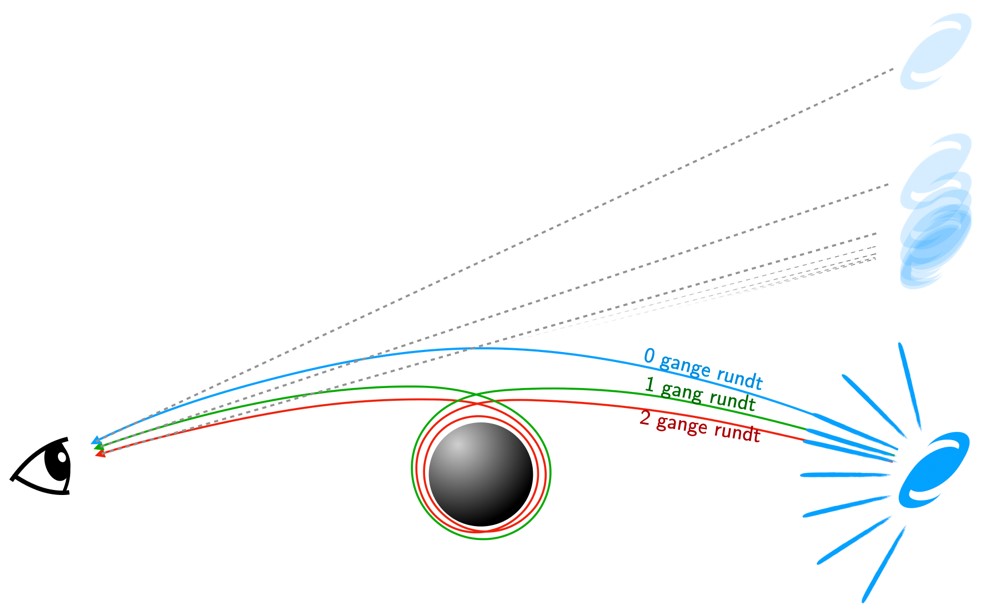 The light from the background galaxy wraps aroundblack hole more and more times the closer it goes to the hole, and therefore we see the same galaxy in several directions (courtesy of Peter Laursen).
Mathematical description of gravitationalLensing, introduced by Albert Sneppen, explains exactly how such “doubles” of lensed objects are created. He found out how the laws of gravity and the principles of the existence of black holes determine the features of the lensing effect. It is worth noting that the scientist, in addition, described lensing generated not by ordinary, but by rotating black holes.
Once upon a time endless images closeto a black hole could become a tool for studying not only the physics of black hole space-time, but also the objects behind them—repeating in infinite reflections.
Read more
Nebulae, comets and stellar nurseries: showing the best astrophotography of the year
Changes in the Earth's orbit contributed to the emergence of complex life on the planet
Data from spy satellites helped to find out the cause of melting glaciers in Asia