This study reveals a new evolutionary history of the giant cave bear, which went extinct around 25 years ago.
Cave bears that were larger than brown bearsbears and weighed up to a ton, were widespread in Eurasia in the Pleistocene. They coexisted with and interbred with brown bears, and modern brown bears still bear the traces of extinct cave bears.
Unlike the brown bear, cave bearswere vegetarians. Their name comes from the fact that they slept in caves in winter, and many died because they could not fatten enough.
The reason for their disappearance is unknown.It is believed that climate change may have been a factor, along with the arrival of modern humans from Africa, which coincided with its decline. The bones of a cave bear were found with human spearheads carved into them, and the ancients also painted images of cave bears on the walls of their caves.
The researchers also found that many importantevents in the evolution of bears could have been caused by global climate change about a million years ago, when the cold phases (ice ages) became longer and more intense, and the warm phases were much shorter.
Researchers analyzed a cave specimena bear that lived in the South Caucasus, on the territory of modern Georgia, approximately in the Middle Pleistocene. The oldest genome sequences previously came from an area where there is permafrost, and, accordingly, the DNA is much better preserved there.
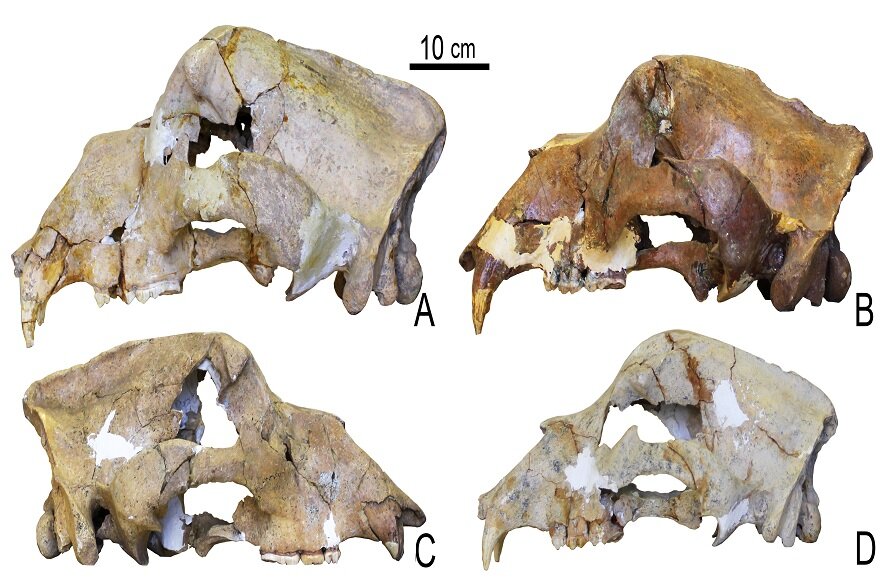
For this study, the scientists wanted to push the timeline for sequencing the Paleogenome much further into warmer and more temperate zones, where many more species lived.
The job was to extract ancient DNA froma tiny piece of stony bone (0.05 g) of the part of the skull where the parts of the inner ear are located, and which is known to be resistant to infection from external DNA sources.
Then the DNA was prepared for sequencing,the result was billions of individual short sequences that were a mixture of the cave bear genome and pollutants that the bone had captured over hundreds of thousands of years.
Computational analysis was used tosorting DNA from contamination, which was done by matching short sequences to the reference genome of a related organism, in this case a polar bear.
To learn more about the evolution of the cavebear, once the team obtained the genome data for the 360,000-year-old bear, they were able to compare it with other bears dating from 35,000 to 70,000 years ago to obtain a broad sample of all the major pedigrees of these animals.
Since the time difference between samplescave bear was so large, the team was able to calculate how many DNA mutations occurred during this period. And then we found out the rate of DNA mutation in the cave bear genome, as well as the time during which the different lines diverged.
Using the newly calculated mutation rate,the researchers found that cave bears and their living relatives, brown and polar bears, were different from their common ancestor. Cave bears interbred with brown bears, now, given the rate of mutation, they can date these events.
Scientists were first able to determine the frequency of mutationsin the cave bear genome. Using this information, they found that severe climatic changes could be a contributing factor to important evolutionary events in these giant bears.
DNA can be used to decipher the genetic codeextinct animals long after they've disappeared, but after thousands of years, the DNA present in ancient samples slowly disappears, creating a time frame for how far back in time you can usually go back. The study showed that this amazing molecule may exist even longer than previously thought, opening up new opportunities for genetic research on previously unimaginable time scales.
All because they analyzed the stonebone that was about seven times older than any previously studied and showed that genomic data could be extracted from temperate samples spanning over 300 millennia.
See also:
The first accurate map of the world was created. What's wrong with everyone else?
Scientists have recorded for the first time how planets form around low-mass stars
An anti-aging medicine that removes senescent cells has been discovered