Cybersport - chess of the XXI century
Computer games have become a sport where you can make money.
This activity is considered a sport becausepeople compare physical and intellectual capabilities within the framework of the game and try to achieve the result at the end of this activity. There is competition here, it is growing every year. Millions of people participate in esports - professionals, amateurs and even beginners.
But to be a professional esports player,training and regimen are necessary. This doesn't mean you have to play for hours on end - there are dozens of training methods. Moreover, this has already been proven: the Shanghai Tigers team trained almost 14-16 hours a day, but did not achieve success - there is no direct correlation between hours of play and success.
Cybersport is called chess of the XXI century, it develops analytical thinking, the ability to think several steps ahead, helps to quickly make the right decision in a short period of time.

Esports is a new social lift
The most successful eSports players earn huge amounts of money.A few examples of esports players whobegan their journey from childhood. The Rodjer player was one of those who won the Russian tournament for the first time. The whole team won a million rubles, and he received 200,000, after which his parents allowed him to continue doing this. Another American Success Story: Sumail, who plays Dota 2, was born in Pakistan in 1999. He is a very talented player: at the age of 15 he won one of the biggest tournaments and made a lot of money. He made a bet on esports and, due to this, gradually moved the whole family to the United States.
Such players unite into professionaleSports teams, among them a captain is chosen - usually the most experienced player. There must be a trainer, his function can be supplemented by the role of an analyst. Super-professional teams even have their own psychologists and nutritionists.
Esports is already analyzing eye movements and carbon content around the player
Data analysis in eSports is just beginning to emerge.The main problem of the coach is that he does not havetools for assessing the mental and physiological state of cyber athletes. But now there are services where you can perform exercises for throwing grenades or practice tactics. It is not yet developed to the same extent as in professional football, where everything is studied - from psychology to correct hitting technique and tactics. In this area, it is difficult to improve something or suggest something new. There are still many such niches in esports, and there is a lot to explore here.
There are several types of data that can beused for analysis in eSports. The first is game telemetry: data from the keyboard and mouse. The second group is physiology, eye tracking, electromyography and video camera.
The third point is the environment data, thattakes place around the player: temperature measurement, carbon dioxide content. The high CO₂ content in the room correlates precisely with the results, therefore it is a very important parameter.
Data is analyzed using AI and advanced analytics.The first tool that is being introduced now isthis is machine learning, AI, which works together with sensors on esports athletes. It helps to visualize and then analyze the physical performance of players. This is the speed at which keys and frequent combinations are pressed. In the future, you can calculate how these indicators affect the result. Another point is the control of the players when they are not playing; it is also important for them to professionally fulfill their obligations.
AI can predict wins, failures, injuries,it can be used to scout players - to check how well they know the materiel, whether they have "chemistry" with the rest of the team. Such technologies can form a full-fledged digital and psychological portrait of a person.
The data shows that the professional gambler's gaze is unique
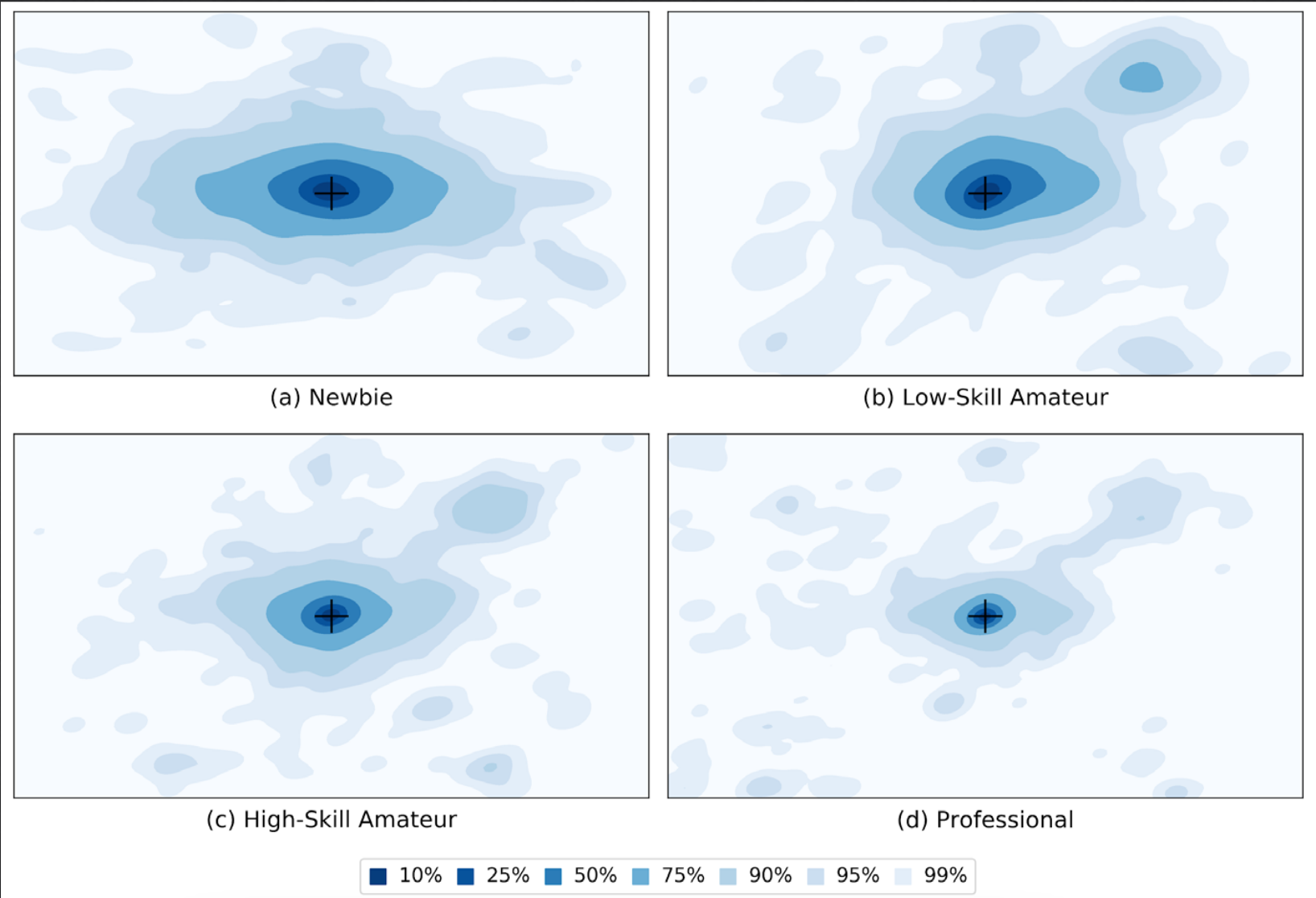
Eye movements betray the amateur athlete.With the help of eye trackers we can highlightcertain areas on the screen, build heat maps and, by the way the player looks at the screen, understand whether he is a professional or an amateur. In the picture below, in the lower right corner are professionals, they are focused on the center of the screen. And in the upper right corner the player spends more time looking at the radar.
We can also split the screen into nine parts andsee where professional athletes are looking. On the left is a heatmap for a professional player, and on the right for an amateur. We can see that amateur players spend 12% more time on the radar, and professionals - 65% of the time look in the center and are focused on their game.
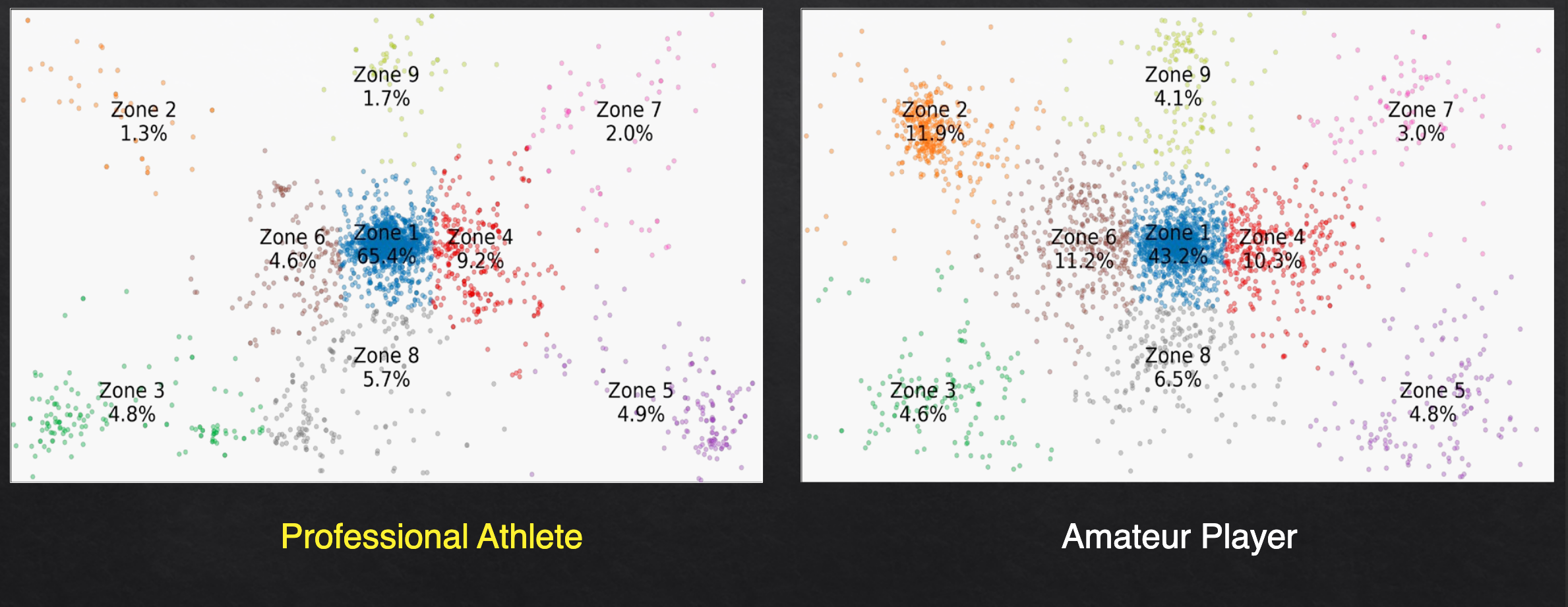
The difference in look is very goodthe hallmark of a professional athlete. This analytics helps the trainer understand what to do next and what aspects it makes sense to pay attention to during training.
Sensors can tell if a player is sick or lying.Next technology to analyzeprofessional attitude to business - this is a thermal imager. For example, definition by the tip of the nose. There are experimental studies that have shown that there is a “Pinocchio effect” - the nose becomes hot if a person lies. The coach can also determine that a player is sick. Usually a person’s left eye is a little warmer - it is closer to the heart, but at elevated temperatures this difference cannot be detected.

Technology can predict in advance the chemistry within a team
Deep learning will pre-define the relationship between players.Development is already underway at various universitieshyperscanning - its point is to analyze whether people are synchronized with each other. This is necessary in order to properly assemble the team and measure the “chemistry” between them.
AI can identify certain patterns -for example, come up with advantageous tactics, spot repetitive enemy positions, or player behavior patterns. This is important data for the coach, which then influences the interactions in the team. It is necessary not only to kill the enemy, but to competently exchange players and understand when it is worth doing it and when not.
With technology, you can work out standard situations - 3 in 3 or 3 in 5. Even if there are fewer of you left, with the right plan, the team will surely win.
Esports has already beaten streaming music, movies and traditional sports
The numbers confirm that esports is already overtaking television, film and music in revenue.Research suggests that growing upThis generation enjoys watching eSports streams rather than classic sports. It is predicted that by 2021, eSports will become the second-largest sport in the United States, ahead only of American football.
Moreover, there are few professional players among the huge number of cybersportsmen.There are only 5% of them, and amateur players without contracts - 95%. The International Dota 2 prize pool is 32 million in the 19th year. In the 17th year, this figure was 27 million. In two years, the delta increased by 5 million.
But the most promising areas in eSports are the areas of analytics and training.This is where a huge number of transactions are carried out, and the most advanced technologies are involved in the process - AI, eye movement sensors.

Startups that analyze esports player data
- SHADOW.GG is designed for professional teams - it is quite expensive, but very effective. This is a service that allows you to generate a plan for a specific game or training plans that you can work out endlessly.
- SCOPE.GG is a positional training game for correct grenade throwing and mine clearance. This is very important - when throwing, you need to stand correctly, calculate the trajectory, and it will not work immediately, but after 5 seconds, so you need to take into account many more factors. This service helps protect all viewed locations on the map and position yourself to win.
- 4dSIGHT.COM - They use deep learning to analyze surfaces to apply personalized banners in real time. This is hugely popular during streaming or competition.
Future technologies - analyzing video and data from dozens of sensors
The next step is advanced sensors, body data and a large amount of information.In the past few years, technology has continued todevelop and push esports forward. If yesterday we only played games, today we already know how to collect and analyze data, which means that tomorrow we will make cognitive e-sports, when we will automatically learn how to receive recommendations, dive into every little thing, fill every niche of data, learn to extract various data and benefit from it. ... It is precisely because of the development of the esports community in Russia and the world that new professions, universities, additional professional education courses or master's degrees, where there is already training in the esports direction, appear.
The next stage of development is the emergence of newscientific tasks. It is a large analysis of multimodal and heterogeneous data - video and sensor data. They will help not only improve the results of esports players, but also give impetus to mobile esports. This is a new direction that has already begun to develop in Korea, China and is poised to capture audiences in the rest of the world.
Read more:
Hawking was right, but sometimes wrong: the scientist's most daring ideas
Astronomers have figured out that the Earth and solar system are in a giant magnetic tunnel
Frozen mammoth and a man in the "asphalt": how nature stops time