The Eye of the Universe is an optical, infrared, 30-meter telescope (TMT). Participated in its creation
TMT Indian Partners are:Inter-University Center for Astronomy and Astrophysics (IUCAA), Pune, Indian Institute of Astrophysics (IIA), Bangalore, and Aryabhatta Research Institute for Observational Sciences (ARIES), Nainital.
One of the developers of the telescope 35-year-oldPrasanna Deshmukh said: “TMT will allow us to look from a distance of one light year (in our solar system) into the early Universe, or about 13.7 billion light years from us. Imagine the power and reach of TMT.”
At present, the two largest telescopes are bothspace ones are the Hubble Space Telescope (diameter 2.5 m, 1990, 535 km above the Earth) and the latest James Webb Space Telescope (diameter 6.5 m, 2021, about 1.5 million km).
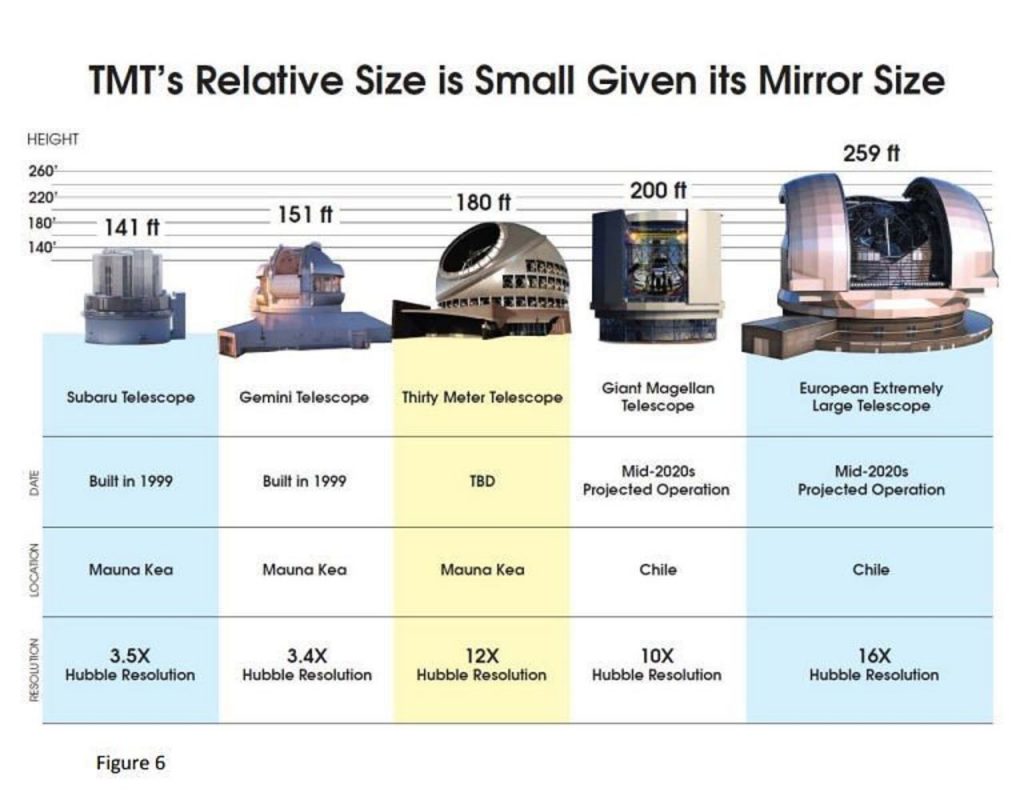 Comparison of the characteristics of the largest telescopes
With the help of TMT, scientists will have a more completevision of planets, stars, galaxies, exoplanets, nebulae, supernovae or pulsars, in unimaginably distant regions of a seemingly infinite universe, conduct spectroscopy of such heavy objects to study their atmosphere, find out if life exists there or can it flourish, explore the possibility of the future " cool address" for earthlings and test the current various hypotheses about the reality of aliens somewhere out there.
With current generation telescopes operating inoptical, ultraviolet or infrared ranges, it is impossible to see many things because of their limited size and resolution, but TMT will open hitherto unknown paths to understanding the secrets and mysterious phenomena of the vast Universe. whose true dimensions still elude man, Deshmukh said.
Explaining TMT, Deshmukh said that the main mirrorwill consist of 492 hexagonal mirrors supported by 1,476 more drives, 2,772 high-precision edge sensors, and 10,332 smaller drives that will align all mirrors, detect the smallest deviations, and correct them to produce clear images from staggering distances in the universe.
Read more:
Scientists from the permafrost zone: how they develop smart clothes and a cancer vaccine
Two planets have been found not far from Earth. Perhaps they are inhabited
Scientists have found out who benefited from the death of dinosaurs