Traditionally, research on the effect of false memories has focused on long-term memory:
For their experiment, scientists from the Netherlands,Great Britain and Canada selected hundreds of volunteers. Participants were shown sets of several letters, some of which were mirrored. After a short period of time (in different experiments it differed, but did not exceed 3 s), the subjects were asked to remember and name one selected letter, if it was mirrored, they also had to remember that.
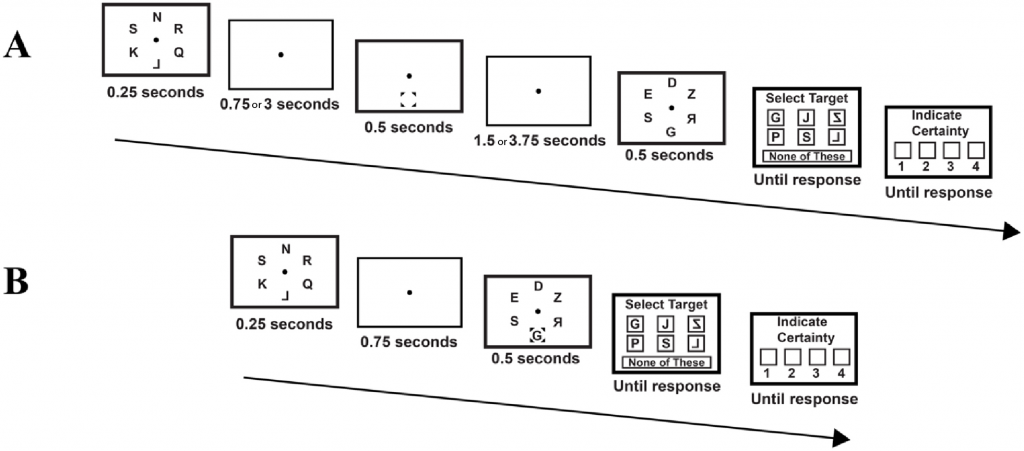 Scheme of experiments.Participants were shown several letters, some of which were mirrored. After a given time, they were asked to indicate which character was highlighted and to rate how confident they were in their answer. Image: Marte Otten et al., PLoS ONE
In general, participants performed well on the task:in about 90% of respondents correctly named the selected letter. But the error rate skyrocketed when the symbol was mirrored: up to 40% of participants claimed they saw the letter in its normal orientation, when in fact they were shown the reversed symbol.
Many of the respondents who misrememberedmirror letters showed a high degree of confidence in their answer. At the same time, the percentage of erroneous answers in such questions increased over time. When it was required to name the selected letter 0.3 s after the demonstration, less than 20% of respondents made mistakes with inverted characters, with an increase in the waiting time to 3 s, the percentage of errors increased.
The results of the study show that memoryalmost immediately begins to form under the influence of prejudice, scientists say. People expect to see regular writing, so mirror characters confuse them. When unexpected situations happen, the brain by default continues to focus on ideas about the “norm”. But this bias does not seem to manifest itself instantly.
Only when memory becomes less reliableafter a short period of time or when additional visual information is added, internal expectations regarding the world begin to play a role.
Marthe Otten, study co-author, in an interview with Gizmodo
Read more:
Scientists have figured out the nature of strange radio signals from a planet similar to Earth
A red halo flared up over Italy. Now its nature has been explained
Webb has found the oldest black hole in the universe