Engineers have developed a coating on windows that blocks the sun's ultraviolet and near
Already now up to 15% of global energy consumptiongoes to cooling buildings, say the authors of a paper published in the Journal of the American Chemical Society. Climate change is intensifying the summer heat, which means that energy consumption will only increase.
To avoid this, scientists have developedcomposite coating. It not only blocks unwanted radiation, preventing the room from heating up, but simultaneously radiates heat from the window surface at a wavelength that passes through the atmosphere into outer space. At the same time, the coating itself transmits visible light and does not interfere with the view.
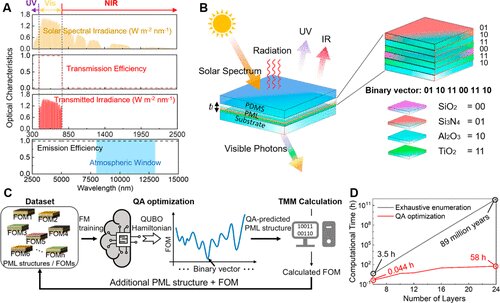 Characteristics (A) and structure (B) of the coating. And the use of machine learning and quantum computing (C) to optimize it (D). Image: Seongmin Kim et al., ACS Energy Letters
To create their coverage, scientists builtmodels of various materials, consisting of alternating thin layers of conventional materials such as silicon dioxide, silicon nitride, aluminum oxide or titanium dioxide, on a glass base, coated with a film of polydimethylsiloxane. They used machine learning and quantum computing to quickly find the optimal type, order, and combination of layers.
Researchers note that in hot and drycities, optimized coverage could potentially reduce cooling energy consumption by 31% compared to conventional windows. However, since the coating does not obstruct visibility, it can also be used in vehicles, reducing fossil fuel consumption.
Read more:
Archaeologists have officially confirmed the legends from the Bible
The grave of the "priestess" of Aphrodite was found: scientists showed what they found there
Scientists have seen what is on the territory of the Mayan capital. The find surprised them.