The study was conducted by several researchers from i4is, a non-profit organization dedicated to
Study 1I/Oumuamua in October 2017revolutionized astronomy and the study of celestial objects. Not only was it an object that formed in another star system, but its arrival and discovery suggested the presence of a large population of such objects. The discovery of 2I/Borisov in 2019 confirmed what many astronomers already suspected—that ISOs hit our Solar System quite regularly.
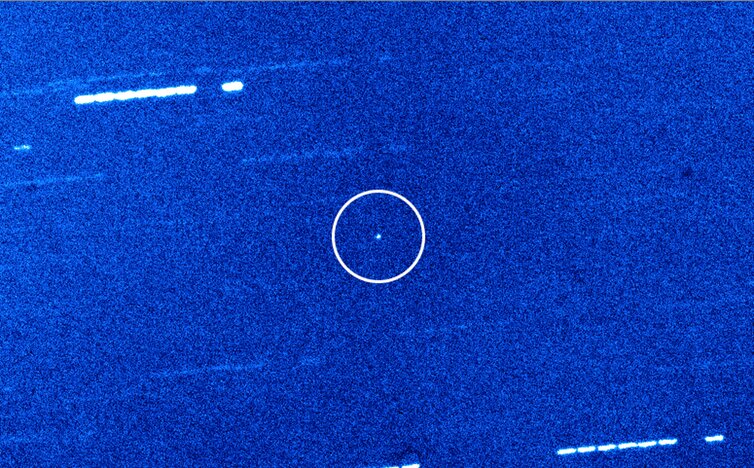 Oumuamua as he appeared with the William Herschel telescope on the night of October 29. Photo: Queen's University Belfast / William Herschel Telescope
Considering that the ISOs formed in another stellarsystem, being able to study them up close would give scientists an idea of the conditions that are present there. In fact, studying ISO is the next best way to send interstellar probes to neighboring star systems. Of course, any such mission poses many technical challenges, not to mention the need for advance warning.
For future missions to meet them,be sure to know as much as possible about how often ISOs arrive and how fast they travel. Scientists have tried to better limit these two variables. They took into account how the local rest standard (LSR) - the average movement of stars, gas and dust in the Milky Way in close proximity to the Sun - affects the speed of an interstellar object.
As a result, scientists discovered thatOn average, up to seven asteroid-like ISOs visit the solar system per year. Meanwhile, objects such as 2I/Borisov (comets) are rarer “guests” and will appear approximately once every 10–20 years. In addition, astronomers have found that many of these objects will move at a speed greater than 'Oumuamua. Let us recall that it moved at a speed of more than 26 km/s before and after receiving an impulse from the Sun.
Read more
Uranus has received the status of the strangest planet in the solar system. Why?
Humans can withstand very low temperatures even without heat sources
Physicists have created an analogue of a black hole and confirmed Hawking's theory. Where it leads?
ISO - interstellar objects - interstellar objects, these are objects or comets that exist in interstellar space, not connected by gravitational forces with any star.
2I/Borisov (preliminary designations: gb00234, C/2019 Q4 (Borisov)) is the first interstellar comet with a heliocentric orbital eccentricity ε > 3.
1I/Oumuamua (formerly C/2017 U1 (PANSTARRS) and A/2017U1 is the first interstellar object discovered to pass through the Solar System. It was discovered on October 19, 2017, based on data from the Pan-STARRS telescope. 'Oumuamua was initially considered a comet, but a week later it was reclassified as an asteroid. This is the first public object of the new classhyperbolic asteroids.