Engineers from Donghua University in China have developed a tactile sensor based on ionic hydrogel,
When the fingertips explore objects that are hardthe ridges act as mechanical micro-arms that transmit tactile vibration signals to receptors in the dermis, the scientists explain. These ridges deform only slightly when in contact with surfaces or objects, allowing them to maintain near-permanent contact. In their work, the researchers recreated complex structures in a soft artificial material.
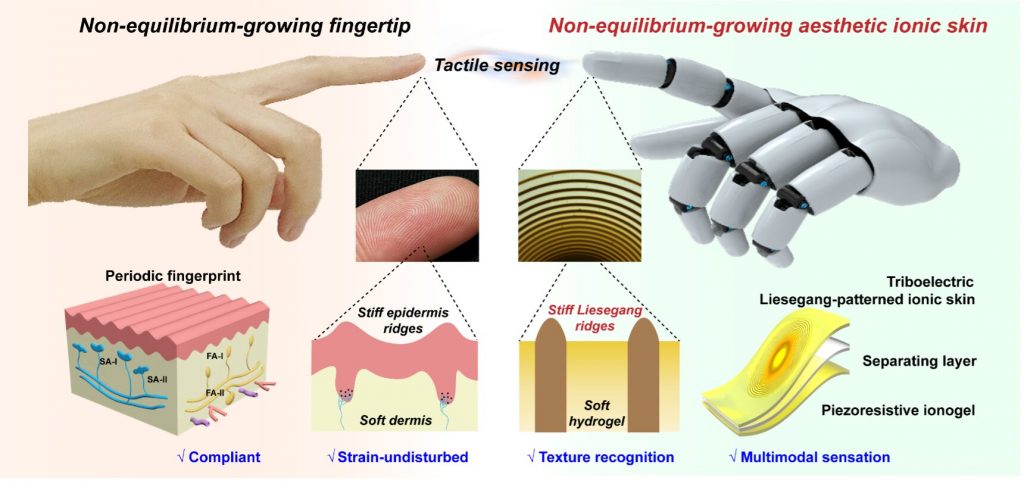 Illustration of the proposed technology for sensitive skin. Image: Haiyan Qiao, Donghua University
As an analogue of fingerprints, engineersLiesegang rings were used. These are concentric rings or rhythmically alternating bands resulting from the periodic precipitation of compounds during diffusion in gel media. With this technique, the scientists created rigid ridges embedded in a flexible hydrogel.
The resulting aesthetic ionic skinwith periodic Liesegang rings features rigid ridges embedded in a soft hydrogel matrix. This modular contrast hybrid structure endows the ionic skin with tactile sensory properties, triboelectric voltage sensitivity, intact pressure sensitivity, and fine texture.
Shentong Sun, research co-author in an interview with Tech Xplore
Preliminary tests confirmed the tactile capabilities of the new material. Engineers will continue to work on improving the technology for practical applications in robotics.
Read more:
Bears separated in childhood reunited: the zoo told how it all went
A photo appeared inside the second deepest underwater sinkhole in the world
Light in the early universe: a new theory changes the way it was