Landing and first photos from Mars
The largest and most advanced rover that NASA has sent to the
 First image of the Perseverance rover from Mars:This is the first image sent by NASA's Perseverance rover since landing on Mars on February 18, 2021. The view from one of the Perseverance surveillance cameras is partially obscured by a dust cover. Credit: NASA / JPL-Caltech.
"This landing is one of those turning points for NASA, the U.S., and space exploration around the world — when we know we're on the cusp of discovery, and we sharpen our pencils, so to speak, to rewrite textbooks," he explainsNASA Acting Administrator, Steve Jurczyk.— The Mars 2020 Perseverance mission embodiesThe spirit of our country is perseverance even in the most difficult situations, inspiring and developing science and research.The mission itself embodies the human ideal of perseverance in the future and will help us prepare for human exploration of the Red Planet."
Mars Entry, Descent and Landing Sensor SetInstrumentation 2 (MEDLI2) collected data on the Martian atmosphere during reentry, and the Terrain-Relative Navigation system autonomously controlled the spacecraft during the last descent. Data from both is expected to help future missions land on other worlds safer and with more payloads.
The first "Martian selfie" and color photographs of the Red Planet
Less than a day after the roverHaving successfully landed on the surface of Mars, engineers and scientists from the Agency's Jet Propulsion Laboratory were awaiting the next data from Perseverance. Gradually, data came in from several spacecraft orbiting the Red Planet, and the mission team was relieved to see the rover's status reports, which showed that everything was working as expected.
Adding to the excitement was a high-resolution image taken during the rover's landing.While NASA's Mars Mars Curiosity rover sent back to Earth a time-lapse video of its descent, Perseverance's cameras recorded a video of its landing, and this still image was taken from a video that was taken at that timewas transmitted to Earth and processed.
 Still imageHigh ResolutionPerseverance landings:it's a high-resolution still image, part of a video captured by multiple cameras as NASA's Perseverance rover landed on Mars.This image was captured by a camera on the descent stageCredit: NASA / Jet Propulsion Laboratory-Caltech
Unlike rovers of the past, mostPerseverance cameras shoot color images. Upon landing, two security cameras (Hazcams) captured front and rear views of the rover, showing one of its wheels, as well as providing the first full color image of Mars.
 First full color view of Mars from Perseverance:This is the first high-resolution color image to be sent back by camerasHazard Cameras (Hazcams) on the underside of NASA's Perseverance rover after it landed on February 18, 2021.Photo: NASA./ JPL-Caltech.
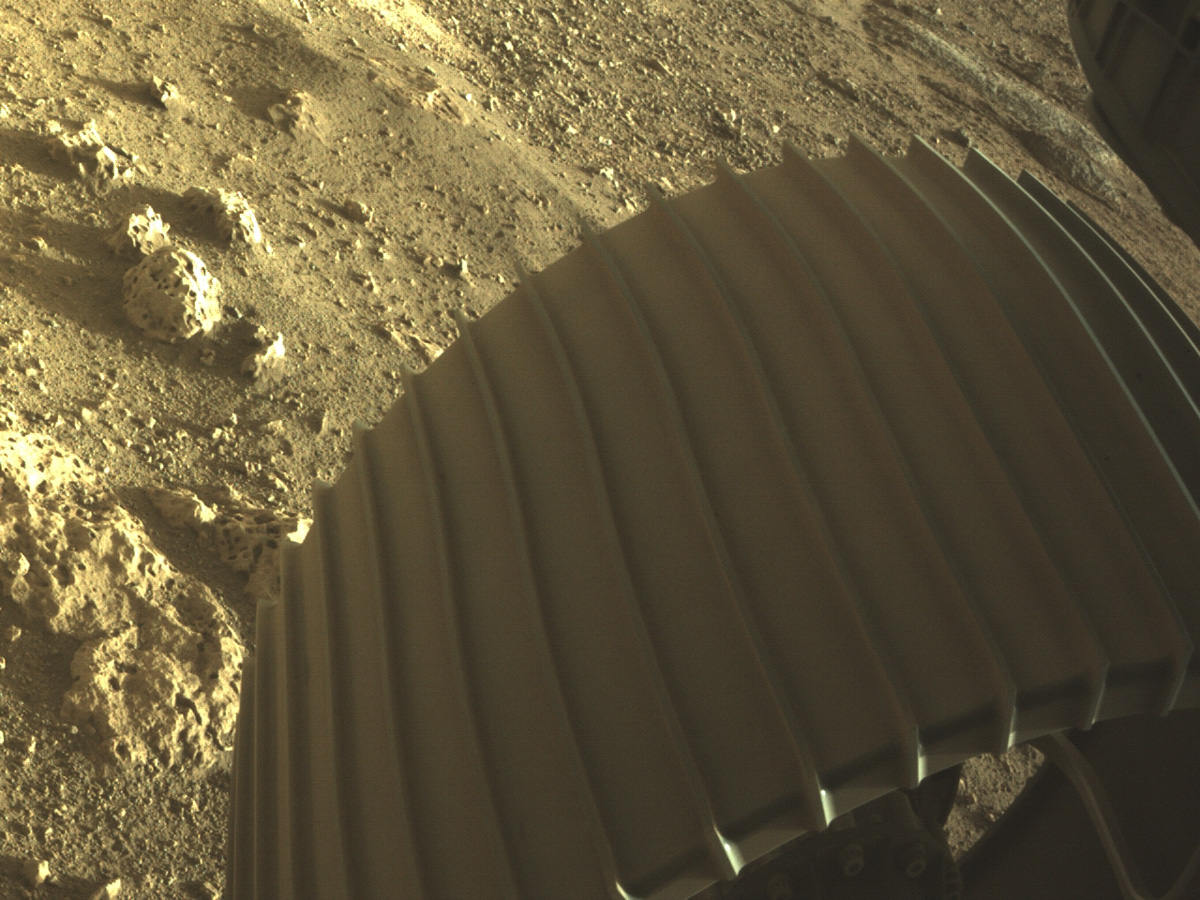 Big wheel Perseverance. OnThis high-resolution image shows one of the six wheels of the rover that landed on February 18, 2021.Photo: NASA/JPL-Caltech.
Perseverance was also filmed from the sky by an orbiter that used a special high-resolution camera called the High Resolution Camera Experiment (HiRISE).The Jet Propulsion Laboratory leads the orbiter's mission, and the HiRISE instrument leads the universityArizona.
 In this picture taken on February 18, 2021With the camera of the High Resolution Imaging Experiment (HiRISE) aboard the Martian Reconnaissance Orbiter, a descent stage with NASA's Perseverance rover can be seen as it plunges through the Martian atmosphere with a parachute trailing behind it. On the left, you can see the ancient river delta that is the target of the Perseverance mission entering Jezero Crater.
The first helicopter on Mars reported on the status
February 21 dispatchers at the Jet LaboratoryMovement (JPL) NASA in Southern California (JPL) received the first status report for the Ingenuity Mars helicopter. It landed on February 18, 2021 in Jezero Crater attached to the Perseverance rover.
Channel descending through the Martianthe reconnaissance orbiter showed that the helicopter and its base station (the electrical box on the rover that stores and directs the communication between the rotorcraft and Earth) are working properly. The helicopter itself will remain attached to the rover for another 30-60 days.
 Helicopter Ingenuity Mars on the surface of Mars.In this illustration, NASA's Ingenuity Mars helicopter stands on the surface of the Red Planet as NASA's Perseverance rover (partially visible left) rolls away.Credit: NASA/Jet Propulsion Laboratory-Caltech
There are two important points in the data:Ingenuity battery charge status and confirmation that the cradle is working properly. That is, all commands to turn on and off the heaters work as they should - the helicopter electronics must remain in standby mode. The dispatchers concluded that everything was working fine. In the near future, NASA will continue charging the helicopter batteries.
Ensuring that there is enough energy on board the Ingenuity to maintain heating and other vital functions, as well as maintaining optimal battery health, is essential to the success of the first helicopter on Mars.After a few days, the batteries will be charged to 35% and future charging sessions will bescheduled weekly as long as the helicopter is attached to the rover.
After Perseverance deploys Ingenuityon the surface, the helicopter will have 30 Martian days (31 Earth days) of experimental flight. If Ingenuity manages to take off and hover on its maiden flight, more than 90% of the project's goals will already be met.
First video of the Perseverance rover landing on Mars
On February 23, the US National Aeronautics and Space Administration (NASA) published a video of the landing on Mars of the latest Perseverance rover.
The video that the department presented underThe headline "Descent and Landing of the Perseverance rover on Mars", filmed by the rover during the minutes of landing on the planet on February 18. The probe began transmitting black-and-white images of Mars almost immediately after landing, but it took several days to receive the heavier video files from its NASA cameras.
"Mars, as it has never been seen," - saidNASA spokesman in connection with the publication of the video. The ministry noted that thanks to the data received, everyone can experience the "possibility of landing on Mars." The probe's camera filmed the entire process of landing on the planet - from the release of the parachute to its landing.
Images were taken by five commercialstandard cameras located on three different components of the spacecraft. Two cameras on the back of the hull, which captured the rover during its journey, photographed the inflating of the parachute. The camera provided a bottom view during the descent phase, including the top of the rover, while two cameras on the rover chassis provided both up and down views.
Perseverance's first voyage to Mars
The Perseverance rover drove across the surface of the Red Planet for the first time since landing.The trip lasted 33 minutes.During this time, the device, whose weight is more than a ton, covered a distance of about 6.5 meters.
 Flexing Perseverance robotic arm:This set of images shows how parts of a robotic arm on NASA's Perseverance rover bend and twist during the first check after landing on Mars.These images were taken by Perseverance's navigation cameras on March 3, 2021.Authors: NASA/JPL-Caltech.
NASA also tested the manipulator onwhich has cameras and various scientific instruments, in particular, the MEDA system developed by the Spanish National Institute of Aerospace Technology for determining the temperature, pressure, direction and speed of the wind.
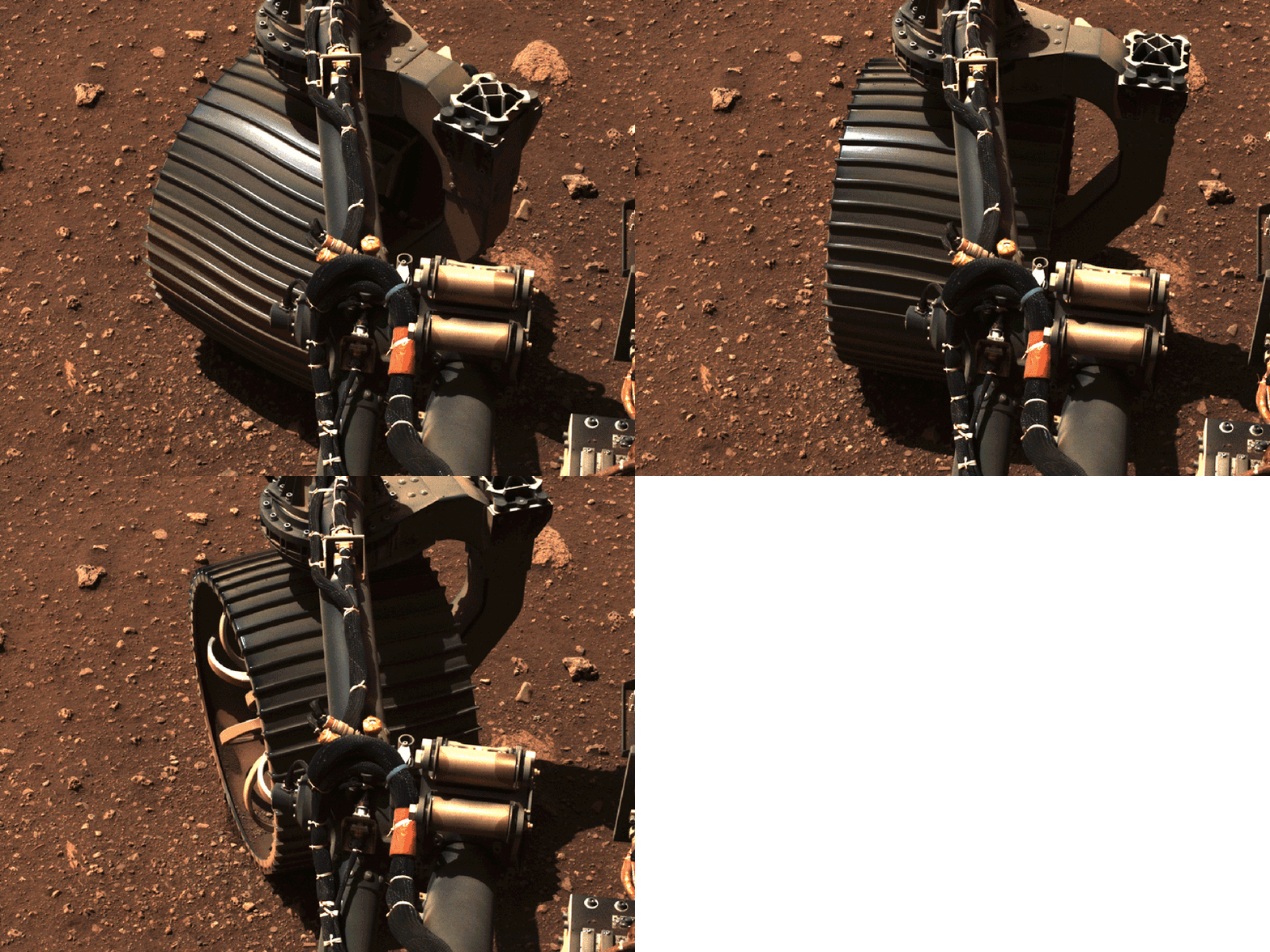 NASA's Perseverance rover turns one of its wheels on this set of images captured by the rover's left navigation camera on March 4, 2021. Credits: NASA / JPL-Caltech
Deputy Project Manager Robert Hogg stated:“On the twelfth Martian day, we launched MEDA wind sensors. In the upper right corner you see an image that was taken during their testing on Earth. In the lower right corner is a picture from Mars: all sensors have been successfully activated. We are very happy about this.”
 Deployed Perseverance Weather Sensors:this set of images shows partdeployment of Mars Environmental Dynamics Analyzer (MEDA) wind sensors on the Perseverance Mars rover captured by the rover's navigation cameras on February 28, 2021. Credits: NASA/JPL-Caltech
The machine is expected to start movinglong distances after testing the first extraterrestrial helicopter attached to it. Experts are considering two possible options for the path of the rover to the delta, where it must take soil samples.
The first sounds on Mars
In addition to the fact that NASA published a video ofAs the new rover landed on the Red Planet, the mission team revealed some of the 30 gigabytes of data received from Perseverance. In particular, the microphone on the rover provided the first audio recording of sounds from Mars.
NASA posted on Twitter a recording of the unique sounds that the Perseverance rover recorded after landing on Mars.
«Now that you have seen Mars, listen to it. Grab your headphones and listen to the first sounds recorded by one of my microphones,” writes NASA on behalf of the rover.
We advise you to wear headphones to hear these unusual sounds.
Later, the «playlist» Perseverance was replenished with several more audio recordings from Mars.
- When the Perseverance rover began to pavefootprints on the surface of Mars, a sensitive microphone in its structure recorded the sounds of the rover. He was able to catch the bumps, rumblings and noise from the six wheels of the robot as they rolled across the Martian terrain.
NASA Sounds of Perseverance Mars Rover Driving - Sol 16 (16 minutes)
- NASA engineers combined three segments fromraw audio file recorded as the Perseverance Mars rover passed through a section of Jezero Crater. The segments 0:20–0:45, 6:40–7:10 and 14:30–15:00 are combined into 90 second clip. Processing and editing was done to filter out some of the noise.
NASA Sounds of Perseverance Mars Rover Driving - Sol 16 (90-second highlights)
On March 10, the firstacoustic recording of laser images on Mars. This is the first acoustic recording of laser impacts on a rock target on Mars from March 2, 2021, using the Perseverance mission's SuperCam instrument. The sounds of 30 blows are heard, some slightly louder than others. Changes in the intensity of impact sounds will provide information about the physical structure of the target, such as its relative hardness or the presence of weatherproof coatings.
Hazard avoidance cameras - type of cameras, usuallyfront and rear rovers to ensure safety during maneuvers on the surface of a celestial body. Such cameras were installed on NASA's Mars rovers - Spirit and Opportunity, Curiosity, as well as on the Chinese lunar rover Yuytu.
NASA First Acoustic Recording of Laser Shots on Mars
The Perseverance rover captures the "dust devil" for the first time
Dust whirlwinds (they are called "dust devils")occur on the Red Planet quite often. A similar tornado was photographed by the Viking apparatus back in the 1970s. But for Perseverance, this "dust devil" is the first.
 "Dust whirlwind" and part of the rover. Photo: NASA
NASA showed a shot taken by the rover, but notindicated the size and speed of the tornado. It is known that eddies on Mars can reach eight kilometers in height and leave behind traces tens to hundreds of kilometers wide.
Dust vortices form in much the same way as onEarth: due to the heated surface and the flow of hot and cold air above it. A horizontal gust of wind spins a vortex, and that, having gained sufficient speed, draws in dust and carries it over a long distance. The "dust devil" filmed by the rover moved from right to left.
And here is how such tornadoes look like from space:
What's the bottom line?
NASA's Perseverance rover spent on the surfaceMars is a busy first month. From Jezero Crater, where the Perseverance landed on February 18, he geology as best he could, taking pictures of the surroundings and analyzing the rocks nearby. A team of scientists have already determined that some of the rocks are chemically similar to volcanic rocks on Earth, and that wind and water have weathered some of them.
“So far so good,” said Kenneth Farley,a geochemist at the California Institute of Technology in Pasadena and a mission scientist. He and others described the progress of Perseverance on March 16 at a virtual meeting of the Moon and Planetary Exploration Conference.
As planned, the main scientificthe rover's experiments will have to wait a few more months while engineers continue to test its scientific instruments and prepare for the first helicopter flight in another world. Eventually, Perseverance will deploy an arsenal of tools, including a drill bit, a close-up camera, and several chemical sensors to look for signs of past life in Martian rocks.
Meanwhile, the group's scientists are planning howThe rover can travel from the landing site, recently named after the late science fiction writer Octavia Butler, to the 40-meter cliffs in the ancient river delta that prompted Jezero. primarily as a landing site. The delta, formed billions of years ago by a river flowing on Mars, would be the ideal landscape for ancient microbial life if such life existed. But the treacherous dune field that the rover cannot cross lies between Perseverance and the Delta. Researchers are debating whether to navigate the rover clockwise or counterclockwise across the dune field; the latter would make the journey shorter, but the former would allow Perseverance to pass more interesting rocks.
However, most likely, this will not happen beforeJune. First, Perseverance must drive to a suitable location to test its Ingenuity helicopter. This location is likely to be a rock-strewn area near the rover's current location. There, the rover will lower Ingenuity from its belly, drive a safe distance, and record a video as the helicopter takes off into the Martian skies. “We're looking forward to these historic early aviation films,” said Jim Bell, a planetary scientist at the University of Arizona at Tempe who leads one of the rover's film crews. The helicopter is being tested first because Ingenuity will fly with the rover as it moves, helping Perseverance navigate the landscape.
Read more
Hear NASA's Perseverance rover move across Mars
Physicists have created an analogue of a black hole and confirmed Hawking's theory. Where it leads?
Humans can withstand very low temperatures even without heat sources
Mars Environmental Dynamics Analyzer