On March 24, 1993, American astronomers Eugene and Caroline Shoemaker and Canadian David Levy first observed
A year after opening, in the second half of July1994, fragments of a comet entered the atmosphere of Jupiter. This was the first observed collision of two solar system bodies. Researchers recorded 20 distinct fragments with a diameter of up to 2 km, which collided with the planet at a speed of 60 km/s.
This observation was not only of scientific importance:she drew public attention to the danger of asteroids and comets colliding with the Earth. A few years after the collision, Hollywood released two films at once about space objects that threaten the Earth - Armageddon and Deep Impact. And since the late 90s, space and research agencies around the world began to work on a system for tracking dangerous near-Earth objects and avoiding collisions.
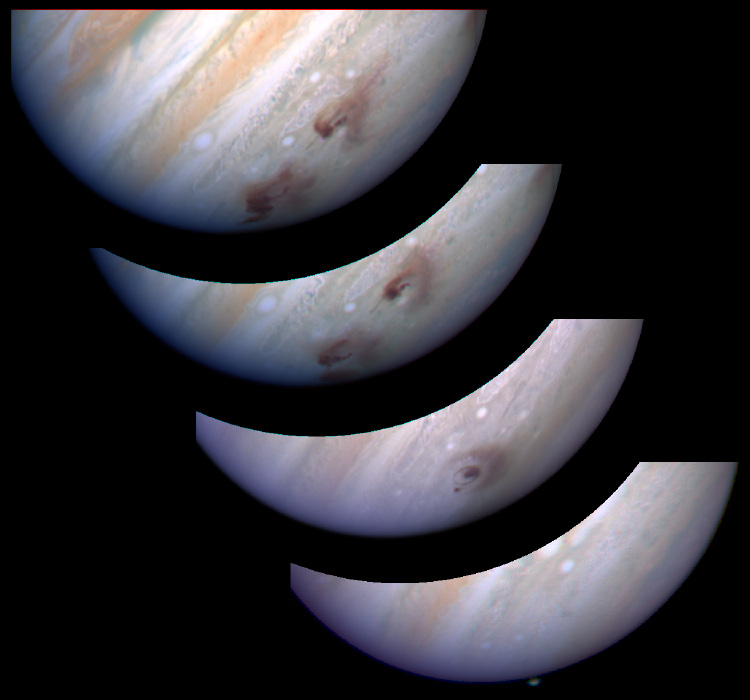 Change over time of the trace from one of the largest collisions. Image: R. Evans, J. Trauger, H. Hammel and the HST Comet Science Team
First comet orbiting Jupiter
The Shoemaker and Levy group of astronomers were among thethe first explorers of the solar system who purposefully searched for asteroids and comets potentially dangerous for the Earth. They used the Palomar Observatory's 0.46-meter telescope to survey the sky regularly, looking for new objects heading towards our planet.
In one of the photographs taken on March 24, 1993year, researchers discovered a bright object moving near Jupiter. Higher-resolution confirmatory photographs taken over the next few days by Jim Scotti using a telescope at Kitt Peak National Observatory showed that the comet had been fragmented into many separate fragments.
The astronomer reported at least five condensationsin the form of a very long narrow chain approximately 47 arcseconds long and about 11 arcseconds wide, with dust trails extending from both sides. This provided the first hint that Comet D/1993 F2 was unusual. In addition, the researchers noted that in the night sky images the comet was only 4° from Jupiter. This could mean either an overlap of objects, or that the comet was extremely close to the gas giant.
Orbital studies have confirmedthe initial hypothesis: unlike all comets known at that time, D / 1993 F2 was indeed captured by the gravitational forces of Jupiter and did not revolve around the Sun, but around this giant planet. The researchers calculated that the comet was captured by a gas giant back in the late 60s or early 70s, and in 1992 it broke into several pieces when it approached the planet at a distance of less than 120 thousand km.
 A series of images of comet Shoemaker-Levy 9. Image: NASA
Collision monitoring
An analysis of the orbit showed that Comet Shoemaker -Levi 9 will crash into Jupiter in July 1994. Astronomers had calculated in advance not only the date but also the location of the collision, so a variety of telescopes on Earth and in orbit and probes in space were ready to observe the event.
The clashes continued for several days:from 16 to 22 July 1994. All collisions took place on the far side of the planet, which was not visible to observers. But the fragments crashed into the gas giant close enough to the morning “terminator” (the dividing line separating the illuminated and dark sides of the planet), and therefore, due to rotation, after a few minutes, the impact marks were already visible from the Earth.
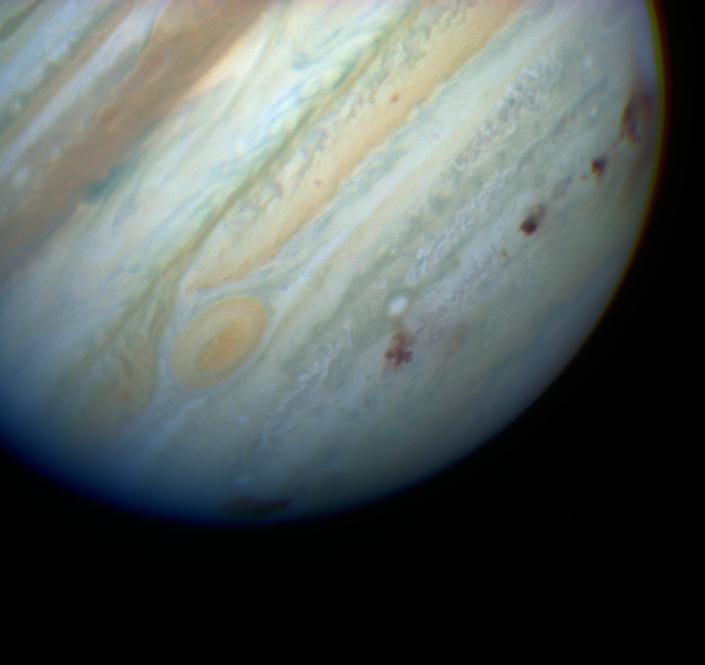 Multiple traces of collisions with fragments of a comet in the atmosphere of Jupiter. Image: Hubble Space Telescope Comet Team and NASA
The first collision took place on July 16, 1994,when fragment A of the comet's nucleus crashed into the southern hemisphere of Jupiter at a speed of about 60 km / s. Instruments on the Galileo, which was still moving towards Jupiter and was at a distance of about 1.6 AU from it, detected a fireball. Its peak temperature reached around 23,700 °C and then quickly cooled to 1,230 °C. For comparison, the normal temperature of Jupiter's upper atmosphere is -143°C. The plume from the fireball reached a height of over 3,000 km and was detected by the Hubble Space Telescope.
Over the next six days there were noless than 20 collisions. The largest of these occurred on July 18, when fragment G entered Jupiter's atmosphere. This collision created a giant dark spot more than 12,000 km in diameter (slightly smaller than the diameter of Earth) and was estimated to release energy of 6 million megatons of TNT. This is approximately 600 times larger than the entire world nuclear arsenal at that time.
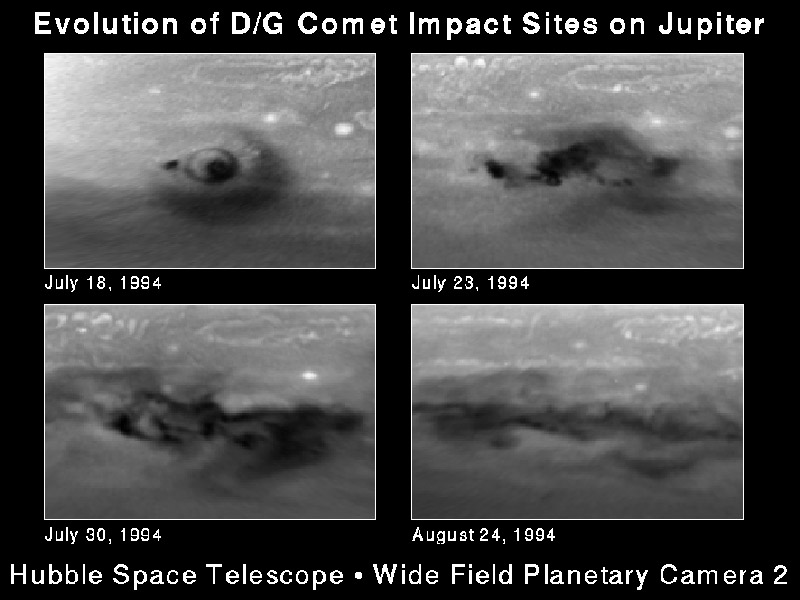 Change in traces from the collision of fragments D and G of the comet in the atmosphere of Jupiter on Hubble images. Image: H. Hammel and NASA
Scientific significance of the collision
Although the dark spots from the collision on Jupiter withdisappeared over time, they provided scientists with a unique opportunity to learn more about the composition of the atmosphere of this planet. The fragments of the comet that flew into the atmosphere pierced the upper layers of the clouds and showed the researchers what was hidden under them.
Spectrographic analysis based onobservations of the Hubble telescope, for the first time showed the presence of diatomic sulfur, carbon disulfide, hydrogen sulfide and ammonia in the planet’s atmosphere. At the same time, the amount of sulfur recorded by the instruments exceeded that which could have reached the planet along with the comet, which means it came from the bowels of Jupiter. In addition, for the first time, researchers recorded radiation from heavy atoms such as iron, magnesium and silicon. Their number was also greater than the comet's nucleus could contain.
The consequences of the collision manifested themselves withinseveral years after the event itself and allowed astronomers to learn more about the properties of gas giants. For example, the ripples on Jupiter's main ring that Galileo detected after the collision were still visible 17 years later, when the New Horizons spacecraft flew by in 2011.
And the observations of the Herschel Space Telescope in2013 (almost 20 years after the collision) showed that in the southern hemisphere of Jupiter, the concentration of water is higher, and most of it is concentrated in places where fragments of the comet fell.
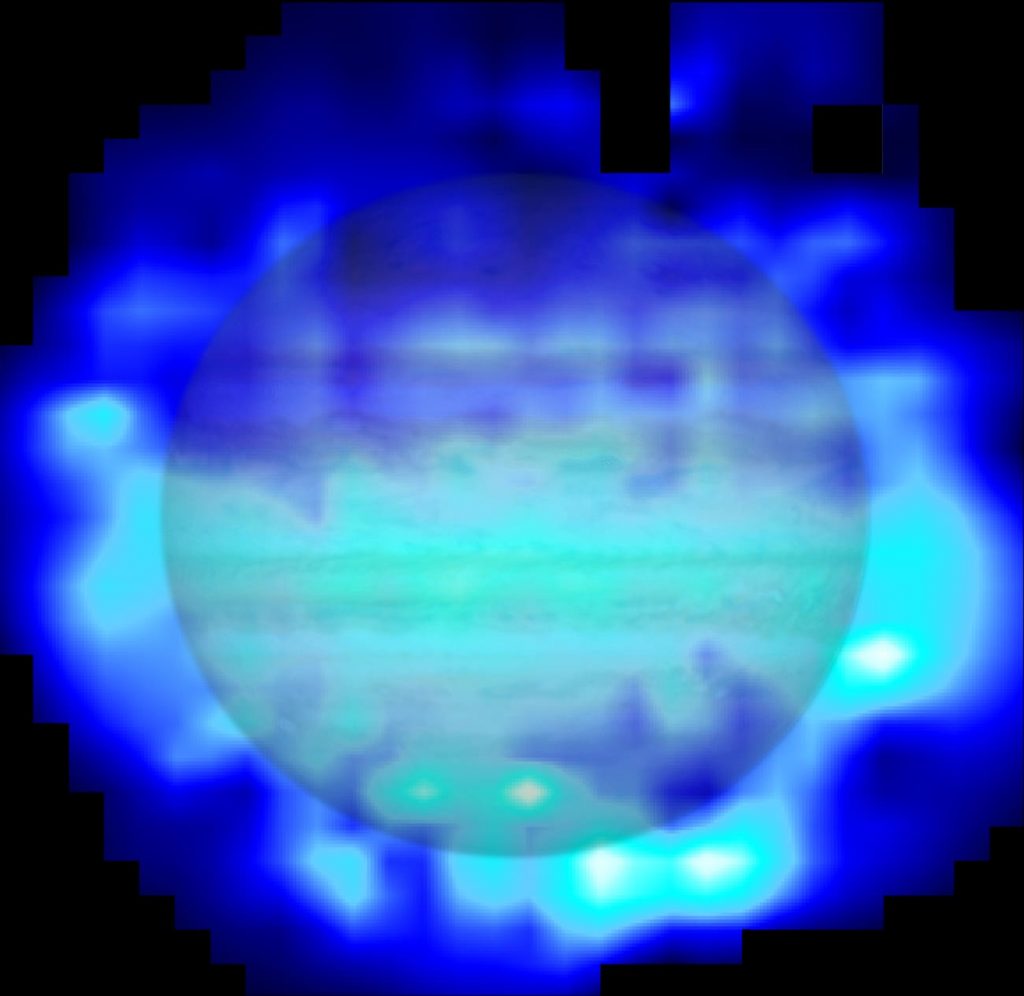 Distribution of water in Jupiter's stratosphere, measured by the Herschel space observatory. Water map:
ESA/Herschel/T. Cavalié et al.; Jupiter Photo: NASA/ESA/Reta Beebe (New Mexico State University)
Today, astronomers know that collisions withJupiter happen quite often. Decades later, photography technology has improved significantly and hobbyists, who are not limited by the expensive time of powerful telescopes, regularly take high-resolution pictures and videos of Jupiter. At least 10 impacts have been recorded since 2009, but Comet Shoemaker-Levy 9 remains unique due to its size. Computer simulations have shown that objects with a diameter of 0.3 km collide with the planet about once every 500 years, and those whose size reaches 1.6 km - every 6 thousand years. This speaks of the extreme luck of astronomers, who were able to notice and predict the collision of such a large object in advance.
Read more:
Found a way to lower blood sugar without insulin injections
Scientists believe that the shape of the universe is not what everyone thinks
NASA helicopter showed sunset on Mars. It doesn't look like earth.
On the cover: a combined image of fragments of a comet and Jupiter. Image: NASA, ESA, H. Weaver & E. Smith (STScI) and J. Trauger & R. Evans (Jet Propulsion Laboratory)