At the end of the Permian period - 252 million years ago - the Earth was devastated by a mass extinction that destroyed
Unfriendly Earth
As part of the study, scientists tried to understand howThe Earth's climate changed at the end of the Permian period - from 298.9 million to 251.9 million years ago, and at the beginning of the Triassic - from 251.9 million to 201.3 million years ago. Then all the continents were one huge land mass - Pangea, and a huge range of Siberian volcanoes was erupting. As a result, warming greenhouse gases entered the atmosphere. According to scientists' theory, this contributed to global extinction.
What is chemical weathering?
Taking all these factors into account, scientistsstudied the process of chemical weathering. Then the rocks on land break down and release calcium, which is washed into the oceans. There it combines with carbon dioxide (CO₂), forming carbonate rocks. The warmer the climate, the faster weathering occurs.
 This illustration shows the percentage of marineanimals that went extinct at the end of the Permian Era, by latitude, from the model (black line) and from the fossil record (blue dots). The color of the water shows the change in temperature: red means the most warming, and yellow the least. At the top is supercontinent Pangea, showing massive volcanic eruptions releasing carbon dioxide. Images below the line represent some of the 96% of marine species that died during the event. Image courtesy of Justin Penn and Curtis Deutsch, University of Washington
The point is that chemical reactions occurfaster at higher temperatures, and running water causes more erosion. Ultimately, this creates a feedback loop that keeps global temperatures under control. When it gets warmer and weathering occurs faster, more CO₂ enters the sea and gets trapped in ocean rocks, helping to cool the climate. When this happens, weathering slows and less carbon dioxide accumulates in ocean rocks, preventing it from getting too cold.
How does the reverse process work?
But there is another process that canoccur in the ocean, known as reverse weathering. This occurs when the mineral silica forms new clays on the ocean floor. During this process, clays release more CO₂ than carbonate rocks can capture.
In modern oceans there are not so manysilica because tiny planktonic organisms absorb it (it is necessary for shell growth), so reverse weathering does not occur. Similarly, during the Permian period, microorganisms—radiolaria—absorbed almost all the silica, thereby reducing reverse weathering to a minimum.
delicate balance
However, all this could change in the endPermian and early Triassic periods. At this point, the silica-rich rocks, which consist of countless radiolarian shells, disappeared. At the same time, scientists discovered that the balance of certain molecular variants in ocean rocks was “out of whack.”
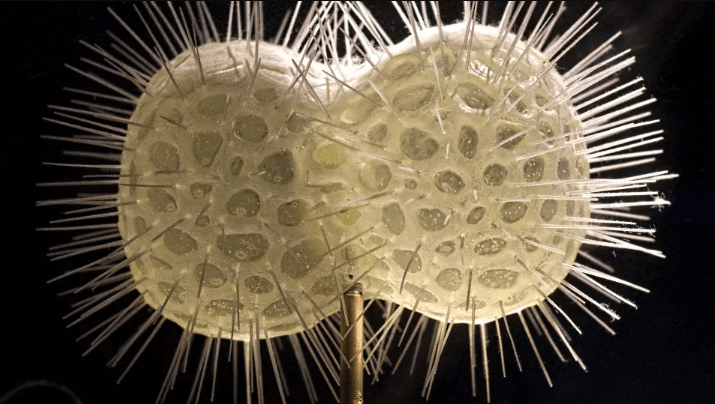 A model of radiolaria at the Smithsonian Museum of Natural History.
Image courtesy of Victoria Pickering - CC BY-NC-ND 2.0 flickr.
As part of the study, biologists studied the relationshipslithium isotopes. Isotopes are versions of an element with a slightly different atomic weight from the norm because they have different numbers of neutrons in their nuclei. Due to their different weights, some lithium isotopes are absorbed in different ratios when new clays are formed, which occurs during reverse weathering.
What did the scientists find out?
It turned out that some isotopes of lithiumvirtually disappeared from the ocean just before the Great Dying and did not recover for about 5 million years during the Triassic period. Ultimately, the loss of radiolarians led to the ocean becoming overfilled with silica, which triggered reverse weathering. The carbon dioxide released as a result of this process could overcome chemical weathering, which was also responsible for trapping CO₂ and, in turn, maintaining a very hot climate. In such conditions the existence of life is very difficult.
What's the bottom line?
To summarize, scientists have found out what delayedrestoration of the Earth. All because of radiolarians, which disappeared after extinction. Their absence radically changed marine geochemistry, allowing the formation of a type of clay that released carbon dioxide. This release of CO₂ would maintain the temperature of the atmosphere and the acidity of the oceans, thereby slowing the recovery of life. Even a very small change can very quickly throw a fragile system out of balance.
Read more:
Created a compact nuclear reactor for safe energy production
Unusual structures found on the edge of the solar system. Only the Voyagers have been there.
Black hole 'spit out' torn star three years after swallowing
On the cover:illustration of the onset of the Permian-Triassic mass extinction, based on the findings of Yurikova et al. (2020), published in the Nature journal article. Ocean acidification and extinction of marine life in the surface ocean caused by a large release of volcanic CO2 from Siberian dekrfyjd. Illustrated by David Adam Iurino (PaleoFactory, Sapienza University of Rome) for the article by Yurikova and colleagues