What kind of competition are we talking about?
Early exploration of futuristic space ideas could spark new ones
“We do not expect all of them to bear fruit, butWe recognize that providing small seed funding for early research can be very beneficial for NASA in the long term, ”explains Jenn Gustetic, director of early innovation and partnerships at NASA's Space Technology Administration (STMD).
STMD has selected 16 NIAC Phase I projects for 2021,which offer a number of inventions and applications. Each proposal will receive a NASA grant of up to $125K. If their first 9 months of project implementation are successful, NIAC Fellows may apply for Phase II grants. All NIAC research, regardless of phase, represents early-stage technology development work.
Top projects
This year, the program has a hugethe number of new members. All but two researchers selected for the Phase I award will receive a NIAC grant for the first time. Committee representatives are confident that NASA's capabilities continue to attract new creative thinkers from across the country. So which projects impressed the jury especially?
- "Railroad" on the Moon
Robotics engineer at JPLNASA Southern California's JPL Ethan Schaler proposed an infrastructure idea for autonomously transporting cargo on the Moon using magnetic robots that would hover over a flexible rail. This will be the first lunar rail system that will provide reliable, autonomous and efficient cargo transportation. A robust, durable robotic transport system will be critical to the day-to-day operations of a sustainable lunar base in the 2030s.
To implement the project, Shaler plans to create FLOAT (Flexible Levitation on a Track) - a flexible levitation system.
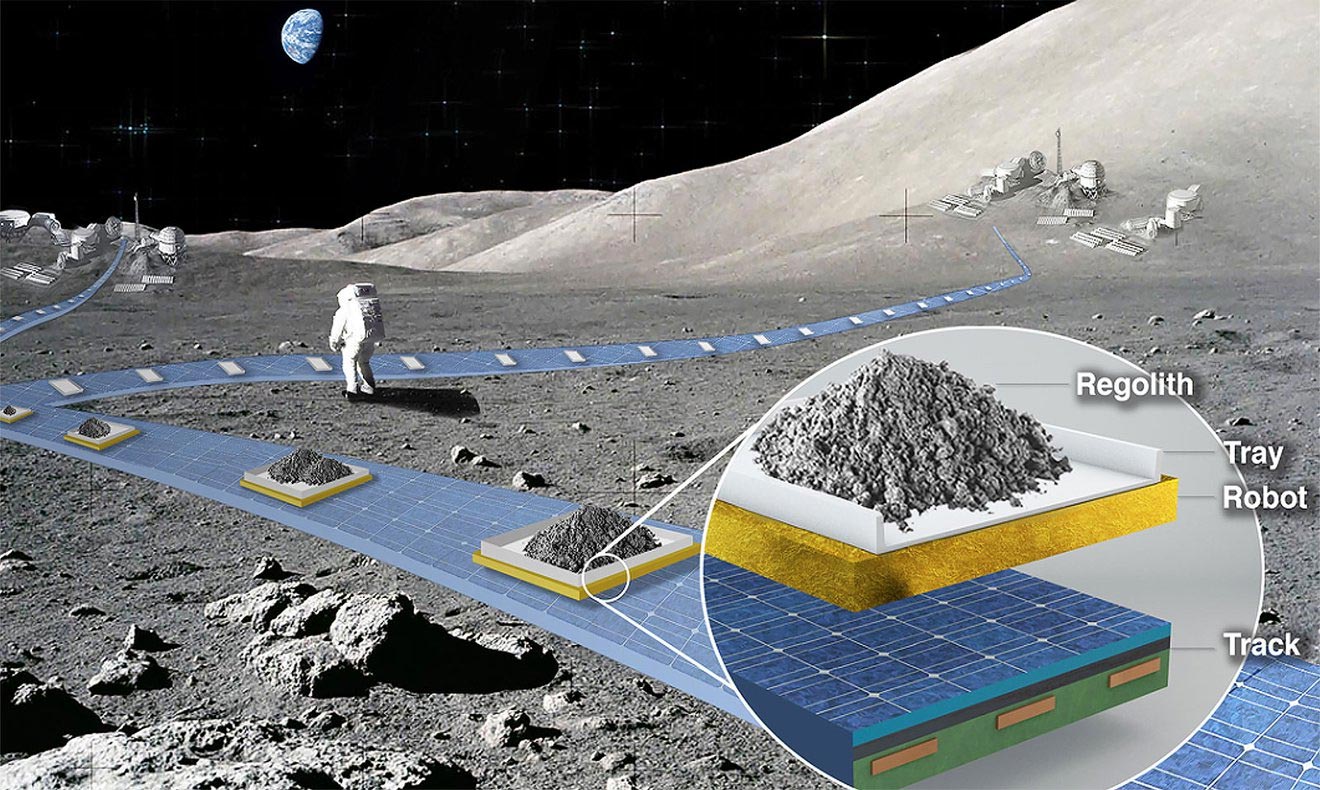
The FLOAT system uses magnetic robots withoutpower supplies that levitate over a three-layer flexible film track: the graphite layer allows robots to passively float along the walkways using diamagnetic levitation, the flexible circuit layer creates electromagnetic thrust for controlled movement of the robots along the walkways, and an additional thin-film solar panel layer generates energy for the base when is in the sun. FLOAT robots have no moving parts and hover over the track to minimize abrasion / wear on moon dust, unlike moon robots with wheels, legs, or tracks.
In parallel, the fellow will research another NIAC Phase I study: floating microrobots to explore ocean worlds.
- Soil from asteroids and mushrooms
Industrial researcher Jane ShevtsovShevtsov from Trans Astronautica Corporation has proposed a conceptual method for creating soil in space using carbon-rich asteroids and fungi. The concept envisions fungi breaking down the material and turning it into soil to grow food and support large-scale habitats in deep space.
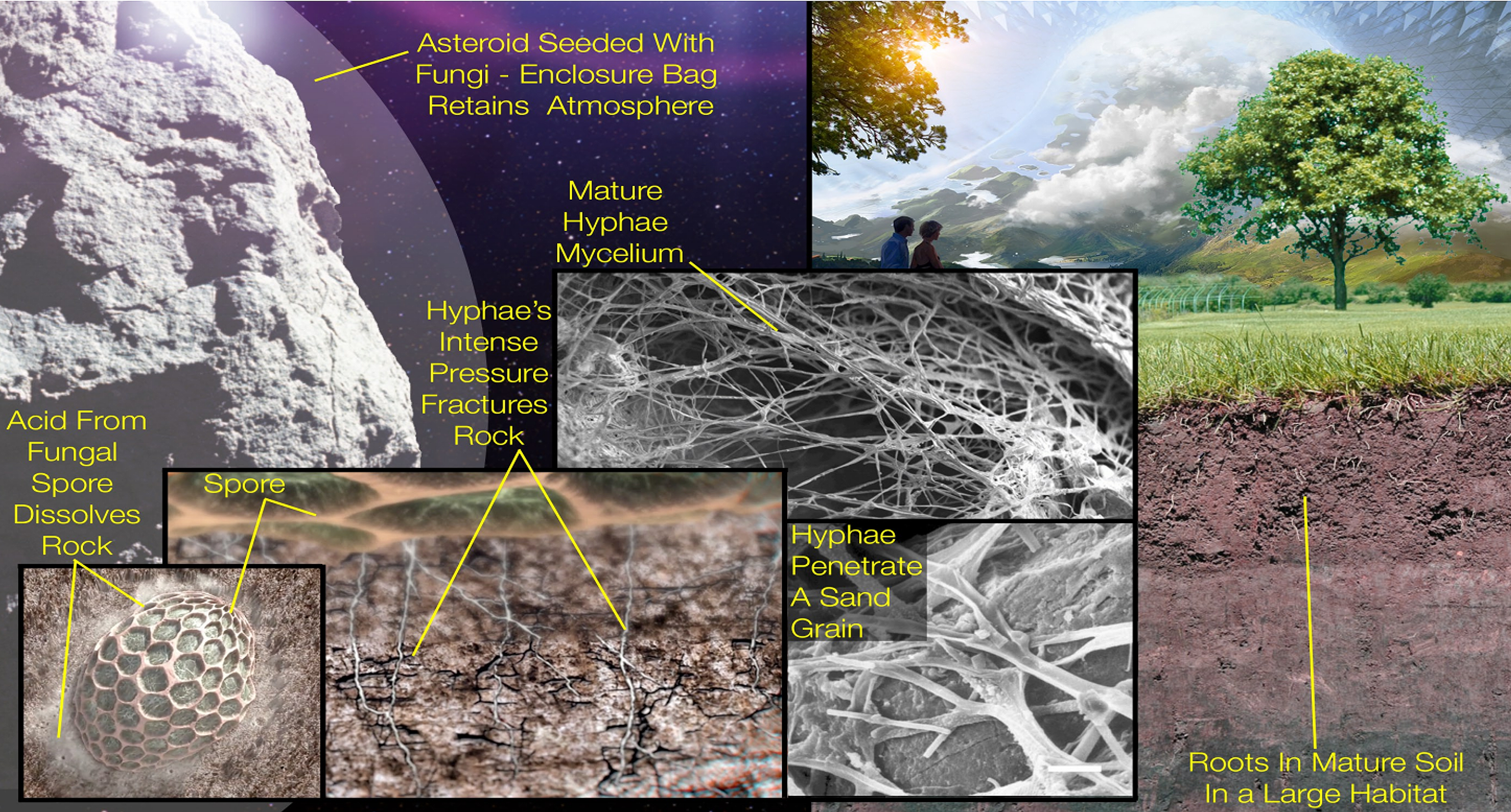 A graphical depiction of a method for creating soil for a space habitat by seeding asteroids with fungi.
Credit: Jane Shevtsov
Any large, long-term habitata person in space will have to grow most of their own food and process nutrients. For easily replenished missions, growing crops in hydroponics makes sense, but soil systems have important advantages in the context of a large settlement that cannot be replenished from Earth at an affordable cost.
- Artificial gravity
Associate Professor at Carnegie Mellon University will study lungand a deployable structure that allows the creation of kilometer-scale structures in space. The proposal suggests that this structure could serve as the basis for a large rotating spacecraft capable of generating artificial gravity.
- Melting the Moon
Sarbajit Banerjee from TexasA&M's experimental engineering station came up with a system of adaptive regolith modifications (RAMs). It was designed to selectively enhance and fuse natural materials on the lunar surface. Much of the current research into modifying lunar regolith focuses on the use of technologies that require a lot of infrastructure for sintering and geopolymerization.
 Graphical representation of the Regolith Adaptive Modification System (RAM)
On the contrary, the RAM system is suitable to supportdeployment during early landing, but can also be used for more mature construction work after the establishment of lunar and Martian settlements. Rather than bringing with it all the materials, equipment, and power supplies needed to modify the regolith for dust suppression and other foundation supports for folding landing pads, fixed landing pads, or roads, RAM uses new microcapsule delivery systems that deliver precursors (mixtures of nanothermite and organosilanes). They are activated during deployment to spot weld anchor points linking surface structures to the underlying regolith by forming advanced high-strength steel pins in place.
- Autonomous robot for deep drilling
It is believed that subglacial liquid waterexists on Mars at a depth of 1.5 km in the South Pole Layered Deposits (SPLD). Quinn Morley, the author of the project to create an autonomous robot for deep drilling (ARD3), is confident that if scientists are going to engage in astrobiology, we need to not just observe it, we need to get a piece of it, extract the purest possible sample.

For this, a robot is being developed that is capable ofdrilling deep wells. Incidentally, the chances that, for example, a subglacial lake may contain life are greatly increased if the liquid phase becomes possible due to the heat generated by volcanic activity under the earth's crust.
- An on-site radio observatory on the far side of the moon
Ronald Polidan from Lunar Resources,Inc. proposes to conduct a comprehensive study to create a very large low-frequency (5-40 MHz) FarView radio observatory on the far side of the Moon using regolith materials. FarView will be a sparse group of ~100,000 dipole antennas located over an area of ~20×20 km. Its peculiarity is that it will be assembled on site.
In connection with the implementation of the NASA Artemis program, thisthe study will provide a timely assessment of the value and needs of this important scientific observatory and develop technologies to ensure a sustainable presence on the moon.
What's next?
NIAC supports forward-thinking researchideas through several progressive learning phases. Researchers from the US government, industry, and academia with important ideas can provide suggestions.
NIAC Phase II Researchers Receive Grants inup to $ 500 thousand for the further development of their concepts for up to two years. Phase III aims to strategically transition NIAC concepts with the greatest potential impact on NASA, other government agencies, or commercial partners. Phase III researchers are awarded a contract worth up to $ 2 million to conceptualize their mission over two years.
Read more
Physicists have created an analogue of a black hole and confirmed Hawking's theory. Where it leads?
The first panorama of Mars appeared. It consists of 142 photos!
Abortion and science: what will happen to the children who will give birth