What are we talking about?
On the last day of summer, the journal Trends in Plant Science published the results of a study where scientists
This seems to be an ordinary discovery:in world botany, figures on the age and origin of species are constantly being updated. But news about the age of flowering plants could change our view of the biological history of the planet.
 The course of evolution of the plant world
Research progress
In January 2022, in a piece of amber from Myanmar, researchers found fragments of shoots of the South African bush Phylica. The age of this sample is more than 100 million years.
Byron Lamon, Distinguished Professor of Ecologyplants from Curtin University (Australia), together with Tianhua He, a molecular geneticist at Murdoch University, used the find to trace the history of the origin of buckthorn using the molecular clock.
“We matched the DNA of the Phylica samples withdynamic changes in the DNA of plants of this species over the past 120 million years and set the molecular clock for the entire family,” Lamon describes the essence of the work.
 Fragments of shoots in a piece of amber
Previously, it was believed that Rhamnaceae plants, towhich this sample also belongs to, arose on the planet about 100 million years ago. It turned out that the first flowering plants of the buckthorn family arose on our planet more than 250 million years ago - this is 50 million years before the beginning of the era of dinosaurs.
About method
Molecular clock is one of the scientific methodsdating phylogenetic events (for example, species divergences). It is based on the hypothesis that evolutionarily significant mutations occur at a constant rate. There is no evidence to support this hypothesis, but it makes it possible to study biological events that occurred millions of years ago and at least approximately restore the course of evolution. To restore a hypothetical chain of mutations, DNA nucleotide sequences and protein amino acid sequences are used.
The method has been known since the 1960s, in fact sincediscovery of the double helix by Watson and Crick. But it gives only approximate results, since the mutation of living organisms does not necessarily occur evenly.
What is the sensation?
Of our time shift in time suchevents like the appearance of flowering plants may seem insignificant: just think, they missed by some 100 million years. But this is really a breakthrough, since the appearance of flowering plants, whenever it happens, is considered a real revolution in the world of flora and herbivorous creatures.
At the household level - you have to forget (or better,redraw) all the pictures from textbooks and encyclopedias, where tyrannosaurs and diplodocus roam among giant horsetails and ferns. Probably, they were surrounded by a different flora, much more diverse and at least able to bloom.
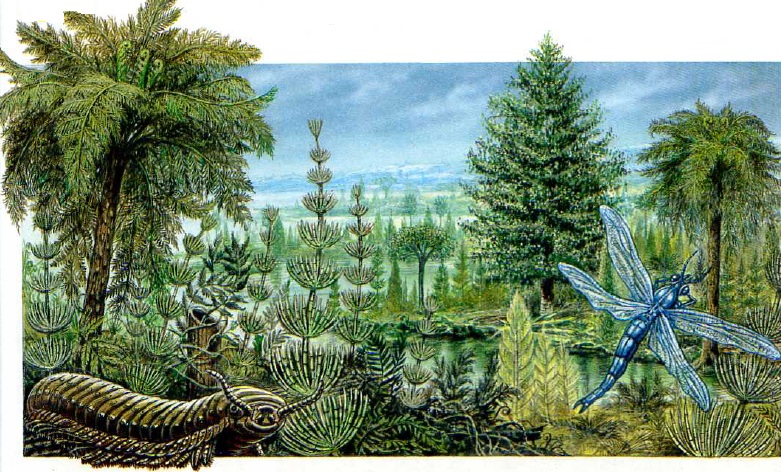 giant trees
In the development of scientific thought, several consequences can also be traced.
First, another time of occurrenceflowering angiosperms means that it took the Earth at least 100 million years less. Gymnosperms were the first to inhabit the land of the Earth and laid the foundation for all existing terrestrial flora. But flowering plants pushed them much earlier.
Secondly, the era of symbiosis began much earlierbetween plants and insects, the main pollinators of flowering plants. The world of insects itself began to develop thanks to the appearance of flowers: the crawlers had an incentive to fly up into the sky, this gave impetus to the development of a class of birds. As long as there is no food in the sky, why fly?
It is the flowering plants on Earth laid the foundation for the exploration of the sky (Before that, there were eras of water and land development).And this happened 50 million years before the beginning of the era of dinosaurs. In other words, primitive lizards have already evolved into a world where it makes sense not only to crawl, but also to fly.
Thirdly, modern flowers have come much morelong path of evolution. The flowering plants we know are the result of a longer struggle for survival, a more severe natural selection, than previously thought. And if the path of modern plants was 100 million years longer, it is difficult to even imagine how many species managed to arise and disappear during this period.
History of the issue
The study of the multimillion-year history of the earth's florahumanity has only been doing it for 200 years. The father of paleobotany, the French scientist Adolphe-Théodore Brongniard, in 1822 wrote a revolutionary article for the whole world of science on the classification and distribution of fossil plants. After 6 years, he systematized all the knowledge in a large monograph, which became a program book for all biologists of the 19th - mid-20th centuries.
It has been known almost since the time of Brongniart that the seed-producing trees are much older than flowers: they appeared during the late Paleozoic period, that is, about 300 million years ago.
The Late Paleozoic era covers a period of approximatelyfrom 419 to 252 million years ago and is divided into three geological periods: Devonian, Carboniferous and Permian. At the beginning of the Devonian period, ferns, horsetails and other gymnosperms with a very simple and extensive method of reproduction: spores were the dominant representatives of the Earth's flora. At the end of the period, some plants evolved to sexual reproduction through seeds.
Scientists found samples of primitive plants infossilized resin or peat deposits. The course of scientific thought depended on the quality of the samples found. The three most famous localities of Late Paleozoic fossil plants are:
- Rhynie Chert, Scotland.Primitive plants about 411 million years old - with water-conducting cells and sporangia, but without formed leaves.
- Wuda District, Northwest China. Here they found a lot of completely preserved plants, preserved in peat bogs, about 298 million years old. Ferns were also predominantly found here.
- Heimnitz, Germany.Here they found deposits of fossil plants agedabout 290 million years. Fossils indicate that dense, moisture-loving vegetation grew during the Permian period. But no pronounced angiosperms were found here either.
Another reason for Lamon's research
One of the important prerequisites for the discovery of Byron Lamon was 2018 find in Jiangsu, China.Here, a group of researchers found fossilized fragments of a flower. According to experts, the age of the fossil is 174 million years. For several years, scientists have wanted to confirm the assumption that flowering plants populated the Earth much earlier than thought.
And a year before, in February 2017, a research team from Austria led by Jürg Schoenenberger recreated the appearance of one of the first flowers on the planet.
Scientists have studied phenotypic featureshundreds of modern flowers, established their common features and, based on these data, brought out their progenitor. Most of all, the artificially recreated forefather resembles a lily: it has five pistils twisted into curls, ten stamens, several petals and sepals (modern lilies, by the way, have three pistils and six stamens).
 Nanjinganthus dendrostyla
Descendants of the first flowers on Earth
Buckthorn representatives are still growing side by side with us. They are indeed a little strange: it is immediately clear that they came from the depths of centuries.
hold the tree
Unusual shrub:its fruits, lignified drupes, look like brown umbrella mushrooms. Its other name is Christ's thorn: according to legend, it was from this tree that the crown of thorns of Christ was woven. The plant is medicinal: a decoction of its fruits has anti-inflammatory and expectorant effects. Derzhiderevo can also be found on the territory of Russia, especially in the southern, southwestern regions and in the Caucasus.
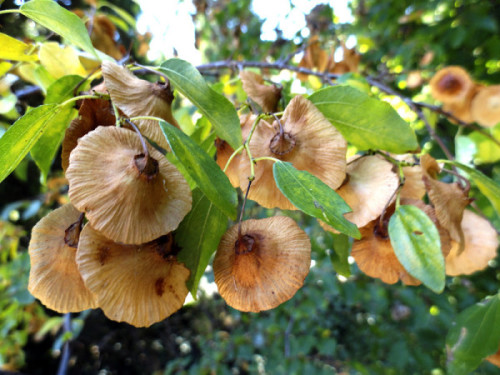 hold the tree
Saherence
There are very few houseplants among buckthorns:It's more like trees and shrubs though. But tea saherence is an exception: it can often be found in the form of bonsai. This plant has a straight, curved trunk and knotty shoots that create a beautiful asymmetrical crown. That is why sageretia is chosen as a house tree.
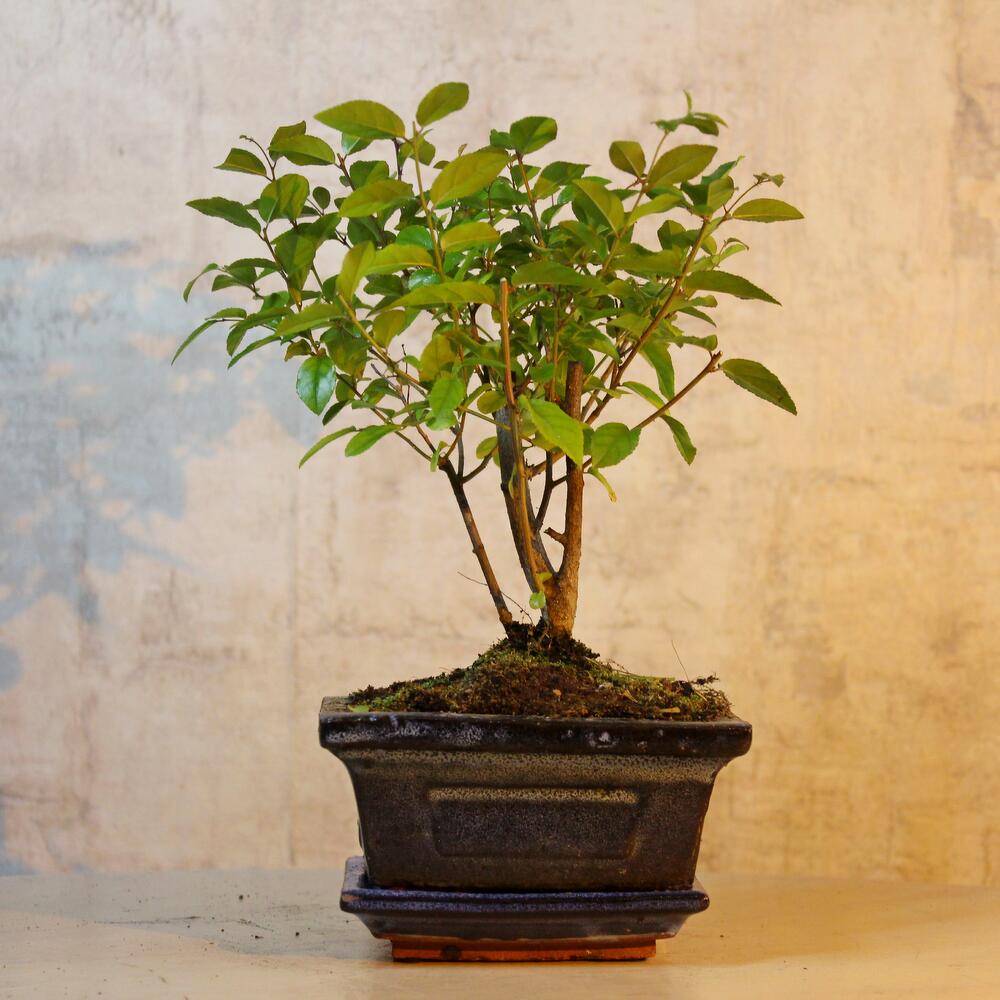 Sageretia tea
But sea buckthorn,so similar to the drawings from Brongniard's book andfinds from northern China have little relation to the ancient buckthorns. It belongs to the genus of plants of the sucker family (Elaeagnaceae). But due to the similarity with ancient fossilized remains, the most common type of this fruit-bearing tree was called sea buckthorn.
Read more:
The space plane will deliver cargo to the ISS and land at a regular "airport"
The star approached the black hole and it was torn apart: scientists observed this from three telescopes
Scientists have found traces of genetic mutations in the blood of every person who has been in space