What solar eclipse will happen on June 10?
According to astronomical classification, if an eclipse is at least somewhere
When an observer is in the shadow of the Moon, heobserves a total solar eclipse. When he is in the penumbra region, he can observe a partial solar eclipse. In addition to total and partial solar eclipses, there areannular eclipses. An annular eclipse occurs whenAt the moment of the eclipse, the Moon is at a greater distance from the Earth than during a total eclipse, and the cone of the shadow passes over the Earth's surface without reaching it.
Visually during an annular eclipse the Moonpasses across the disk of the Sun, but turns out to be smaller in diameter than the Sun, and cannot completely hide it. In the maximum phase of the eclipse, the Sun is covered by the Moon, but around the Moon a bright ring of the uncovered part of the solar disk is visible.
The sky remains unchanged during an annular eclipsebright, stars do not appear, it is impossible to observe the corona of the Sun. Sometimes it happens that the same eclipse in some parts of the central band is visible as a total eclipse, and in others as an annular eclipse. Such an eclipse is calledannular-completeorhybrid.
On average, 237 solar eclipses occur over 100 years, of which:
- 160—privatewhen the Moon passes along the edge of the Sun's disk, hiding only part of it;
- 63—fullin which the moon completely covers the sun;
- and everything14—annular.
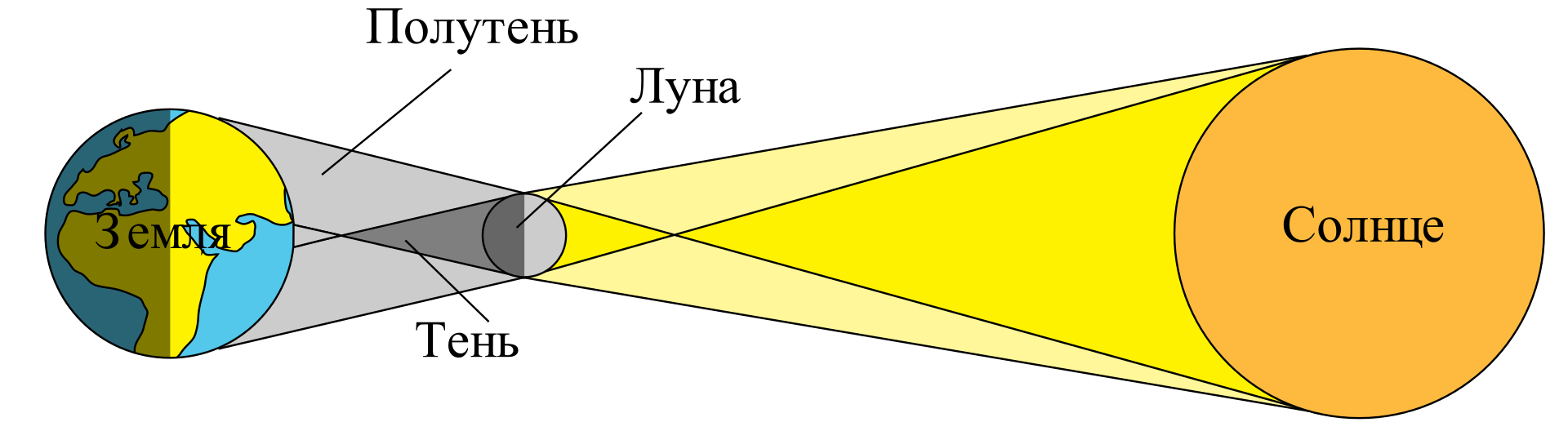 Diagram of an annular solar eclipse.
When will an annular eclipse occur?
On June 10 at 13:40 Moscow time, the Moon will cover 0.94 times the diameter of the solar disk, leaving only its thin edge visible.
The annular phase of the eclipse will be visible in the province of Ontario (Canada), Greenland and at the North Pole, in Russia it can be seen in Yakutia and Chukotka.
Why is this eclipse unique?
There were no similar solar eclipses on the territoryRussia is already half a century old. The next annular eclipses of the Sun in the central part of the country can be seen in 2030, 2039, 2048, 2075 and 2084.
The upcoming eclipse is unique in that it canwill be seen at the North Pole, this is the only annular eclipse passing through this point in the 21st century. In addition, it opens a whole series of similar phenomena on the territory of Russia, they will occur in the summer with an interval of 9 years.
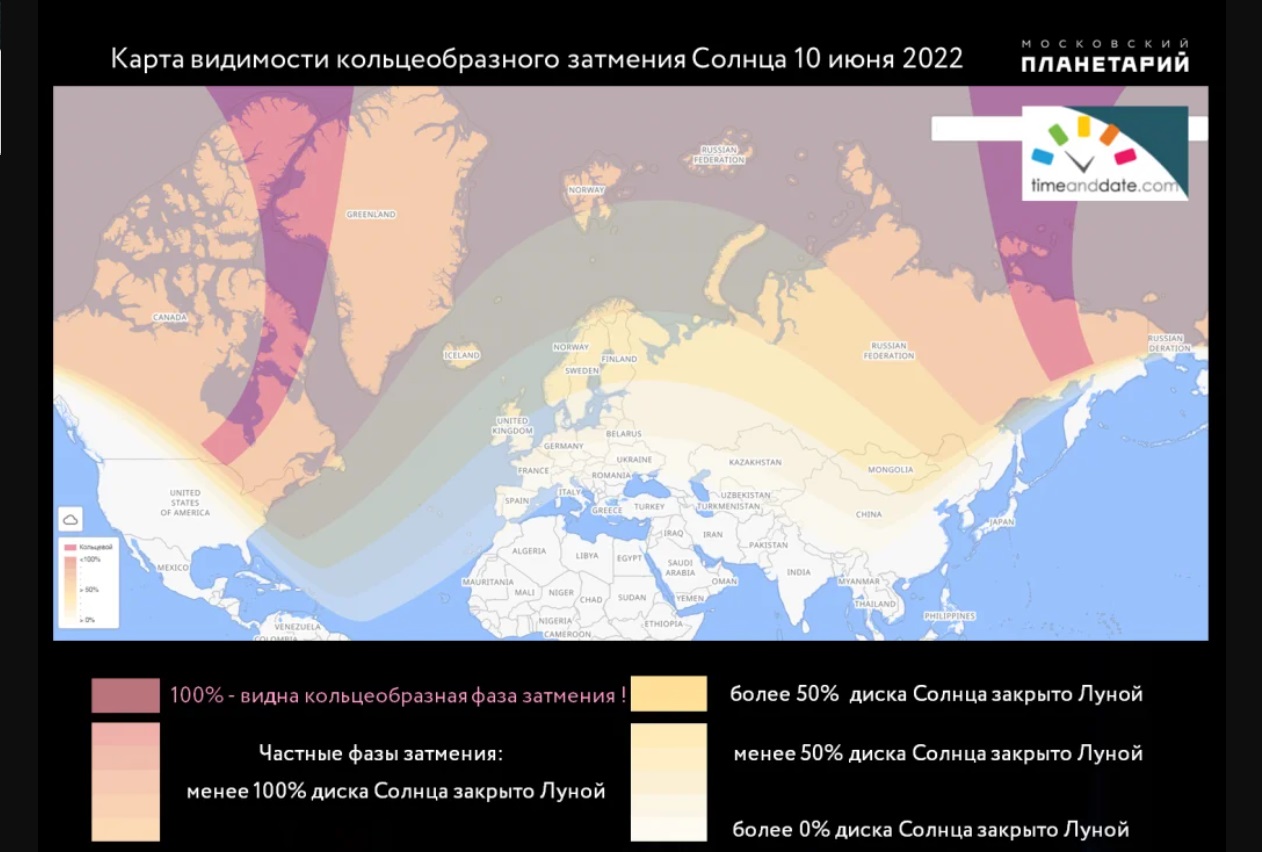
Where will the eclipse be observed from?
The annular phase of the eclipse will be visible in the province of Ontario (Canada), Greenland and at the North Pole, in Russia it can be seen in Yakutia and Chukotka.
The eclipse will begin at 12:48 Moscow time at sunrise, on Lake Superior between Canada and the USA. The greatest phase of the eclipse (0.944) is expected on the northern coast of Greenland (Knud Rasmussen's land). In Russia, the maximum (0.94) will occur near the mouth of the Indigirka River (the villages of Chokurdakh and Tabor). The eclipse will end at 14:33 Moscow time at sunset just north of Magadan.
Almost the entire territory of Russia will fall into the field of visibility of the phenomenon. In the European part of the country, the eclipse phase will be small, but in Siberia, and especially in its north, it will be much more noticeable.
Over Moscow the eclipse will be partial and not at all annular. At this moment, the Moon will cover the Sun by 16%, which is 0.26 times the diameter of the Sun.
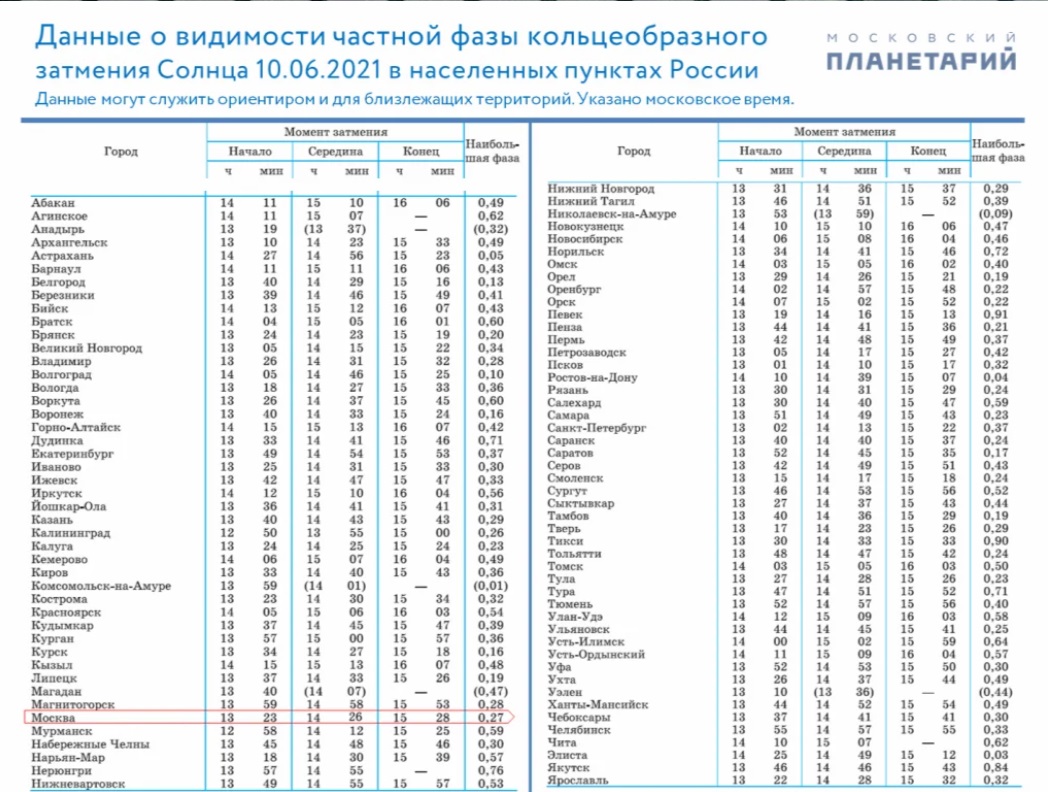
How to observe an eclipse?
Experts remind that observations of privateA solar eclipse, like any observations of the surface of the Sun, must be carried out with strict adherence to safety rules. It is strictly forbidden to look at the Sun with your eye or through a telescope without using special solar filters.
Experts do not recommend observing the Sunthrough photographic film, magnetic film, smoked glass and CDs. Although sunglasses can protect the observer from dangerous solar radiation, they will not help to see the eclipse itself, because their degree of brightness reduction is small. It is recommended, for example, to purchase a welding helmet.
Read more:
The animal came to life after 24 thousand years of hibernation in the Siberian permafrost
The limit of a person's life: for how many years our body is designed and what factors affect it
Physicists explain why it is impossible to find dark matter: it is in another dimension