For decades, physicists have tried to create a model of quantum gravity that would unify quantum
But some of the models predict the effectwhich can be investigated in the laboratory: a slight violation of a fundamental quantum principle known as the Pauli exclusion principle. It determines, for example, how electrons are arranged in atoms. This is exactly what the employees of the INFN underground laboratory project under the Gran Sasso mountains in Italy are working on. Their goal is to look for signs of radiation caused by such a violation, in the form of atomic transitions forbidden by the Pauli principle.
In two papers published in the journals Physical Review Letters and Physical Review D, the scientists described whether they succeeded.
How does the Pauli principle work?
In school chemistry lessons, they teach that electronsarranged in atoms only in a certain way. It turns out that this is due to the Pauli exclusion principle. At the center of an atom is the atomic nucleus, surrounded by orbitals with electrons. The first orbital, for example, contains only two electrons.
The Pauli exclusion principle, formulatedAustrian physicist Wolfang Pauli in 1925 states that no two electrons can have the same quantum state. So, in the first orbital of an atom, two electrons can have oppositely directed spins. This quantum intrinsic property is usually depicted as an up or down axis of rotation, although the electron does not have an axis in a literal sense.
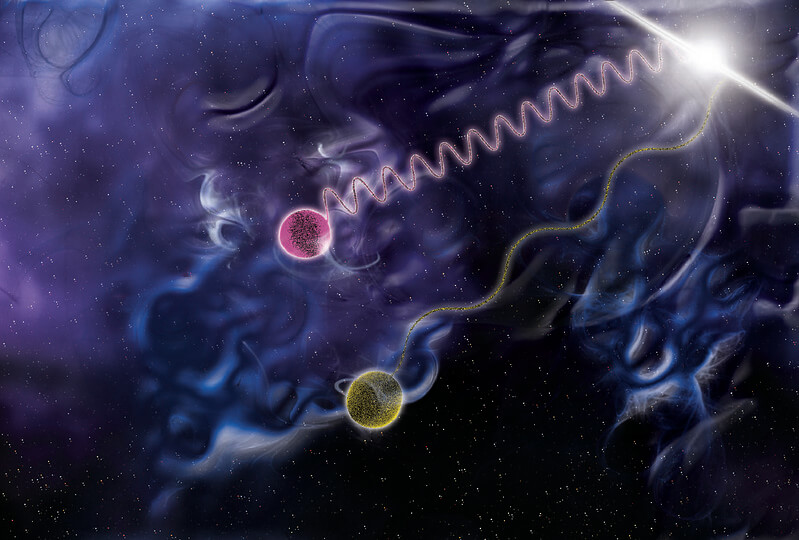 Quantum gravitational photon race. Photo: NASA
Essentially, this means that matter alone cannotpass through another. As the scientists explain, this works everywhere - "you, me, we are based on the Pauli exclusion principle." The simplest example of this law is the fact that people cannot walk through walls.
This principle applies to all elementaryparticles that belong to the same family as electrons and are known as fermions. It was mathematically derived from a fundamental theorem known as the spin statistics theorem. Also, the Pauli exclusion principle was confirmed experimentally. Until now, this was assumed to be true for all fermions. The Pauli exclusion principle is one of the basic principles of the Standard Model of particle physics.
Violation of the principle
But according to some speculative theories,that go beyond the Standard Model, this principle can be violated. For decades, physicists have been looking for a fundamental theory of reality. The Standard Model is excellent at explaining particle behavior, interactions, and quantum processes at the micro level. However, it does not include gravity.
So, physicists are trying to develop a unifyingthe theory of quantum gravity, some versions of which predict that various properties that underlie the Standard Model, such as the Pauli exclusion principle, can be violated under extreme circumstances.
For example, many of these disorders are naturallyoccur in the so-called non-commutative theories and models of quantum gravity. One of the most popular is string theory. She describes fundamental particles as tiny vibrating filaments of energy in multidimensional spaces. Some models of string theory also predict such a violation.
Difficulty of verification
It is traditionally believed that such predictionshard to check. Quantum gravity is "organic" only for places where a huge amount of gravity is concentrated in a tiny space. The simplest example is the center of a black hole, the birthplace of the universe.
However, the authors of the new study came up with an alternative. The effect of violating the exclusion principle and the spin statistics theorem can be detected in laboratory experiments on Earth.
Deep beneath the Gran Sasso mountains, just outside the cityL'Aquila in Italy, physicists are working on the VIP-2 experiment to violate the Pauli principle. The special apparatus is based on a thick block of Roman lead, next to which there is a germanium detector. It picks up small signs of radiation coming from the metal.
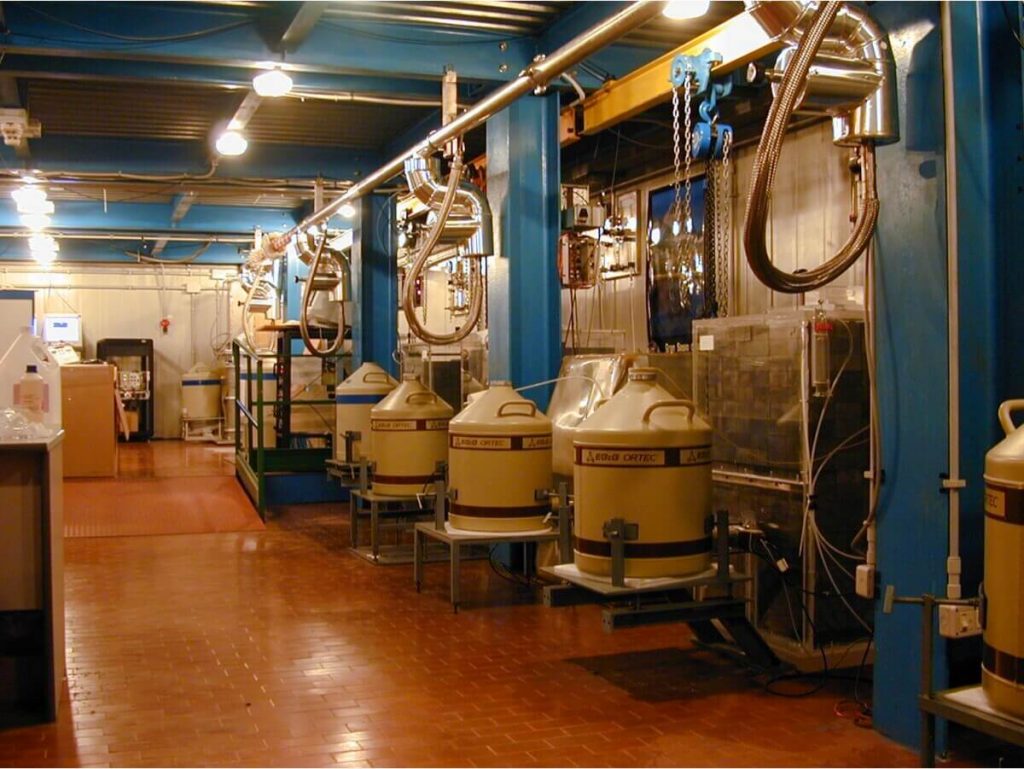 Underground laboratory of low radioactivity in Gran Sasso.
Photo: Massimiliano De Deo, LNGS-INFN
The idea is that if the prohibition principlePauli will be violated, inside the lead there will be a "forbidden" atomic transition, generating X-rays with a distinct energy signal. It will be picked up by a germanium detector.
Space silence
The laboratory was specially placed underground,because the radiation from such a process would be so weak that it would otherwise be drowned out by the general background radiation from cosmic rays on Earth. As Italian scientists explain, their laboratory provides the so-called cosmic silence - Mount Gran Sasso reduces the flow of cosmic rays by a million times. However, this alone was not enough.
The frequency of the signal physicists are looking for isjust one or two events a day or less. This means that the materials used in the experiment must themselves be "radio-clean" - they must not emit anything. And the equipment must be shielded from the radiation of rocks. On modern accelerators, this is impossible, scientists write.
What have the scientists done?
After conducting an experiment in an underground laboratory,scientists have found no evidence of a violation of the Pauli principle. This excludes some models of quantum gravity. In other words, physicists did not catch the "forbidden" signal. Anyway, for now.
Also, as part of the project, physicists analyzedpredictions of the Poincaré theta model and ruled out some versions of the model on the Planck scale (the scale at which the known classical laws of gravity are violated). In addition, their analysis contradicts some specific implementations of quantum gravity.
What's next?
The researchers are now planning to expand their research toother models of quantum gravity together with Chinese physicists. They will use new materials and analysis methods to search for weak signals in order to "reveal the fabric of space-time," the authors of the experiments explain.
“The interesting thing is that we can explore somemodels of quantum gravity with such high accuracy that it is impossible to do on modern accelerators, ”the scientists conclude. “This is a big leap both theoretically and experimentally.”
Read more:
17-year-old engineer came up with a magnetless motor: it can be used in electric vehicles
Two planets have been found not far from Earth. Perhaps they are inhabited
A unique meteor rewrote the history of the solar system: where did it come from
Cover photo: Wikipedia