Types of weapons prohibited by conventions, which still happen to be used today by the USA, Russia and many others
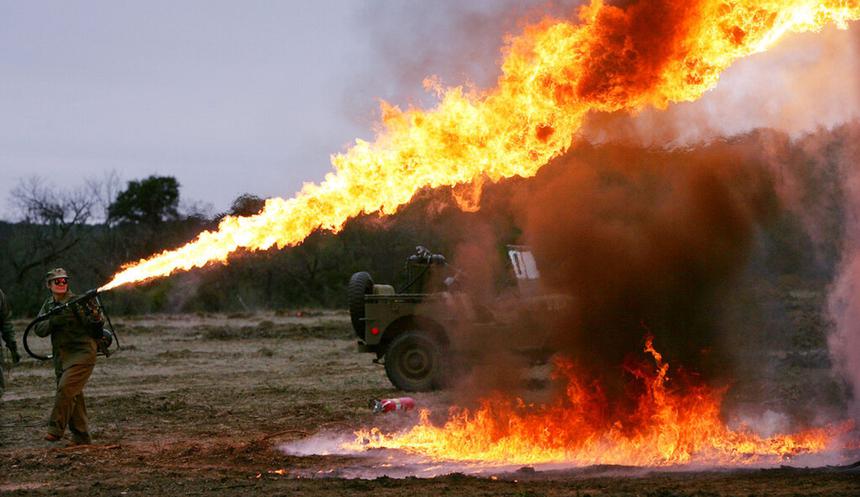
Table of contents
- Expansive bullets
- cluster munitions
- Incendiary and volumetric detonating bombs
- Balloons
- Forbidden?
Why are there prohibited weapons, or howsometimes they say “inhumane weapons”? After all, this is an obvious oxxxymiron - the point is clear that permitted weapons quite tear and burn people quite well, and without any restrictions or violations.
The root of the question goes, as always, into history andthe first conference on the laws of war in St. Petersburg in 1868. This "root" began to sprout against the background of industrialization and the wild development of a variety of means of killing in war. Moreover, many of these remedies were ... well, let's say, excessive - they caused a long and painful death, guaranteed not to alleviate suffering by medical means, or simply had an exorbitant lethality.
There was no consensus even then (there is nonemost types of weapons today). Someone said, “What the hell? Stick your head in, and I will wet you with what and how I want. Others argued - "But this is mutual, but what if they use weapons against me, which I have no analogues for a symmetrical response?".
In short, war is hell
Expansive bullets
The first prohibited type of ammunition is that it is characterized by significant deformation of its original shape when it enters human tissue. There are very different types of bullets that fall into this category.
-
Can beshellless, and for a long time almost all bullets were like thisthe appearance of repeating rifles and the appearance of shell rifles. This means that all the lead was “naked”, and under the influence of temperature and when it enters the body, it expands and increases the wound channel and the volume of tissue damage.
-
Actually expansive- with cavities or special “cuts”, which lead to the destruction of the bullet and the spread of its fragments over a large area.

 12
12
Jacketless bullets vs. jacketed at the end
Today, such bullets remain for hunters - they allowdo not leave wounded animals, and, in this case, they are just humane, in contrast to those that have become purely military shells. There is also a loophole left for anti-terrorism special forces - the advantage (disadvantage that turns into an advantage) of expansive bullets is that they remain in the body, and this allows the hostages not to be hit by ricochets.
Another question is about bullets, easyunfolding in the body - they were banned in the same year. But modern calibers 5.56 and 5.45 (calibers AR-15 and AK-74, respectively) weigh very little, which makes them less stable when hit - they can sharply change the trajectory, twist in different projections. As a result, the wound is deeper and more tissue is affected, and, finally, extracting such a bullet is much more difficult. And no one panics about it - this is still the caliber of the main modern automatic rifles.
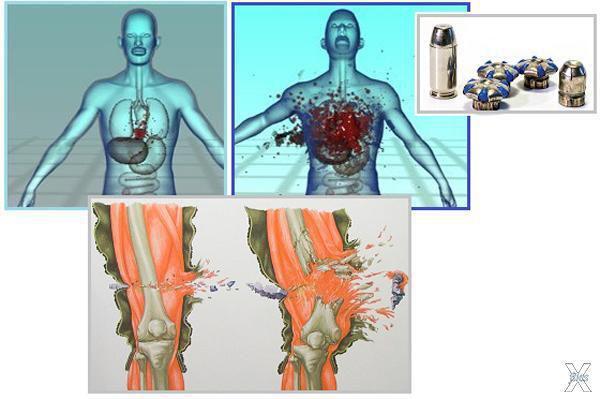
Impact difference
After the Soviet war in Afghanistan,comparative tests of low-pulse cartridges (as these calibers are called) and the behavior of their bullets, which revealed a number of correspondences with the Hague Convention of 1899, which banned the use of expansive and self-deploying bullets. Thus, formally, we can say that the infantry of most countries today is armed with, in general, prohibited weapons.
cluster munitions
You probably come across this in the news aboutconflicts all the time. Although there is nothing special about this ammo that would make it some kind of demonic weapon. In essence, this is such a bomb-womb (or simply a container), stuffed with an abundance of smaller warheads
-
anti-personnel mines
-
High-explosive fragmentation small bombs
-
Cumulative feathered shells (can be scattered over the formation of tanks)
-
Incendiary projectiles
They are commonly referred to as "submunitions".
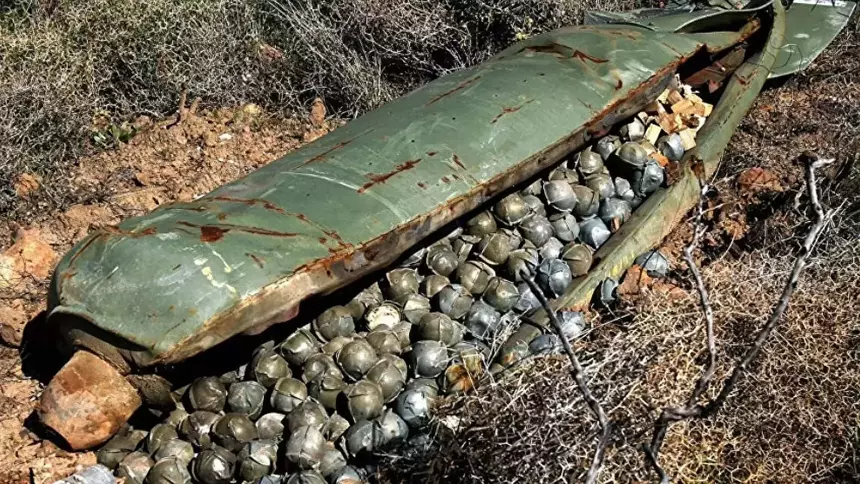
Santa Claus and a bag with gifts
These types of bombs have been known since the Secondworld, they have several types and options for triggering (when and how dispersion occurs), but they have one thing in common - this is a weapon of area destruction. It was created to bombard multiple targets or a dispersed enemy.
But, since the 90s, there has been a debate about their ban.Why? After all, shotgun shells and shrapnel shells, similar in principle, were used in the past. The reason is that a large part of the submunitions did not work and subsequently the affected area was teeming with an abundance of unexploded ordnance dangerous to the civilian population.
They also give rise to the urban legends that both Americans and Russians were often accused of - they say they deliberately scatter toy bombs to kill and maim children. But in fact submunitionsspeciallypainted in bright, eye-catching colors so that sappers could then easily detect them. But, as often happens, where children and other curious people discovered them earlier, they were injured and died as a result.
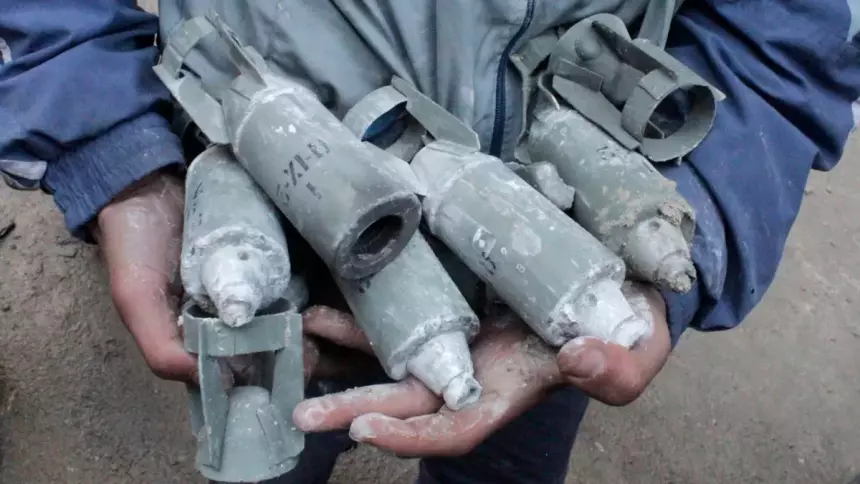
submunitions
That's why they decided to ban such ammunition,but the agreements were not ratified by many countries (USA, Russia, China), and several countries directly refused to participate in the signing - Brazil, India, Israel, Pakistan, South Korea.
As a result, they agreed that today cassettebombs need to be regulated and used purely for military purposes, and in a densely populated urban area, or simply in an area where there has not been a mass evacuation of civilians, their use is prohibited. That is, cluster bombs are classified as weapons of indiscriminate action, but the ban law has been signed and ratified by countries that participate in modern conflicts very little.
Today, countries are modernizing submunitions according toparts of the reliability of fuses, as well as built-in self-destruction systems, including remote-automatic. Therefore, today cluster bombs remain the most actively used, de facto, type of officially banned ammunition.
Incendiary and volumetric detonating bombs
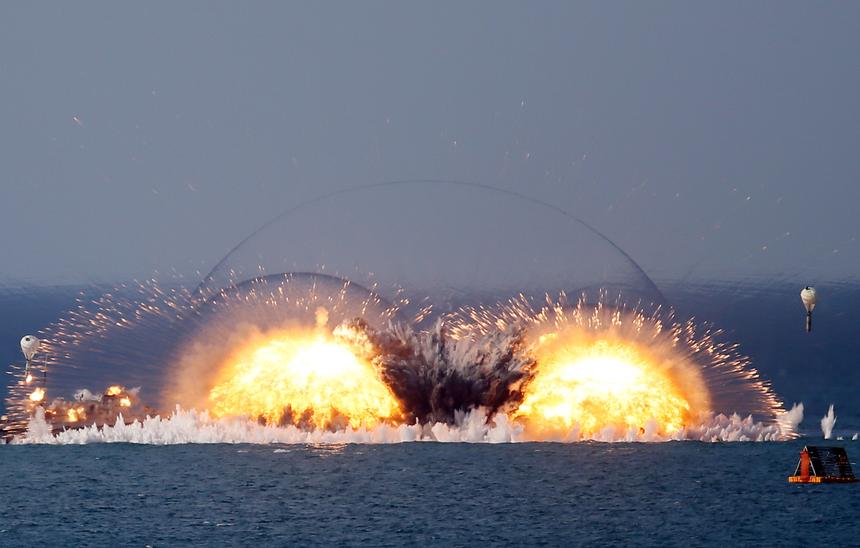
Visual illustration
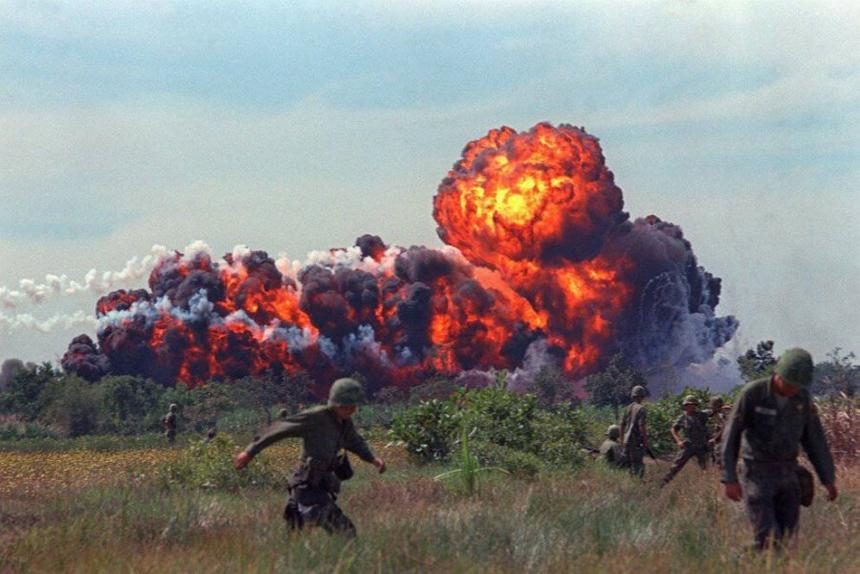
The heyday of such ammunition came in the wars after World War II, when the military chemical industry reached its peak. The most famous (or infamous) weapon here is napalm.
Essentially this type of weapon is a developmentflamethrowers, but traditional backpack or vehicle-mounted flamethrowers had poor range, and different countries solved this problem in different ways. The Americans came up with a special mixture of gasoline and frozen orange juice concentrate of aluminum naphthenates and palmitates (the name is derived from the abbreviations).
The result was combustible at a temperature900-1100 degrees gel (in modifications up to 1500 degrees), which easily sticks to any surface and settles at any angle, and then burns for a long time under any atmospheric conditions. The addition of an alkali metal group made the mixture self-igniting when it hit the surface, and at the same time not subject to extinguishing. It was possible to drop on a snow-covered or abundantly moisture-covered target - this is already supernapalm.
Napalm today
Finally, pyrogens - the addition of magnesium made it possible to obtain a mixture that burned through even concrete and metal structures.
In 1980, they reached this type of weapon,having banned it by a special UN convention and a protocol on the prohibition or restriction of the use of incendiary weapons. But the same United States refused to sign, and with them Turkey and Israel. Armenia, Azerbaijan, Kazakhstan have abandoned the CIS, while Afghanistan, Egypt, and, ironically, Vietnam, which has suffered the most from such weapons, remain unratified signatories.
Russia joined, but, on the other hand,everything is difficult for us with thermobaric ammunition (for example, the Buratino and Solntsepyok flamethrower systems, and with volumetric explosion ammunition similar in action (air bombs, as a rule). The principle of operation is reduced to the formation and undermining of a fuel-combustible mixture in the form of an aerosol cloud, which, in contrast from simple land mines, it has a higher temperature and greater overpressure.
This type of explosion allows you to get even goodhidden enemy, because the explosion leaks almost anywhere, along with the attendant factors of defeat. Pressure and temperature leave almost no chance of survival, which makes these weapons excessively lethal, because modern conventions require combat operations to have priority on neutralizing the enemy, which is not the same as killing him.
thermobaric bomb
So-called vacuum bombs in terms of powercomparable to tactical nuclear weapons, but they are much easier to use and do not leave a radiation background. Yes, it is very difficult to give up such weapons, which is why they are still on the drawing board, but without any noticeable progress - it seems like they should be banned, but no one is in a hurry.
Balloons
What? Yes!The Hague Convention of 1899 forbade aerial bombardment, at that time it meant - you can’t bomb from balloons, it was considered not in a boyish way, inhumane way, as it left no chance to find shelters. They did not have time to drag and discuss the aviation that appeared soon, while its potential turned out to be much higher, but soon the air force became an integral part of military operations, and no one was even going to discuss their ban.
But if you suddenly decide instead of tacticalbomber with a cluster bomb to use a balloon and some kind of fragmentation bomb, know that you are committing a direct war crime, for which The Hague is waiting for you! The law has not been repealed.
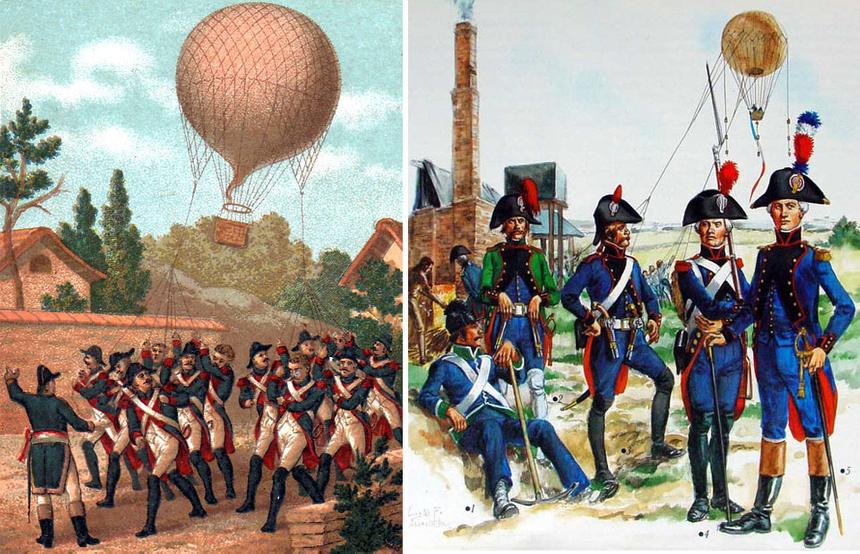
Terrifyingly lethal weapon in action
Forbidden?
As you can see, not everything is the same with prohibited weapons.simply. A country that has not signed or ratified the protocols of the conventions reserves the right to use weapons prohibited by this convention, while bringing it to international responsibility for this is more difficult than the signatories.
This is due to the fact that the international position andrelations with neighbors are different - it's good to give up weapons when you are Liechtenstein or Denmark. But not really when you are Israel or India, and countries that want to destroy you, or superpowers that do not mind profiting from your territories, border on you.
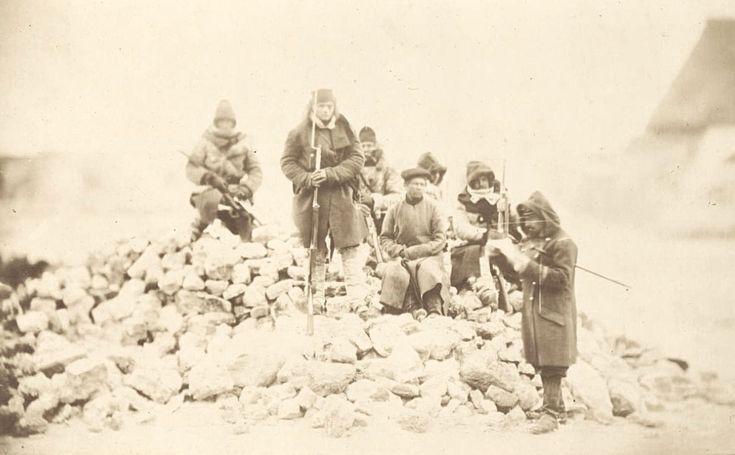
1855, French landing and Russian prisoner of war on the ruins of the Kinburn fortress. Kherson province, Crimean war.
In addition, prohibited weapons are also, as a rule,very effective. And for the sake of this effectiveness, countries and their leaders are ready to sacrifice their reputation as humanists and peacemakers. Much has been deeply studied and brought to perfect forms, and this gives an obvious and significant advantage over the enemy, which the world community is proposing to take from you. And in return he offers to throw more soldiers, citizens of your country, into the furnace of “conventional weapons”.
It would be much more promising to develop international relations that exclude war as a way to resolve disputes and conflicts between states.