Japanese researchers examined a global land-use dataset to find out how global
The researchers note that along with the growthpopulation of the Earth, this has led to a significant reduction in the number of forests per capita. It has decreased by more than 60%: from 1.4 hectares in 1960 to 0.5 hectares in 2019.
The authors also confirmed the forest transition theory.It assumes that the loss of green cover occurs mainly in low-income tropical countries, while the gain occurs in higher-income countries outside the tropics. The results of the study confirmed this hypothesis.
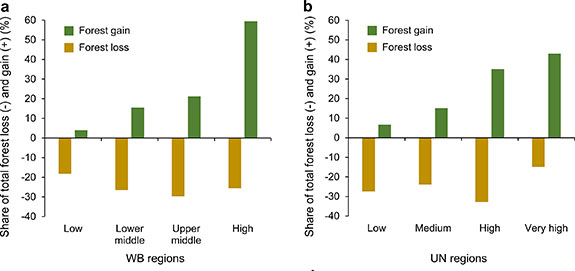 Forest change in countries with different income levels. Rich and poor countries are identified based on the methodology of the World Bank (left) and the United Nations (right).
Researchers believe that significantChanges in forest cover affect ecosystem integrity and biodiversity. In addition, it worsens the lives of at least 1.6 billion people, mainly in developing countries, whose lives are to some extent connected with forest resources.
Despite such a spatial pictureloss of forests, which occurs mainly in less developed countries, the impact of more developed countries also requires in-depth study. With increased forest protection in more developed countries, forest loss is shifting to less developed countries, especially in the tropics.
Ronald Estock, research leader at the Center for Biodiversity and Climate Change at the Forestry and Forest Products Research Institute
Read more:
An out-of-control Chinese rocket will soon fall back to Earth. What's happening
Scientists filmed a strange creature with tentacles, which they mistook for a flower
Marine archaeologists find wreckage from medieval shipwreck