Scientists from Nagoya University and the National Astronomical Observatory of Japan conducted a new
We are talking about the GHZ2/GLASS-z12 galaxy, originallyit was found in the GLASS survey data from the James Webb Telescope. The image was made from several photographs produced using different broadband color filters. For distant galaxies, light takes so long to reach Earth that the expansion of the universe has shifted its color toward the red end of the visible light spectrum. Studying this redshift helped scientists identify GHZ2/GLASS-z12 as “the most compelling candidate” to be the most distant galaxy observed, the study authors wrote.
As part of the study, scientists studied spectrallines GHZ2/GLASS-z12. They are present in the light spectrum of a galaxy and are used to identify the elements in them. 40 radio telescopes from the ALMA array in Chile were pointed at GHZ2/GLASS-z12 to look for an emission line associated with oxygen. It is a common element in distant galaxies.
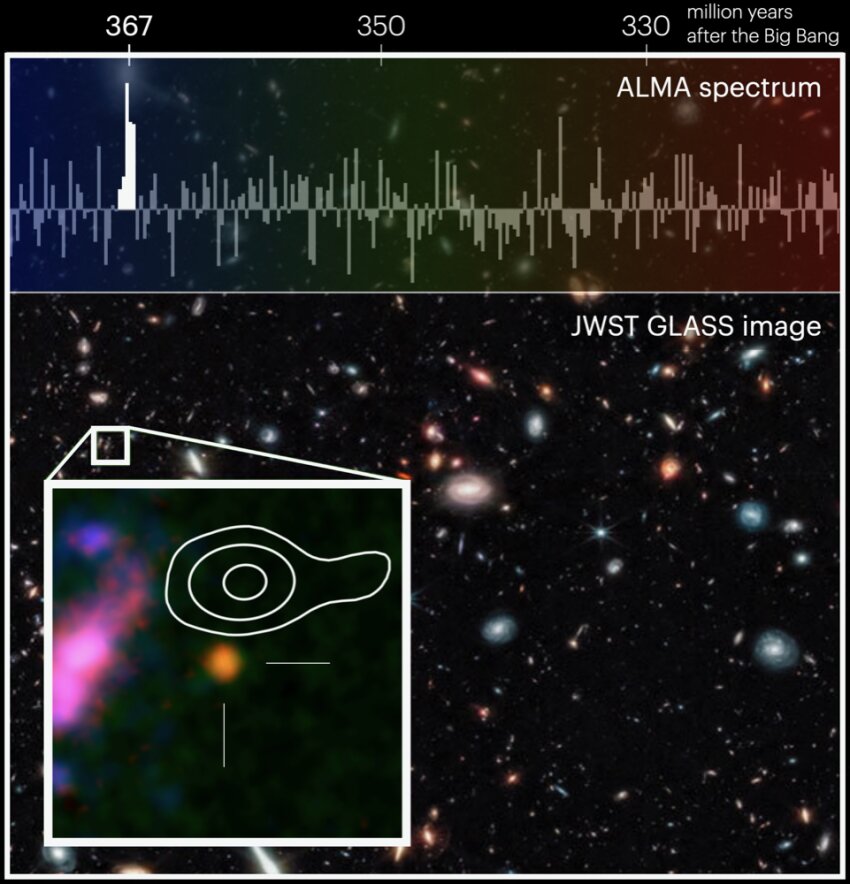 Image of the GHZ2/GLASS-z12 galaxy with corresponding ALMA spectrum. Credits: NASA / ESA / CSA / T. Treu, UCLA / NAOJ / T. Bakx, Nagoya U.
The ALMA radio telescope array has pinpointedspace age of GHZ2/GLASS-z12 identified by Webb. It turned out that it appeared just 367 million years after the Big Bang, at the dawn of the birth of the Universe.
Let us recall that according to modern concepts and according to the ΛCDM model, the age of the Universe is 13.799 ± 0.021 billion years.
Read more:
Earth's core will soon be spinning in a different direction
A giant sunspot is turning towards the Earth. It is visible to the naked eye
10 seconds closer to the end of the world: what will happen if the Doomsday Clock strikes