Scientists made the discovery while observing a nearby star known as HD 18599 (or TOI-179). It seems that around this
TESS (English)The Transiting Exoplanet Survey Satellite is a space telescope designed to discover exoplanets by the transit method, developed by the Massachusetts Institute of Technology as part of the NASA Small Research Program.
Scientists have recorded the light curve of the brightK-dwarf TOI-179 (other names HD 18599 and HIP 13754) and detected a transit signal. Its planetary nature was confirmed by subsequent observations using the High Accuracy Radial Speed Planet Searcher (HARPS) and Spectro-Polarimetric High-contrast Exoplanet Research (SPHERE) instruments.
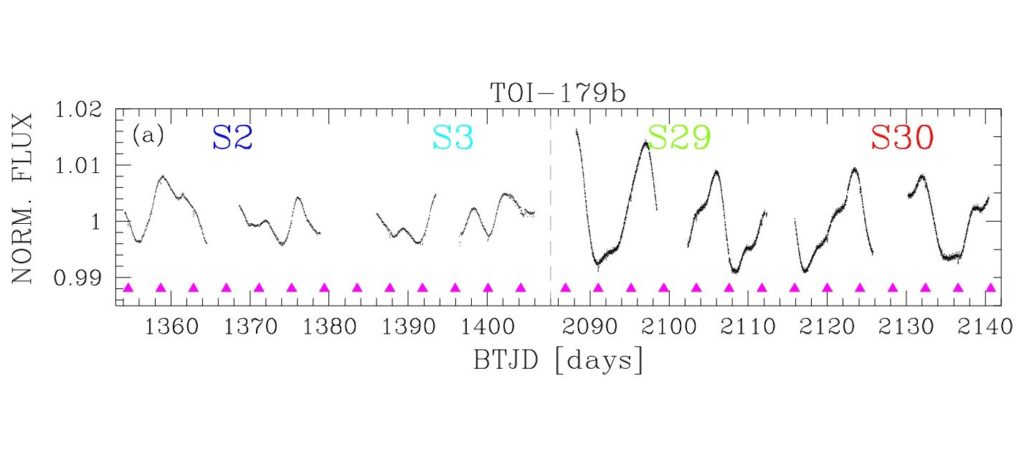 The panel shows the flux-normalized light curve of TOI-179.
Image Credit & Copyright: Desidera et al., 2022
The new planet was named TOI-179 b, it is approximately2.62 times larger than Earth and 24 times more massive. This means it has a high average density of around 7.4 g/cm³. The exoplanet orbits its host star every 4.14 days at a distance of 0.048 AU. from it in an eccentric orbit.
An astronomical unit (AU) is a unit of distance measurement in astronomy, roughly equal to the average distance from the Earth to the Sun. It is currently taken to be exactly 149,597,870,700 meters.
In addition, SPHERE observations identifiedanother object in the TOI-179 system with an estimated mass of about 83 Jupiter masses. It lies on the border between brown dwarfs and low-mass stars. The object was named HD 18599 B and it orbits at a distance of about 3.3 AU. from the parent star
The host star TOI-179 belongs to the spectralclass K2V, has a radius of approximately 0.76 solar radii, and its measured mass is 0.83 solar. The age of the star is estimated at about 400 million years, and its effective temperature is 5,145 Kelvin (4,871, 850 °C). Summing up, the authors of the study emphasized the uniqueness of the TOI-179 system, taking into account the properties of its components.
Read more:
Starlink signal hacked to be used as an alternative to GPS
"Hubble" looked into the "keyhole" of the universe
NASA revealed the origin of Haumea - the most mysterious planet in the solar system
On the cover: HD 4308 b Hot SuperEarth, Wikimedia Commons